Disclosure: We may earn a commission if you purchase through links on this page, at no additional cost to you. Our editorial conclusions are developed independently.
Four botanicals. Five probiotic strains. One daily step.
What ingredients are in FemiCore?
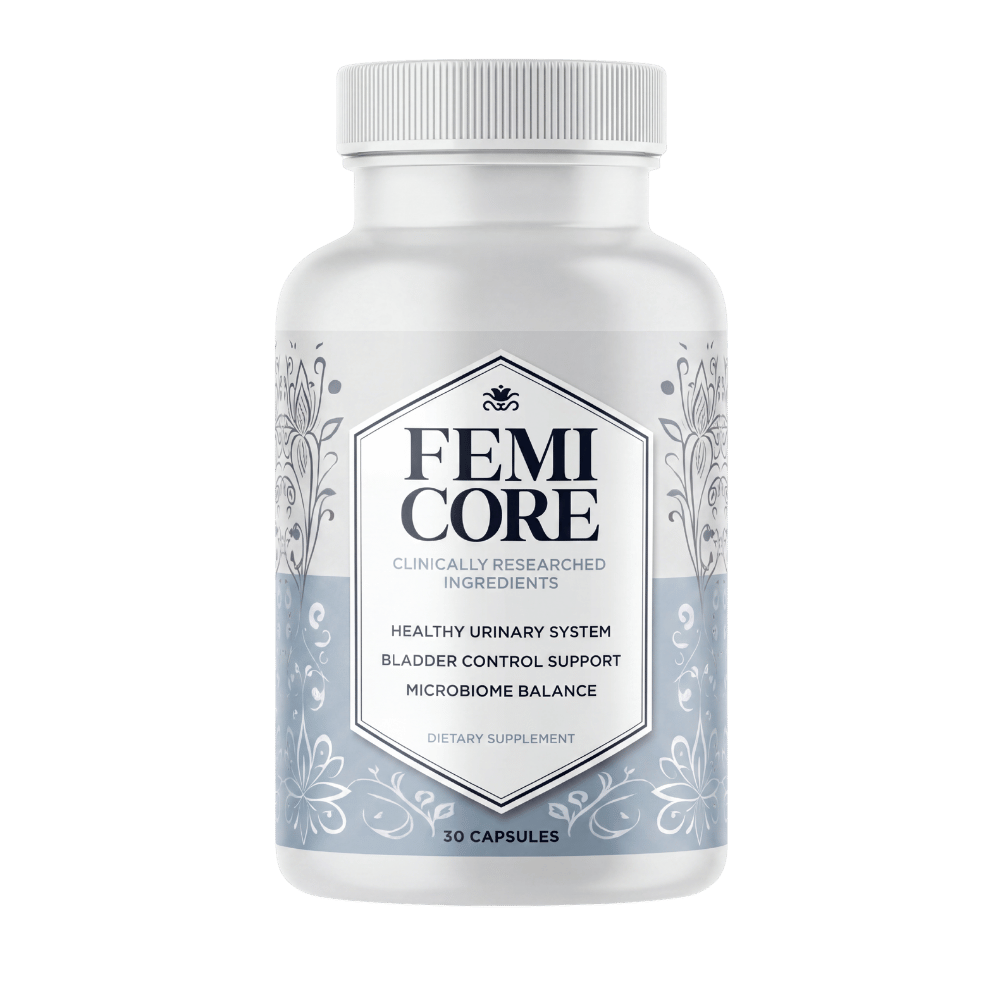
FemiCore contains nine named active components in two proprietary blends: a 350 mg Herbal Blend with Mimosa pudica seed extract, cranberry extract (30% proanthocyanidins), bearberry leaf and granular berberine hydrochloride extract (8%); plus a 50 mg Probiotic Blend listing five Lactobacillus strains: L. crispatus, L. acidophilus, L. plantarum, L. gasseri and L. casei. The reviewed label directs adults to take one capsule daily and lists 30 servings per bottle. Individual botanical doses, live probiotic CFU counts and the daily cranberry PAC amount are not disclosed.
When urinary concerns quietly influence which outings feel easy or how far you feel comfortable being from home, another complicated routine rarely sounds appealing. Cranberry may be familiar, and probiotics may sound promising, yet choosing whether to take one or both can leave you comparing labels long after you wanted to make a simple decision.
FemiCore’s practical appeal is straightforward: a botanical blend and five named Lactobacillus components in one daily capsule. That can simplify the choice for someone who would otherwise research several separate products. The question worth exploring is whether this particular formula offers enough information to feel confident about that convenience.
Nine ingredients on a label are not, by themselves, a reason to buy. What matters is what each contributes, which details you can check and whether the trade-offs fit your priorities.
Label evidence: PRM’s FemiCore Research Dossier and its reviewed Supplement Facts image. Seller positioning checked November 4, 2026: FemiCore presentation.
Start with the bottle, not the promotional headline
What does the FemiCore Supplement Facts label actually disclose?
One labeled serving contains two proprietary blends totaling 400 mg of declared blend material: 350 mg of herbs and 50 mg of probiotics. That figure is the sum of the two blend weights, not the full capsule weight including its shell and excipients. Each blend lists its components but not their individual contribution.
| Label entry | What is declared | What it means to a buyer |
|---|---|---|
| Serving and supply | 1 capsule; 30 servings per container | A one-step daily routine with approximately 30 labeled days per bottle. |
| Herbal Blend | 350 mg total: Mimosa pudica seed; cranberry berry extract; bearberry leaf; berberine HCl extract | Four named botanicals, but no individual milligram amounts. |
| Cranberry extract | Standardized to 30% proanthocyanidins (PACs) | A concentration percentage, not a known number of PAC milligrams per capsule. |
| Berberine extract | Granular berberine hydrochloride extract 8% (bark/root) | An extract specification, not an 8 mg dose or a standalone 350 mg berberine serving. |
| Probiotic Blend | 50 mg total: five named Lactobacillus components | The species and strain identifiers are supplied, but neither total nor strain-specific CFU is declared. |
| Inactive ingredients | Gelatin capsule, brown rice flour, magnesium stearate, olive oil, silicon dioxide | Gelatin makes the reviewed capsule unsuitable for someone requiring a vegetarian capsule. |
The label goes beyond a generic “herbs and probiotics” claim: it names the botanicals and probiotic species, and specifies a standardized cranberry extract. Those are useful details to check against the bottle—even though the exact potency of each component remains undisclosed.
The botanical half of the formula
Which four herbs make up FemiCore’s 350 mg Herbal Blend?
FemiCore combines Mimosa pudica seed extract, cranberry extract, bearberry leaf and berberine hydrochloride extract in one 350 mg blend. Their scientific relevance is not equal: cranberry has the most directly relevant human research for a defined urinary-prevention outcome, whereas the other botanicals add composition breadth but do not establish a clinical benefit for this exact capsule.
Botanical / 01
Mimosa pudica seed extract
Mimosa pudica gives FemiCore a less conventional plant component than standard cranberry-only supplements. Its presence is clearly disclosed in the herbal blend, but PRM’s reviewed evidence does not establish a convincing human urinary-leakage or bladder-control effect for this ingredient.
Its role in the buying decision: adds formula variety, not a verified standalone urinary outcome.
Botanical / 02
Cranberry extract — 30% PACs
Cranberry is the most familiar urinary-health ingredient here. Some human research supports reducing recurrence of symptomatic UTIs in certain women using studied cranberry preparations. The label’s 30% PAC standardization identifies the extract’s concentration but leaves its actual daily PAC intake unknown.
Its role in the buying decision: the strongest urinary-specific herbal research context, without a dose match to FemiCore.
Botanical / 03
Bearberry leaf — Arctostaphylos uva-ursi
Bearberry has a long history in traditional urinary preparations. The European Medicines Agency describes restricted traditional medicinal uses for certain bearberry leaf preparations; those conclusions do not automatically apply to a daily multi-ingredient capsule with an undisclosed bearberry dose.
Its role in the buying decision: recognizable traditional context, with preparation-specific limitations worth checking.
Botanical / 04
Granular berberine hydrochloride extract — 8%
Berberine is studied in several metabolic and microbial contexts. FemiCore lists an 8% extract specification but does not disclose the weight of that extract within the 350 mg blend. This is not a verified urinary treatment dose, and interactions with medicines are relevant.
Its role in the buying decision: another distinct botanical approach, not proof of improved bladder control.
For someone looking beyond cranberry alone, the mix is the point: one familiar ingredient, a traditional urinary botanical and two additional plant extracts. The decision is whether that combination fits your needs—not whether a longer ingredient list sounds more powerful.
The percentage that sounds more precise than it is
How much cranberry PAC does a FemiCore capsule actually provide?
The exact amount cannot be calculated from the reviewed label. “30% proanthocyanidins” tells you the concentration of PACs in the cranberry extract, not how much cranberry extract is inside the 350 mg blend. Without that second number, a daily PAC dose in milligrams remains unknown.
What the label does tell you
A standardized cranberry extract
Standardization is useful because it names a particular category of plant compounds rather than describing the ingredient only as “cranberry.” It makes the label more informative than a completely unspecified botanical entry.
What the label cannot tell you
Whether the PAC dose matches a study
The blend total also includes Mimosa, bearberry and berberine extract. Assigning all 350 mg to cranberry would be wrong, and multiplying 350 mg by 30% would invent a PAC dose the label does not reveal.
That difference matters because cranberry trials investigate particular products, doses and outcomes. The NIH’s NCCIH reports that cranberry products may reduce recurrent symptomatic UTI risk in some women, with mixed findings across studies. It does not recommend cranberry as treatment for a current UTI, and recurrent infection prevention is not the same endpoint as reducing urinary leakage.
The buyer’s takeaway: standardized cranberry is a relevant ingredient choice, but without its quantity per capsule, you cannot compare FemiCore milligram-for-milligram with a trial-tested cranberry preparation.
The other half: five named Lactobacillus components
What is in the 50 mg FemiCore Probiotic Blend?
The reviewed formula identifies five Lactobacillus species and codes: L. crispatus, L. acidophilus, L. plantarum, L. gasseri and L. casei. That is more descriptive than a generic “probiotic complex.” However, the label gives 50 mg for the group and no colony-forming unit (CFU) count, so the number of live organisms per serving cannot be determined.
The PRM Review/Dossier transcription lists the five identifiers as LCRb6, LA88, N13, LG08 and LC16. As with any strain-specific comparison, confirm the printed identifier on the bottle or label image: species naming alone does not establish that a different strain used in a clinical trial is included.
Probiotic / 01
Lactobacillus crispatus — LCRb6 in PRM’s transcription
L. crispatus is especially relevant to research on female urogenital microbial communities. But a well-known recurrent-UTI trial used a different strain, CTV-05, delivered intravaginally. That is not evidence that orally delivered FemiCore achieves the same result.
Probiotic / 02
Lactobacillus acidophilus — LA88
This familiar Lactobacillus species appears in gastrointestinal and other microbiome discussions. The strain code adds identity, but no human urinary-leakage outcome for this exact FemiCore dose has been established in PRM’s evidence record.
Probiotic / 03
Lactobacillus plantarum — N13
L. plantarum contributes another named species to the mixture. Its presence is a formula fact, not a reason to assume all research on other L. plantarum strains applies to N13 or to this oral product.
Probiotic / 04
Lactobacillus gasseri — LG08
L. gasseri expands the species coverage of the blend. Whether this exact strain reaches a particular site, remains viable or changes a clinical urinary outcome cannot be concluded from a milligram blend total.
Probiotic / 05
Lactobacillus casei — LC16
L. casei rounds out the five-component group. Identifying it is useful when checking a label against research, but it does not establish a therapeutic effect or quantify the number of viable cells supplied.
For buyers interested in probiotics, the named species offer a useful starting point for further research. The missing information is equally decisive for a dose-based comparison: neither live-cell counts nor a demonstrated urinary result for this oral combination is supplied.
Why 50 mg cannot be read as a bacterial count
Does FemiCore disclose CFU counts or proven doses for its probiotics?
No. The label lists 50 mg for the entire probiotic blend but neither a total CFU count nor an individual count for any of its five strains. Milligrams measure mass; CFUs estimate viable organisms. They are not interchangeable, and there is no reliable conversion from FemiCore’s 50 mg figure to a number of live bacteria.
| Question | What is known | Why it matters |
|---|---|---|
| Which bacteria? | Five named Lactobacillus species with identifiers in PRM’s label record. | A starting point for checking strain-specific research. |
| How much blend? | 50 mg total weight. | Does not show the number of living microorganisms. |
| How many CFU? | Not disclosed, in total or per strain. | Prevents a direct CFU comparison with probiotic trials. |
| How viable at use? | No batch viability or expiry-date CFU evidence in the reviewed PRM record. | A label name alone does not demonstrate live-cell delivery. |
| Proven in this capsule? | No finished-product randomized trial identified in the reviewed record. | Research on different strains or routes cannot be presented as a confirmed FemiCore effect. |
According to the NIH Office of Dietary Supplements, strain identity, live-organism count and appropriate studied use matter more than assuming a larger blend weight guarantees a bigger benefit. Higher CFU figures do not automatically mean superior results, either.
FemiCore’s probiotic blend is easier to identify than an unnamed bacterial mix, but not possible to compare by live-cell count with products that disclose CFUs. If probiotic potency is your deciding criterion, that information is worth requesting before you buy.
Separate the scientific idea from a finished-product result
Do studies support FemiCore’s urinary-microbiome approach?
The general research direction is scientifically relevant, but the finished-product result has not been demonstrated by the evidence PRM reviewed. Human studies have observed associations between urinary-microbiome composition and incontinence severity. That does not establish that microbiome imbalance is the single cause of leakage or that taking FemiCore orally will reverse it.
Human observational research
Why Lactobacillus belongs in the conversation
A 2024 study of women with mixed urinary incontinence found some urinary microbial community types associated with greater total and urgency-leakage frequency. The study measured associations; it did not test FemiCore or establish a causal intervention.
Human intervention research
Why exact strains and delivery routes matter
A trial involving L. crispatus CTV-05 studied an intravaginal preparation for recurrent-UTI prevention. FemiCore is an oral multi-strain capsule, so the trial cannot be used as proof that FemiCore stops leaks or prevents UTIs.
The formula has an understandable scientific rationale, but rationale is not a demonstrated result. No randomized controlled trial of the complete current FemiCore oral formulation was identified in PRM’s reviewed record. Ingredient research is useful for asking informed questions, not predicting a personal outcome.
For the detailed bibliography, study populations and evidence-transfer boundaries, see the FemiCore Research Dossier.
What this formula offers in everyday terms
Why might someone prefer FemiCore to a cranberry-only supplement?
FemiCore’s advantage is convenience and formula breadth—not proven superiority. If choosing and coordinating several supplement bottles sounds exhausting, its one-capsule format provides a practical alternative: four botanical entries and five named Lactobacillus components together.
One step
A daily routine that stays small
The labeled instruction is one capsule a day with water. For someone who dislikes complicated supplement schedules, the practical simplicity is concrete and easy to understand.
Broader composition
Botanicals plus probiotics
Instead of making cranberry the entire formulation, the product combines four herbal ingredients with five named Lactobacillus entries. That is a distinct purchasing proposition, not evidence that more components deliver better results.
Easy to identify
Nine named entries to inspect
The reviewed physical label names each component and the extract types. You can check those details against the bottle rather than relying only on the sales page’s high-level description.
Real trade-off
Less control over individual doses
Someone choosing a specified PAC dose or a clinically studied probiotic CFU may prefer a more transparent single-purpose product. FemiCore prioritizes a ready-made mixture over separately disclosed amounts.
That makes the choice personal: would you prefer carefully specified standalone ingredients, or a ready-made combination with fewer daily steps? Neither preference requires assuming that the broader formula works better clinically.
A small routine still deserves a thoughtful check
What ingredient and safety considerations should you know before trying FemiCore?
The most relevant checks involve medications, pregnancy or breastfeeding, kidney concerns and symptoms that may need diagnosis rather than supplementation. Berberine may interact with medicines, bearberry has preparation-specific safety restrictions, cranberry should not be used to treat an existing UTI, and probiotics are not suitable for everyone.
The reviewed label warns adults not to exceed the recommended serving and advises consultation for people who are pregnant, nursing or have known medical conditions. It contains gelatin, which matters to vegetarian buyers. A clinician or pharmacist can help resolve relevant medicine interactions before use.
Safety context: NCCIH on cranberry · EMA on bearberry leaf preparations · NCCIH on berberine · NIH ODS on probiotics.
A little more clarity, without another complicated plan
You shouldn’t need a shelf of bottles to make one thoughtful choice.
There can be a surprising amount of work behind the words “simple wellness routine.” One bottle emphasizes cranberry. Another talks about beneficial bacteria. Before long, you are comparing labels, schedules and claims when all you wanted was to make an informed choice.
When the concern is personal—and may affect how you plan an outing or a busy afternoon—that extra mental load matters.
FemiCore offers a modest kind of simplicity: several ingredient categories in one daily capsule, rather than a collection of separate products. It does not remove the need to check suitability; it simply gives you one defined formula to evaluate.
Confidence comes from knowing both sides of that choice: what is in the capsule, why the ingredients are included and what remains uncertain. You should be able to make that decision without sorting through another stack of promises.
Convenience is valuable. Understanding the convenience you’re buying is better.
Choose on the basis of what matters to you
Who is the FemiCore formula a reasonable fit for?
A meaningful reason to consider it
Explore FemiCore further if…
- You want a one-capsule formula rather than managing separate botanical and probiotic products.
- The four-herb and five-Lactobacillus composition matches your preference for a broader urinary-wellness approach.
- You recognize that the formula’s practical appeal is not a guarantee of reduced leakage or UTI prevention.
- You have reviewed relevant medication, health and ingredient-suitability questions.
- You’re comfortable with disclosed blend totals rather than exact amounts for every component.
A reason to make a different choice
Pause or choose a more transparent product if…
- You need a specified cranberry PAC dose or an independently verified probiotic CFU count.
- You want an exact study-matched strain, delivery route and dose.
- You require a clinical trial showing the complete FemiCore formula improves urinary leakage.
- You’re pregnant, nursing, have kidney disease or use medicines that warrant review of botanicals such as berberine.
- You are looking for treatment of a suspected infection or another urinary condition.
Our buying recommendation: FemiCore belongs on the shortlist if you want one daily capsule combining botanicals and probiotics and have checked personal suitability. It is less compelling if you require disclosed per-ingredient doses, verified CFUs or clinical trials of the finished formula. Its strongest reason to consider it is a simpler routine—not a promise of proven urinary outcomes.
Nine named ingredients, one clear next decision
More than a cranberry capsule—without more steps in your day.
You have seen what is inside the capsule—and what the label leaves unanswered. If the blend suits your preferences, one defined daily step may feel more manageable than researching and coordinating several separate products.
If this formula fits your needs, check the seller’s current offer, compare the terms and choose only the supply you expect to use. The link opens the seller presentation, not a preselected package. Buying more bottles does not change the clinical evidence behind the ingredients.
A final pre-purchase ingredient check
What should you confirm on the current FemiCore bottle before ordering?
01 / Identity
Compare the exact ingredient names
Look for four herbal entries and five named Lactobacillus entries. Compare the printed strain codes to the source label, especially before assuming any outside probiotic study is applicable.
02 / Amounts
Recognize the blend-level numbers
350 mg and 50 mg are group totals. Do not interpret either as an individual ingredient dose or use the 30% cranberry specification to invent daily PAC milligrams.
03 / Serving
Check the directions and capsule material
The reviewed label says one capsule daily with water, thirty servings per bottle, and a gelatin capsule. Confirm the current label if those details affect your choice.
04 / Purchase
Separate formula value from order size
More bottles do not alter the amount in a capsule. Review the seller’s current offer and return policy before choosing the duration of supply you actually intend to use.
PRM’s concluding ingredient assessment
Are FemiCore’s ingredients worth considering?
Yes, for the right buyer: FemiCore offers a practical alternative to managing botanical and probiotic supplements separately. Its cranberry component has relevant research in recurrent-UTI prevention, while urinary-microbiome studies provide context for interest in Lactobacillus. Neither establishes that the finished product improves leakage, so the choice still depends on your needs and priorities.
The appeal is a manageable once-daily routine built around identifiable ingredients. The limitation is that the label does not disclose individual doses or probiotic CFU counts needed for precise comparisons with studied products.
Choose it for the routine and formula profile you can verify—not for an invented dose or promised clinical result. If convenience and ingredient variety matter most, comparing the current seller offer may be worthwhile after your safety and budget checks. If exact quantities are essential, a more transparent product may be the better fit.
Ingredient questions, answered directly
FemiCore ingredients and formula FAQs
What are the nine active ingredients in FemiCore?
Four herbal ingredients—Mimosa pudica seed extract, cranberry extract, bearberry leaf and granular berberine hydrochloride extract—plus five Lactobacillus components: L. crispatus, L. acidophilus, L. plantarum, L. gasseri and L. casei.
How much of each ingredient is in FemiCore?
The reviewed label declares a 350 mg Herbal Blend and a 50 mg Probiotic Blend, but not each ingredient’s individual amount. It is not possible to identify a clinically matched cranberry, bearberry or berberine dose from those totals.
How many capsules of FemiCore are taken each day?
The reviewed physical label directs adults to take one capsule daily with 6–8 ounces of water or as advised by a healthcare professional. It lists 30 servings per container. Do not increase the serving to imitate a study dose.
Does FemiCore contain cranberry extract?
Yes. The Herbal Blend lists cranberry (Vaccinium macrocarpon) berry extract standardized to 30% proanthocyanidins. Its individual extract quantity is not disclosed, so actual PAC intake per day cannot be calculated.
Does 30% PAC mean FemiCore contains 30 mg of cranberry PACs?
No. Thirty percent describes the concentration in the cranberry extract. Without the weight of that extract within the 350 mg blend, the number of PAC milligrams per serving is unknown.
Can cranberry in FemiCore treat a urinary tract infection?
No such conclusion is supported. NCCIH explains that some cranberry products may help prevent recurrent symptomatic UTIs in certain women but are not recommended as treatment for an existing infection. FemiCore’s cranberry exposure is not disclosed or trial-matched.
What is Mimosa pudica doing in the formula?
Mimosa pudica seed extract is one of the four named botanicals. It adds to the plant profile, but PRM did not identify sufficiently transferable human urinary-outcome evidence to establish that it improves leakage or bladder control.
Why does FemiCore contain bearberry leaf?
Bearberry has a history of use in certain traditional urinary preparations. The EMA’s conclusions apply to specified preparations and short-term traditional medicinal uses, not automatically to this undisclosed-dose daily multi-ingredient product.
How much berberine is in FemiCore?
The label lists granular berberine hydrochloride extract 8% inside the 350 mg Herbal Blend, but does not give the extract weight. An 8% extract specification does not establish an 8 mg berberine serving or a studied dose.
Which probiotic strains does FemiCore list?
The PRM label transcription lists Lactobacillus crispatus LCRb6, L. acidophilus LA88, L. plantarum N13, L. gasseri LG08 and L. casei LC16. Compare the exact characters on the physical label before relying on any strain-specific research claim.
How many CFU are in FemiCore’s probiotic blend?
The reviewed label supplies a 50 mg total probiotic weight but does not disclose CFU, either for the complete blend or for individual strains. Milligrams cannot be converted into an accurate number of living organisms.
Has Lactobacillus crispatus been studied for urinary health?
Yes, defined L. crispatus strains have been studied, including CTV-05 in an intravaginal recurrent-UTI prevention trial. The studied strain and delivery route differ from FemiCore’s oral formulation, so the trial is not proof of FemiCore’s results.
Does FemiCore contain five different Lactobacillus species?
Yes. The blend names L. crispatus, L. acidophilus, L. plantarum, L. gasseri and L. casei. Naming them makes the formula easier to inspect, but does not establish the CFU or clinical effect of the combination.
Is FemiCore a vegetarian or vegan capsule?
The reviewed Other Ingredients list includes gelatin in the capsule. It should not be treated as vegetarian or vegan unless an updated authenticated label shows a different capsule material.
Does FemiCore have a proven clinical trial of the finished product?
No randomized controlled trial of the complete current FemiCore oral formula was identified in PRM’s reviewed research record. Ingredient and microbiome studies are useful context but are not finished-product proof.
Is FemiCore better than taking cranberry alone?
It contains more kinds of ingredients and provides a once-daily combined routine, which some buyers may prefer. That is not evidence of greater clinical effectiveness. A cranberry-only product with a specified PAC dose may provide more precise exposure information.
Who should discuss FemiCore with a healthcare professional first?
People who are pregnant or nursing, take regular medications, have kidney or other medical conditions, or experience persistent or new urinary symptoms should seek individualized advice. Berberine and bearberry raise specific safety considerations, and the exact amounts in FemiCore are not disclosed.
Where can I verify the FemiCore formula and the current offer?
Read PRM’s Research Dossier for label and study evidence, the full Review for the broader decision, and use the PRM-managed offer to inspect the seller’s current terms before paying.
The evidence behind this ingredient assessment
How PRM researched the FemiCore ingredients
Pro Review Metric used its previously approved FemiCore Research Dossier and FemiCore Review as the established product record. That work documented a physical Supplement Facts image, serving size, two blend totals, four botanicals, five Lactobacillus components, other ingredients and seller claims. We checked the publicly accessible seller presentation on November 4, 2026 for current formula positioning; the seller’s claims are not independent clinical results.
We compared the formula with independent primary health sources: NCCIH on cranberry, the NIH ODS probiotic fact sheet, the EMA bearberry evaluation, human urinary-microbiome observational research and the specified L. crispatus trial. Each finding was restricted to the studied preparation, strain, route, population and outcome.
PRM did not independently assay FemiCore, measure live probiotic organisms, authenticate batch purity, conduct a customer-use trial, obtain otherwise hidden individual ingredient doses or verify the finished formula in a randomized trial. When the formula names an extract percentage but not the extract quantity, no actual milligram exposure is inferred. Similarly, a 50 mg probiotic blend is not treated as a CFU count.
Product labels and seller terms can change. Compare the current packaging and its exact strain identifiers with the reviewed source image before relying on a study-specific assertion. The Research Dossier provides the extended evidence ledger and limitations behind this ingredient summary.
PRM primary product record: FemiCore Dossier · FemiCore Review · Supplement Facts image.
External research: NCCIH Cranberry · NIH ODS Probiotics · EMA Bearberry · NCCIH Berberine · Urinary Microbiome Study · L. crispatus CTV-05 Trial.