It separates the physical label, seller and checkout record from independent research. FemiCore identifies nine active components across a 350 mg Herbal Blend and a 50 mg Probiotic Blend, but individual ingredient amounts, total CFU, strain-level CFU and actual cranberry PAC/day are not disclosed. Research on urinary microbiome patterns, cranberry, selected probiotics and uva-ursi provides context; it is not a clinical trial of the finished FemiCore capsule.
FemiCore Research: Quick Answers
30 servings per container on the reviewed physical label.
Four herbs and five named Lactobacillus strain codes.
350 mg Herbal Blend and 50 mg Probiotic Blend; individual allocations are not disclosed.
No randomized clinical trial of the complete FemiCore oral formula was identified in the approved source record.
What Sources Did Pro Review Metric Verify?
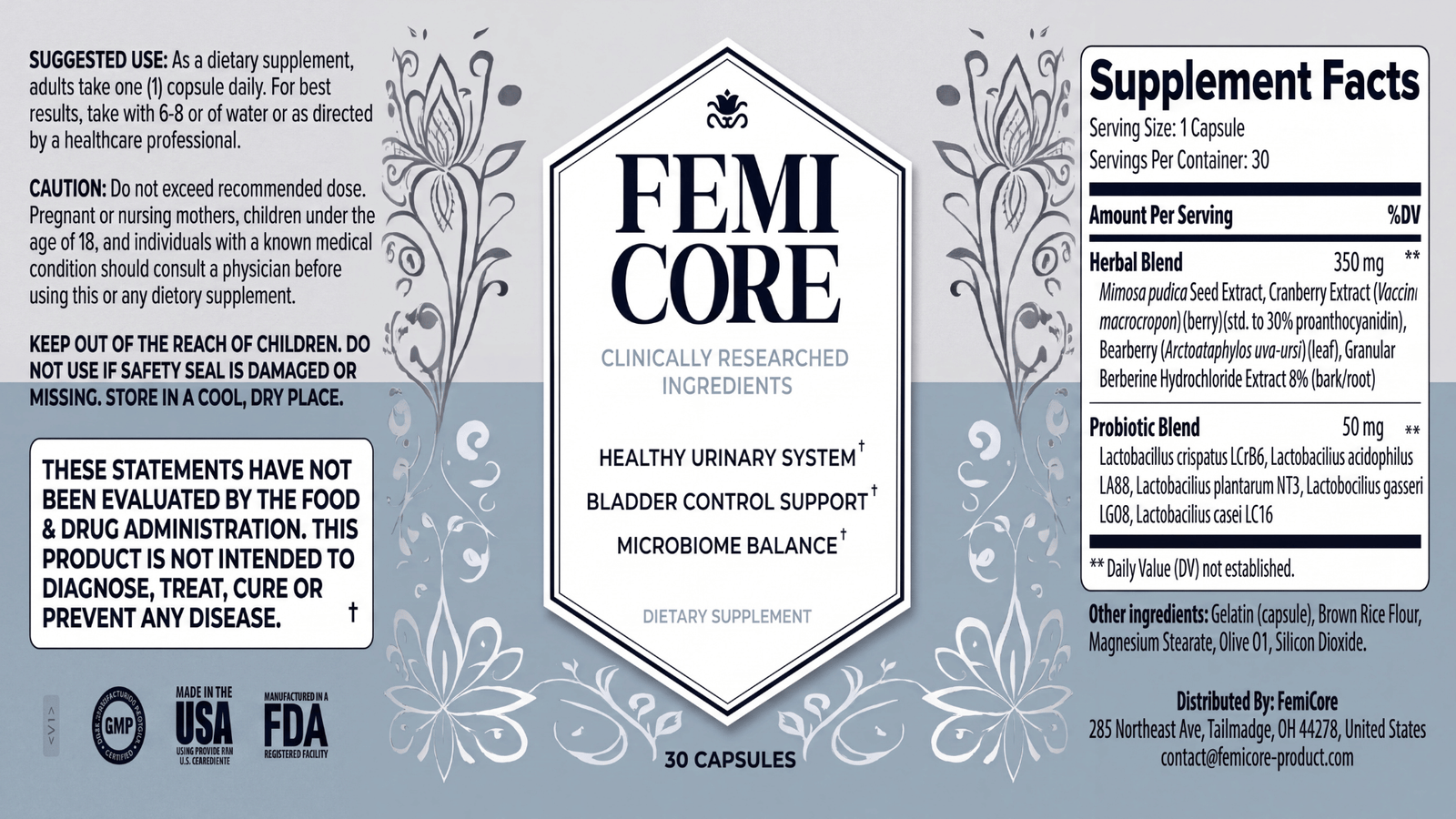
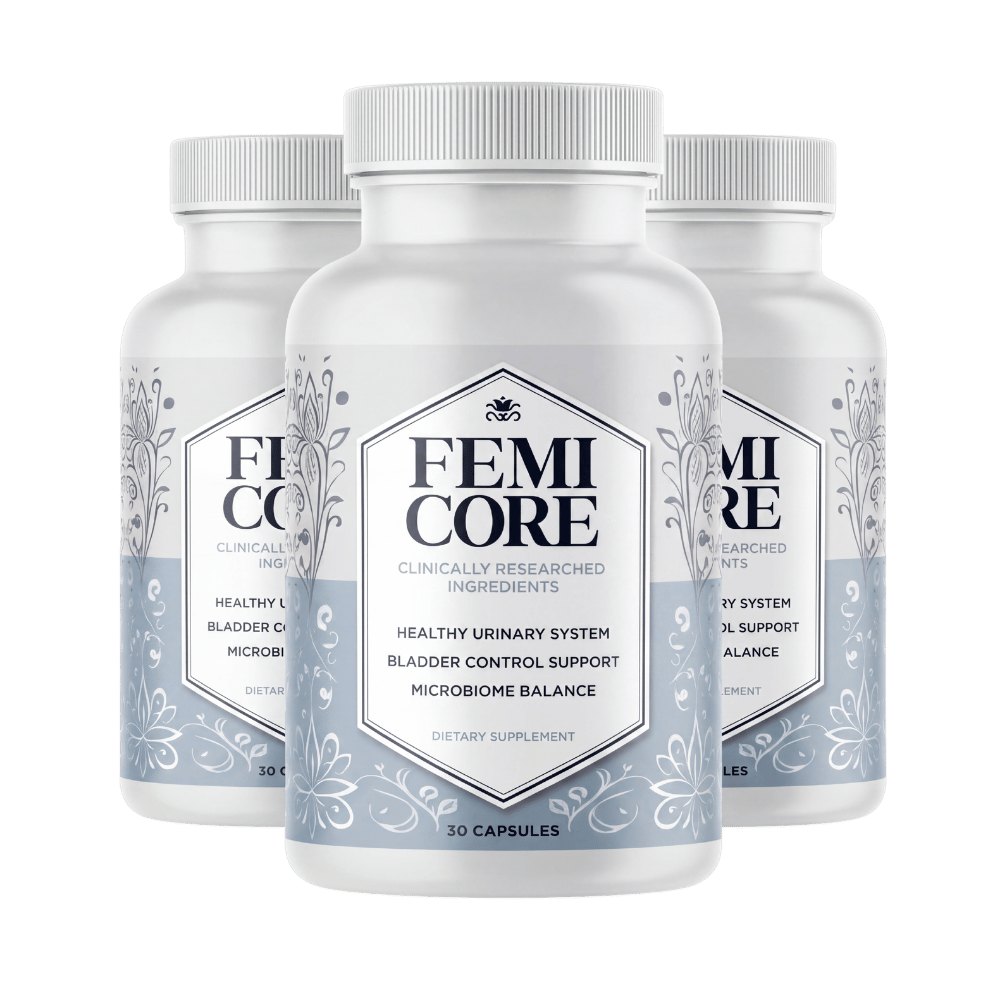
What Does the FemiCore Label Actually Disclose?
| Label item | Declared detail | What the label supports | Important boundary |
|---|---|---|---|
| Serving Size | 1 capsule; 30 servings per container | One-capsule serving and approximately 30 daily servings per bottle. | Serving information does not establish effectiveness. |
| Suggested Use | Adults take one capsule daily with 6–8 oz of water or as directed by a healthcare professional. | The labeled daily routine. | A faster or higher-dose regimen should not be inferred. |
| Herbal Blend | 350 mg total | Mimosa pudica Seed Extract; Cranberry Extract (Vaccinium macrocarpon, berry) standardized to 30% proanthocyanidin; Bearberry (Arctostaphylos uva-ursi, leaf); Granular Berberine Hydrochloride Extract 8%. | Individual amounts are not disclosed. |
| Probiotic Blend | 50 mg total | Lactobacillus crispatus LCRb6; L. acidophilus LA88; L. plantarum N13; L. gasseri LG08; L. casei LC16. | Individual quantities, total CFU and strain-level CFU are not disclosed. |
| Other ingredients | Gelatin capsule, brown rice flour, magnesium stearate, olive oil, silicon dioxide | The current inactive-ingredient list. | PRM did not independently test excipient identity, purity or batch composition. |
How Transparent Is the FemiCore Formula?
The label identifies what is in the two active blends, but not how the totals are divided. That distinction matters whenever published research depends on dose, PAC exposure or probiotic CFU.
| Formula item | Declared | What can be verified | What remains unresolved |
|---|---|---|---|
| Serving | 1 capsule; 30 servings per container | Adults are directed to take one capsule daily with 6–8 oz of water or as directed by a healthcare professional. | The label does not establish a clinically validated urinary outcome for this serving. |
| Herbal Blend | 350 mg total | Mimosa pudica seed extract; cranberry extract (Vaccinium macrocarpon, berry) standardized to 30% proanthocyanidin; bearberry (Arctostaphylos uva-ursi, leaf); granular berberine hydrochloride extract 8%. | The individual amount of every herb. |
| Cranberry exposure | 30% proanthocyanidin standardization stated | The extract standardization printed on the physical label. | The cranberry amount inside the 350 mg blend, so actual PAC/day cannot be calculated. |
| Probiotic Blend | 50 mg total | L. crispatus LCRb6, L. acidophilus LA88, L. plantarum N13, L. gasseri LG08 and L. casei LC16. | Individual strain quantities, total CFU and strain-level CFU. |
Does FemiCore Work? What the Evidence Actually Supports
Short answer: FemiCore contains ingredients and probiotic strategies with relevant urinary-health research, but that is not the same as proving the complete current formula works for bladder control, urinary leakage or recurrent UTI prevention. Cranberry and selected Lactobacillus interventions provide the strongest context, while FemiCore does not disclose individual herbal doses, total probiotic CFU or strain-level CFU. No randomized clinical trial of the finished product was identified in the approved source record.
| Seller positioning | How PRM records it | Evidence status |
|---|---|---|
| Supports bladder control, microbiome balance and a healthy urinary system. | Structure/function positioning documented from the physical label and official seller materials. | Seller / label positioning; not proof of a clinical outcome for the finished product. |
| Urinary-microbiome imbalance is presented as a root cause of involuntary contractions and leaks. | Seller mechanism claim. | Human urinary-microbiome research shows associations, not one proven universal causal mechanism for urinary leakage. |
| “Toxic dioxins” disrupt the urinary microbiome. | Seller theory documented from the official sales material. | No sufficiently reliable evidence in the approved source record established this as the mechanism targeted by FemiCore. |
| The formula repopulates the urinary microbiome with good bacteria and helps prevent bladder leaks. | Promotional efficacy / mechanism claim. | No finished-product trial or direct urinary-colonization evidence for this exact five-strain oral formula was identified. |
| “Clinically Researched Ingredients” appears on the physical package. | Packaging language. | Ingredient-level research does not make the finished FemiCore formula clinically proven. |
Has the Current FemiCore Formula Been Clinically Tested?
Short answer: no randomized clinical trial of the finished FemiCore formula was identified in the approved source record. The evidence below concerns urinary-microbiome associations, defined cranberry preparations, other probiotic strains or delivery routes, uva-ursi and indirect multi-component berberine context. This wording records the reviewed source set; it does not claim that no FemiCore trial could exist anywhere.
What Does Research Say About FemiCore’s Ingredients?
This record follows the same rule used in the FemiCore Review: study findings are carried only as far as the studied strain, route, dose, preparation, population and outcome allow.
Urinary microbiome evidence
Urinary microbiome community types associated with urinary incontinence severity in women
Supports: Urinary-microbiome community patterns can be associated with urinary-incontinence severity. In the reviewed study, lower-Lactobacillus / higher-diversity patterns were associated with more total and urgency leakage.
Important limit: Cross-sectional association does not establish causation, a universal microbiome mechanism, or an effect from oral FemiCore.
Open the sourceThe female urinary microbiome: comparison of women with and without urgency urinary incontinence
Supports: Women with urgency urinary incontinence can show urinary-microbiome characteristics that differ from women without urgency urinary incontinence.
Important limit: The study does not show that microbiome differences caused the condition or that an oral probiotic reverses it.
Open the sourceThe urinary microbiome in women with mixed urinary incontinence compared with similarly aged controls
Supports: Urinary-microbiome differences have also been studied in mixed urinary incontinence.
Important limit: This is context for the research area, not proof of a single cause or a FemiCore treatment effect.
Open the sourceCranberry evidence
2025 multicenter randomized double-blind placebo-controlled whole-cranberry-fruit-powder trial
Supports: A defined whole-cranberry-fruit-powder preparation was tested in females with a recurrent-UTI history and reported fewer culture-confirmed UTIs than placebo.
Important limit: The preparation and exposure are not equivalent to FemiCore’s undisclosed cranberry amount, and recurrent-UTI prevention is not urinary-leakage evidence.
Open the source2024 randomized double-blind placebo-controlled cranberry trial in recurrent uncomplicated cystitis
Supports: A defined cranberry product was associated with fewer UTIs and longer UTI-free survival than placebo in the studied population.
Important limit: A defined study product cannot be treated as proof for FemiCore’s undisclosed cranberry exposure or for bladder-leakage outcomes.
Open the sourceHigh-dose versus low-dose standardized cranberry proanthocyanidin trial
Supports: PAC exposure and preparation matter when interpreting cranberry research.
Important limit: The primary comparison did not show a statistically significant overall reduction in symptomatic UTIs; a more favorable result appeared in a post-hoc subgroup. FemiCore’s PAC/day cannot be calculated.
Open the sourceNCCIH cranberry usefulness and safety
Supports: NCCIH describes recurrent-UTI prevention findings as variable and notes that cranberry may reduce recurrent symptomatic UTI risk in some women.
Important limit: Cranberry is not recommended as treatment for an existing UTI; large amounts may cause gastrointestinal upset, and medicine-interaction questions can matter.
Open the sourceLactobacillus / probiotic evidence
Lactobacillus crispatus CTV-05 for prevention of recurrent UTI
Supports: A specifically identified L. crispatus strain has been tested in a randomized recurrent-UTI prevention trial.
Important limit: The study used CTV-05 intravaginally. FemiCore lists LCRb6 orally. CTV-05 ≠ LCRb6, intravaginal ≠ oral, and the study exposure is not FemiCore’s undisclosed exposure.
Open the sourceOral L. rhamnosus GR-1 + L. reuteri RC-14 recurrent-UTI trial
Supports: Oral probiotic strategies have been tested in postmenopausal women with recurrent UTIs.
Important limit: The species, strains, doses and formulation differ from FemiCore’s five-strain blend; the probiotic strategy did not meet the study’s noninferiority criterion versus antibiotic prophylaxis.
Open the sourceBearberry / uva-ursi evidence
Uva ursi extract versus fosfomycin in women with uncomplicated UTI
Supports: Uva-ursi/bearberry has been studied in a randomized clinical setting rather than only traditional-use literature.
Important limit: The uva-ursi strategy reduced antibiotic use but did not meet symptom noninferiority and carried a higher symptom burden and more safety concerns. It does not validate daily FemiCore use.
Open the sourceBerberine evidence
Multi-component urinary study containing berberine-related combinations
Supports: The approved source record contains urinary context for a multi-component intervention involving combinations such as berberine, arbutin, birch and D-mannose.
Important limit: The study cannot isolate berberine’s contribution and does not replicate FemiCore’s formulation or undisclosed berberine exposure.
Open the sourceNCCIH berberine safety context
Supports: NCCIH notes gastrointestinal adverse effects and potential medicine interactions, including clinically relevant interaction concerns.
Important limit: Pregnancy/breastfeeding and infant safety concerns matter, and FemiCore does not disclose its berberine amount.
Open the sourceMimosa pudica evidence status
No sufficiently transferable human urinary-outcome evidence identified
What is supported: Mimosa pudica is present on the physical label and adds a distinct botanical component to the Herbal Blend.
What is not established: the approved source record does not contain convincing human urinary-support evidence relevant enough to validate a FemiCore urinary outcome. Broader phytochemical or traditional-use literature is not substituted for that missing evidence.
What Are the Biggest Evidence Gaps?
- Urinary-microbiome association is not proof of one universal causal mechanism for leakage or urgency.
- Cranberry recurrent-UTI prevention evidence is not evidence that FemiCore reduces urinary leakage.
- Lactobacillus species evidence is not exact FemiCore strain evidence.
- L. crispatus CTV-05 is not LCRb6.
- Intravaginal administration is not the same intervention as an oral FemiCore capsule.
- A known study dose or CFU exposure is not the same as FemiCore’s undisclosed strain exposure.
- Defined cranberry PAC exposures cannot be matched to FemiCore because the amount of cranberry extract is not disclosed.
- Ingredient-level evidence is not finished-product evidence.
- No randomized clinical trial of the finished FemiCore formula was identified in the approved source record.
- No independent certificate of analysis, probiotic viability result or batch-testing report was included in the approved source record.
- No sufficiently transferable evidence was identified to establish the seller’s “toxic dioxins” mechanism as the explanation targeted by FemiCore.
How Much Does FemiCore Cost?
Short answer: the reviewed seller presentation lists $158 total for 2 bottles, $207 for 3 total bottles and $294 for 6 total bottles. The 2-bottle package currently displays $9.99 U.S. shipping, while the larger packages display free shipping. The reviewed six-bottle ClickBank item shows a one-time purchase rather than a recurring subscription. Seller-controlled pricing, shipping and refund terms can change.
60-day supply. The current package presentation displays $9.99 U.S. shipping.
90-day supply. Free shipping is displayed on the current package.
180-day supply, free shipping and three digital bonuses are displayed in the current offer.
The reviewed six-bottle ClickBank item shows $294 USD, $0 shipping and no recurring subscription on that item.
Where Do the FemiCore Product and Offer Facts Come From?
FemiCore physical Supplement Facts panel
Supports: serving size, servings per container, blend totals, ingredient names, strain codes, other ingredients and printed cautions.
Does not prove: effectiveness, probiotic viability, CFU count or exact ingredient quantities hidden by the blends.
View the label imageFemiCore official sales page
Supports: current marketing language, package presentation, bonus presentation, advertised 60-day policy and seller-described one-time purchase structure.
Important limit: seller efficacy and mechanism statements are not independent clinical evidence.
View the official product pageFemiCore affiliate page and advertising rules
Supports: approved affiliate linking and restrictions against deceptive or unsubstantiated content, unauthorized checkout bypass and prohibited promotional methods.
Does not prove: product effectiveness.
View the affiliate pageCurrent FemiCore funnel and ClickBank checkout record
Supports: the reviewed six-bottle item title, $294 subtotal/total, $0 shipping on that item, USD currency, 60-day refund period and no recurring subscription on that item.
Does not prove: product effectiveness or that price, shipping and policy terms will remain unchanged.
Open the current FemiCore offerIs FemiCore Safe?
Short answer: FemiCore is sold as a dietary supplement, but the available source record does not establish a finished-product adverse-event rate or universal suitability. The label directs pregnant or nursing mothers, children under 18 and people with a known medical condition to consult a physician before use. Cranberry and berberine also have interaction and tolerability considerations that can matter for some users.
The label directs pregnant or nursing mothers, children under 18 and individuals with a known medical condition to consult a physician before use.
The label says not to use the product if the safety seal is damaged or missing and to store it in a cool, dry place.
NCCIH does not recommend cranberry as treatment for an existing UTI and notes gastrointestinal and medicine-interaction considerations.
NCCIH notes gastrointestinal adverse effects and medicine interactions; FemiCore’s undisclosed berberine amount prevents exposure-specific comparison.
How Was This FemiCore Dossier Prepared?
The Pro Review Metric Editorial Team compared the physical Supplement Facts panel, current seller and affiliate materials, package presentation and supplied ClickBank checkout record with the approved independent human urinary-microbiome studies, cranberry trials, probiotic trials, uva-ursi research and federal health guidance listed above.
Seller claims remain seller claims. Observational associations were not rewritten as causes. Ingredient studies were not presented as proof of the finished formula. Strain, route, dose, formulation, population and outcome differences were treated as transfer limits.
Pro Review Metric did not conduct a firsthand FemiCore product-use trial, laboratory assay, probiotic-viability test or physical batch inspection. See the Methodology, Editorial Policy, Editorial Team, Affiliate Disclosure and Medical Disclaimer for the standards governing this source record.
Last updated: September 15, 2026. This dossier is reviewed when product details, pricing, labeling or material evidence changes.