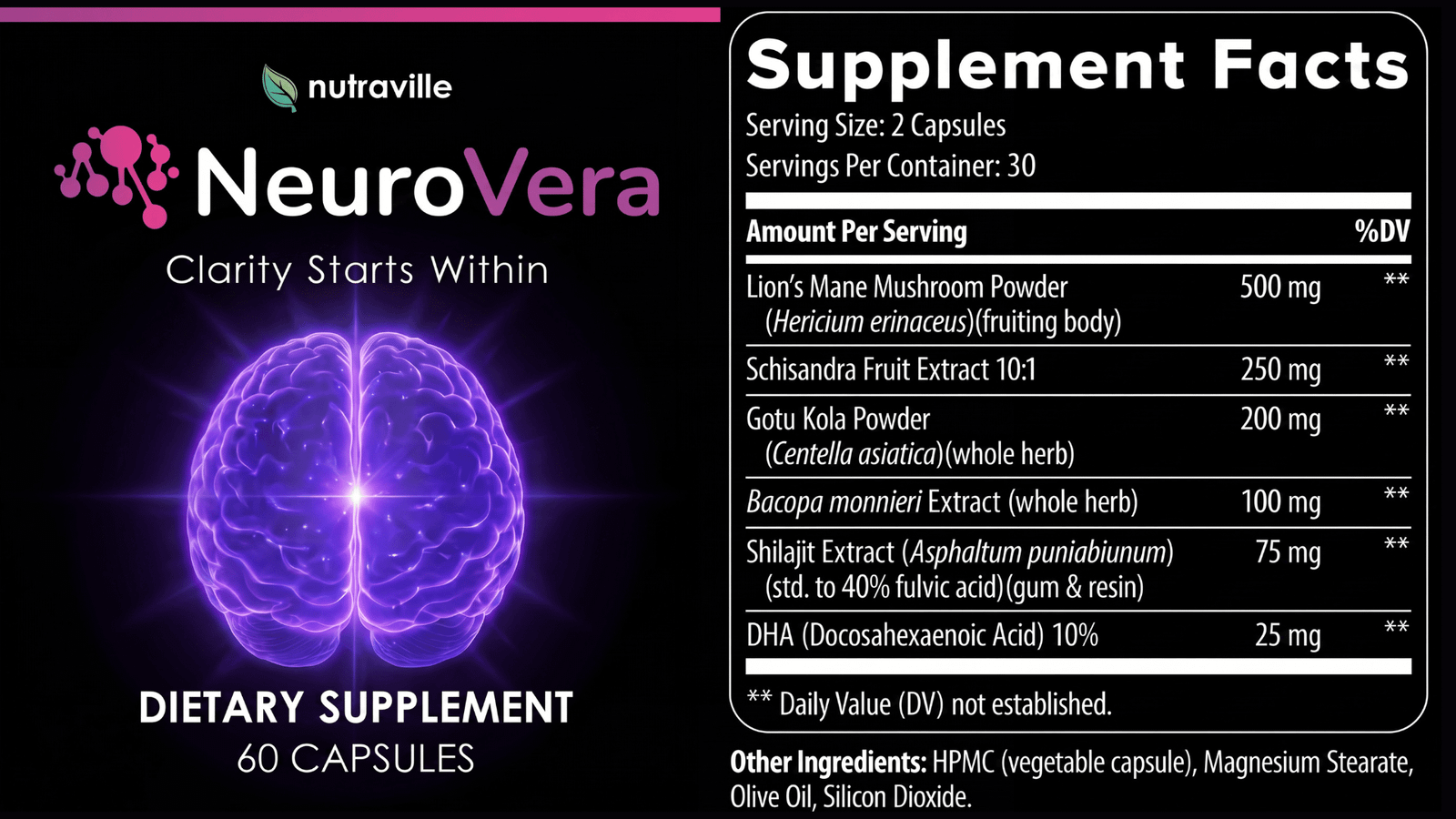
NeuroVera uses a two-capsule serving with six separately listed active ingredients. The label is comparatively transparent about amount and form, but disclosure alone does not make those inclusions trial-matched. Human cognition evidence is strongest for Lion’s Mane and Bacopa, while the remaining ingredients have lower-transfer or non-cognitive human evidence in the reviewed record. No finished-product NeuroVera clinical trial was identified in our research.
NeuroVera Research: Quick Answers
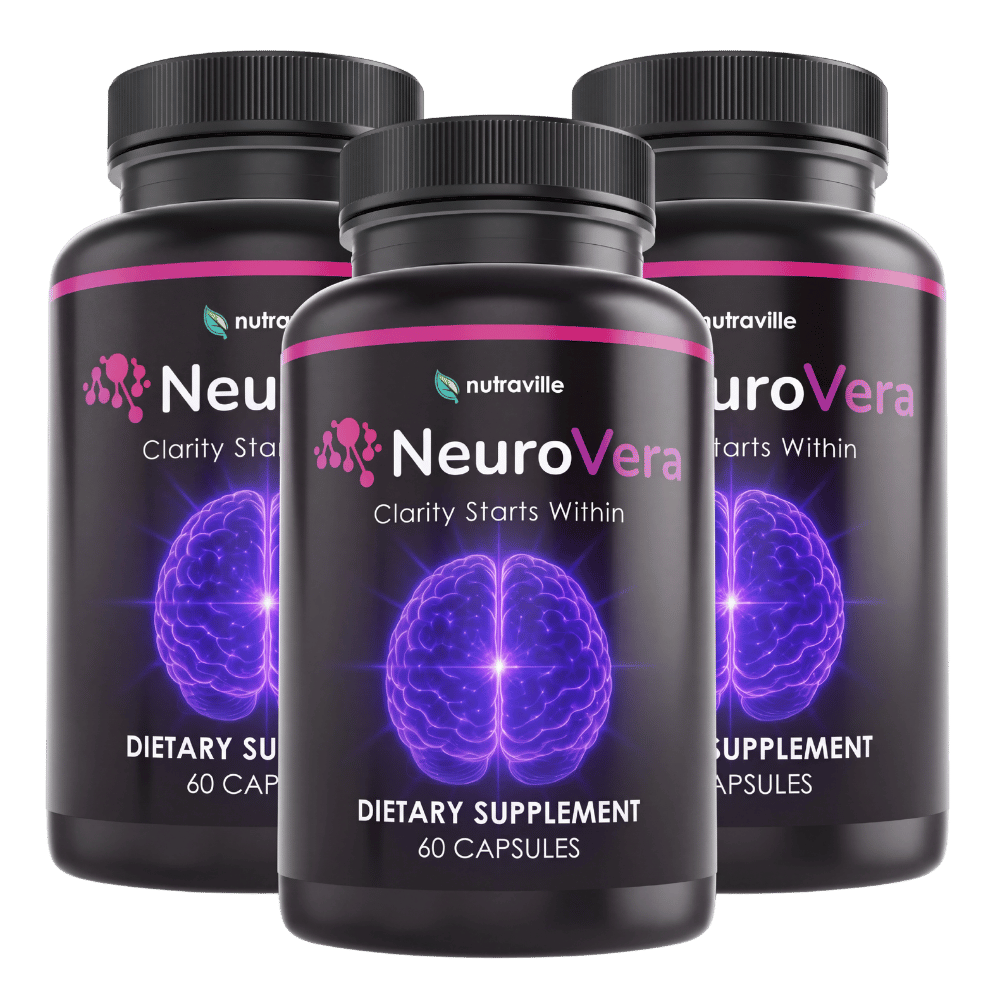
30 servings per container; 60 capsules per bottle.
Lion’s Mane, Schisandra, Gotu Kola, Bacopa, Shilajit and the DHA 10% line.
There is no proprietary active blend hiding ingredient allocation.
No finished-product clinical trial was identified in our research.
What Sources Did Pro Review Metric Verify?
Used to document seller positioning, directions, commercial claims and affiliate rules. Seller claims remain seller claims.
Used to confirm current one-time-fee / no-autoship messaging and the reviewed six-bottle transaction presentation.
Used only for the ingredient, preparation, dose, population and endpoint actually studied.
PRM did not assay NeuroVera, verify raw-material identity, or independently test a physical batch.
What Does the NeuroVera Label Actually Disclose?
| Active line | Amount per 2-capsule serving | Form / label detail | Recording rule |
|---|---|---|---|
| Lion’s Mane Mushroom Powder | 500 mg | Hericium erinaceus, fruiting body | Recorded as fruiting-body powder; not reclassified as a standardized extract. |
| Schisandra Fruit Extract 10:1 | 250 mg | 10:1 extract | Extract ratio retained exactly as stated. |
| Gotu Kola Powder | 200 mg | Centella asiatica, whole herb | Whole-herb powder is kept distinct from human trials using extracts. |
| Bacopa monnieri Extract | 100 mg | Whole-herb extract; no bacoside standardization stated on the reviewed panel | No unlisted bacoside percentage is inferred. |
| Shilajit Extract | 75 mg | Asphaltum punjabinum, gum & resin; standardized to 40% fulvic acid | Standardization is documented without treating non-cognitive Shilajit trials as cognitive proof. |
| DHA (Docosahexaenoic Acid) 10% | 25 mg line item | The panel prints “DHA (Docosahexaenoic Acid) 10% — 25 mg.” | PRM does not reinterpret the line as 25 mg of pure DHA because the pure-DHA contribution is not specified. |
| Other ingredients | Not listed by amount | HPMC (vegetable capsule), magnesium stearate, olive oil, silicon dioxide | Recorded as inactive ingredients from the reviewed panel. |
How Transparent Is the NeuroVera Formula?
The panel is more transparent than a proprietary blend because each active line has a separately stated amount. The remaining question is whether the form and exposure match the human evidence closely enough to support transfer.
| Ingredient | Label amount | Form / standardization | Transparency status | Material evidence-transfer issue |
|---|---|---|---|---|
| Lion’s Mane | 500 mg | Fruiting-body powder | HIGH | Human cognition trials in the reviewed record used materially higher exposures, roughly 3–3.2 g/day. |
| Schisandra | 250 mg | 10:1 extract | GOOD | No close-match independent cognitive trial was identified for this NeuroVera preparation in the reviewed source record. |
| Gotu Kola | 200 mg | Whole-herb powder | GOOD | The human cognition study used a materially different extract at approximately 1,000 mg/day with exercise as a co-intervention. |
| Bacopa monnieri | 100 mg | Extract; bacoside standardization not stated | PARTIAL CHARACTERIZATION | Major human trials in this record used characterized extracts at 300 mg/day. |
| Shilajit | 75 mg | 40% fulvic acid | GOOD CHARACTERIZATION | Identified human trials used materially higher exposures and non-cognitive endpoints. |
| DHA | “10% — 25 mg” | Label line disclosed | LIMITED COMPOSITIONAL INTERPRETATION | The pure-DHA contribution cannot be established from the reviewed panel. |
Does NeuroVera Work? What the Evidence Actually Supports
Short answer: NeuroVera contains ingredients with meaningful human cognition research—especially Lion’s Mane and Bacopa—but that does not establish that the complete current formula improves memory, focus or cognition. The reviewed human studies used different doses, preparations or products, and no finished-product NeuroVera clinical trial was identified in the research used for this dossier.
| Seller position / theme | Source type | Independent evidence status | PRM interpretation |
|---|---|---|---|
| Memory support | Seller positioning | Ingredient-level human cognition evidence exists mainly for Lion’s Mane and Bacopa in this record. | The evidence supports ingredient relevance. It does not directly establish memory improvement from the finished NeuroVera formula. |
| Brain / cognitive support | Seller positioning and formula rationale | Some supporting human evidence exists at ingredient level, with low-to-moderate transfer quality depending on ingredient. | A plausible supplement rationale is not the same as a product-level efficacy finding. |
| Simple daily routine | Direct product fact | Two capsules per serving; 30 servings per bottle. | This is a usability characteristic, not a clinical outcome. |
| “Clarity Starts Within” | Label tagline | Not an independently validated outcome statement. | Recorded as branding language, not as evidence that NeuroVera improves clarity. |
What Does Research Say About NeuroVera’s Ingredients?
The evidence below is organized by ingredient and keeps the studied preparation, dose, population and endpoint attached to each conclusion. Same ingredient name does not create trial equivalence.
Lion’s Mane — primary evidence anchor
NeuroVera lists 500 mg of Lion’s Mane mushroom powder from the fruiting body per two-capsule serving. Human cognition trials make this the formula’s strongest ingredient-level evidence anchor, but the studied exposures were materially higher.
Mori K, et al. — mild cognitive impairment
What it supports: Participants received four 250 mg tablets containing 96% Hericium dry powder three times daily—approximately 3 g/day. Cognitive function scale scores were significantly higher than placebo at weeks 8, 12 and 16.
Transfer limit: Performance decreased after treatment stopped. The trial was small, and both the study product and the approximately 3 g/day exposure differ materially from NeuroVera’s 500 mg fruiting-body powder serving.
Transfer status: Partial / Moderate
Open the PubMed recordSaitsu Y, et al. — oral Hericium erinaceus in adults over 50
What it supports: A significant between-group signal was reported on MMSE.
Transfer limit: No significant between-group effect was reported for the Benton Visual Retention Test or the standard verbal paired-associate learning test. The roughly 3.2 g/day study exposure is materially above NeuroVera’s 500 mg serving.
Transfer status: Partial
Open the PubMed recordPRM evidence conclusion
Human cognition trials make Lion’s Mane NeuroVera’s strongest evidence anchor. However, the reviewed NeuroVera serving provides 500 mg of fruiting-body powder, materially below the roughly 3–3.2 g/day exposures used in the cited trials. The studies therefore support ingredient relevance, not clinical equivalence of NeuroVera.
Bacopa monnieri — secondary evidence anchor
NeuroVera lists 100 mg of Bacopa monnieri extract per serving. The reviewed label does not state bacoside standardization.
Stough C, et al. — chronic Bacopa extract use
What it supports: The trial reported improvement in some measures including speed of visual information processing, learning rate and memory consolidation.
Transfer limit: The studied amount was 300 mg/day and the intervention was a specific commercial extract. NeuroVera provides 100 mg and does not state a comparable bacoside standardization on the reviewed panel.
Transfer status: Partial
Open the PubMed recordLopresti AL, et al. — Bacumen® in healthy adults
What it supports: Some secondary stress and fatigue outcomes favored Bacopa.
Transfer limit: No significant between-group treatment effect was found on the primary cognitive outcomes of verbal learning, attention and working memory. The 300 mg characterized Bacumen extract is not trial-matched to NeuroVera’s 100 mg inclusion.
Transfer status: Partial
Open the PubMed recordPRM evidence conclusion
Bacopa has a meaningful human cognition research history, but results are not uniformly positive and the NeuroVera inclusion is not trial-matched. NeuroVera provides 100 mg and the reviewed panel does not specify bacoside standardization, while the cited human trials used 300 mg/day of characterized extracts.
Gotu Kola
NeuroVera lists 200 mg of Gotu Kola whole-herb powder per serving.
Phoemsapthawee J, et al. — Gotu Kola plus multicomponent exercise
What it supports: Exercise-related groups improved versus control in the study.
Transfer limit: The Gotu Kola arm used 500 mg extract twice daily—1,000 mg/day—together with multicomponent exercise. Adding Gotu Kola did not establish a clear additional cognitive advantage over exercise alone. The preparation, dose, co-intervention and population differ from NeuroVera.
Transfer status: Low
Open the PubMed recordPRM evidence conclusion
Gotu Kola has human cognition context, but this study is not a close match to NeuroVera’s 200 mg whole-herb inclusion.
Schisandra
NeuroVera lists 250 mg of Schisandra Fruit Extract 10:1 per serving.
Park J, et al. — Schisandra extract in adult women
What it supports: The ingredient has been studied in humans under controlled conditions.
Transfer limit: The endpoints were quadriceps muscle strength and fatigue-related outcomes, not cognition. The 1,000 mg/day exposure also differs from NeuroVera’s 250 mg 10:1 inclusion.
Cognitive transfer: Insufficient
Open the PubMed recordSchisandra chinensis for menopausal symptoms
What it supports: This adds human-study context for Schisandra as an ingredient.
Transfer limit: The clinical setting was menopausal symptoms, not cognition, so it does not establish a cognitive effect for NeuroVera.
Cognitive transfer: Insufficient
Open the PubMed recordADAPT-232 cognitive study
What it supports: A cognition-oriented human study exists for a combination that included Schisandra.
Transfer limit: Because the intervention combined three ingredients, its cognitive findings cannot be attributed to Schisandra alone and cannot be treated as validation of NeuroVera’s Schisandra line.
Direct Schisandra cognitive transfer: Insufficient
Open the PubMed recordPRM evidence conclusion
Human Schisandra research supports that the ingredient has been clinically studied, but the reviewed evidence does not establish a close-match independent cognitive effect for NeuroVera’s 250 mg 10:1 inclusion.
Shilajit
NeuroVera lists 75 mg of Shilajit extract standardized to 40% fulvic acid per serving.
Pandit S, et al. — purified Shilajit and testosterone
What it supports: The source provides controlled human-study evidence that a characterized Shilajit preparation has been clinically studied.
Transfer limit: The endpoint was androgenic hormones, not cognition, and the 500 mg/day exposure was materially above NeuroVera’s 75 mg inclusion.
Cognitive transfer: Insufficient
Open the PubMed recordShilajit and fatigue-induced muscular strength changes
What it supports: The study adds human supplementation context for higher Shilajit exposures.
Transfer limit: The endpoints were muscular performance and fatigue-related outcomes, not cognition. The doses were also materially above NeuroVera’s 75 mg inclusion.
Cognitive transfer: Insufficient
Open the PubMed recordPRM evidence conclusion
NeuroVera’s 40% fulvic-acid standardization improves ingredient characterization, but the human Shilajit evidence identified here does not establish cognitive efficacy for NeuroVera’s 75 mg inclusion.
DHA
The reviewed panel lists “DHA (Docosahexaenoic Acid) 10% — 25 mg.” PRM records this line exactly as printed because the panel does not specify the pure-DHA contribution represented by the 25 mg line item.
Stonehouse W, et al. — DHA, memory and reaction time
What it supports: The study provides human cognition-relevant context for DHA.
Transfer limit: The trial used 1.16 g/day of DHA. NeuroVera’s reviewed label does not establish the pure-DHA amount represented by its “DHA 10% — 25 mg” line item.
Transfer status: Not meaningfully transferable
Open the PubMed recordDHA in age-related cognitive decline
What it supports: Some learning and memory measures improved in the studied population.
Transfer limit: Not all cognitive domains improved. The 900 mg/day DHA exposure is materially larger than anything that can be established from NeuroVera’s label line.
Transfer status: Not meaningfully transferable
Open the PubMed recordPRM evidence conclusion
The DHA literature establishes a cognition-relevant biological context for DHA, but it does not meaningfully validate the NeuroVera DHA line because the panel does not disclose the pure-DHA contribution and the studied exposures are materially larger.
Has the Current NeuroVera Formula Been Clinically Tested?
Short answer: no finished-product clinical trial was identified in the research reviewed for this dossier. Ingredient-level human evidence exists, with trial-match quality ranging from low to moderate depending on the ingredient. Lion’s Mane is the primary evidence anchor and Bacopa monnieri is the secondary evidence anchor. This wording records the reviewed search; it does not claim that no NeuroVera trial could exist anywhere.
What Are the Biggest Evidence Gaps?
- Association is not causation.
- Ingredient evidence is not finished-product evidence.
- The same ingredient name does not establish the same preparation.
- Powder is not automatically equivalent to a standardized extract.
- A different dose is not a trial-matched dose.
- A different study population does not establish an identical expected outcome.
- Combination-product findings cannot be attributed to one component unless the study isolates that component.
- A clinical study using a non-cognitive endpoint does not establish cognitive efficacy.
- Label transparency improves inspectability; it does not establish clinical efficacy.
- For NeuroVera, the pure-DHA contribution represented by the “DHA 10% — 25 mg” label line remains unresolved from the reviewed panel.
How Much Does NeuroVera Cost?
Short answer: the reviewed seller presentation lists $49 for 1 bottle, $117 for 3 bottles and $174 for 6 bottles. The 6-bottle package currently states free shipping, and the reviewed ClickBank presentation describes the order as a one-time fee with no autoship. Seller-controlled pricing, shipping and guarantee terms can change.
1-month supply; $49 per bottle.
3-month supply; $39 per bottle. No free-shipping inference is made for this package.
6-month supply; $29 per bottle. Free shipping is stated for this package.
The seller currently advertises a 365-day money-back guarantee. Pricing, shipping and policy terms remain seller-controlled.
Is NeuroVera Safe?
Short answer: the reviewed label clearly discloses the six active amounts, but no finished-product clinical safety trial was identified in the research used for this dossier. Ingredient-level tolerability cannot establish that the complete formula is appropriate for every user. People who are pregnant, nursing, taking medication or managing a medical condition should follow the seller’s physician-consultation guidance.
No finished-product clinical trial was identified in the reviewed research.
Tolerability observed in an ingredient study does not automatically establish the safety profile of the complete NeuroVera formula.
People who are pregnant, nursing, taking medications or managing a medical condition should follow the seller’s physician-consultation guidance.
NeuroVera should not be presented as treatment for dementia, mild cognitive impairment, Alzheimer’s disease or another medical condition. See the Medical Disclaimer.
How Was This NeuroVera Dossier Prepared?
The Pro Review Metric Editorial Team compared the physical NeuroVera Supplement Facts panel, seller and affiliate materials, package presentation and supplied ClickBank checkout verification with the PubMed-indexed human studies listed above.
Study conclusions were carried only as far as the ingredient, form, dose, standardization, population and endpoint allowed. Combination-product findings were not assigned to one ingredient, non-cognitive studies were not presented as cognitive proof, and the DHA label line was preserved without mathematically inferring a pure-DHA amount.
PRM did not conduct firsthand NeuroVera use, laboratory analysis, raw-material authentication or a finished-product clinical trial. See the Methodology, Editorial Policy, Editorial Team, Affiliate Disclosure and Medical Disclaimer.
Last updated: September 15, 2026. This dossier is reviewed when product details, pricing, labeling or material evidence changes.