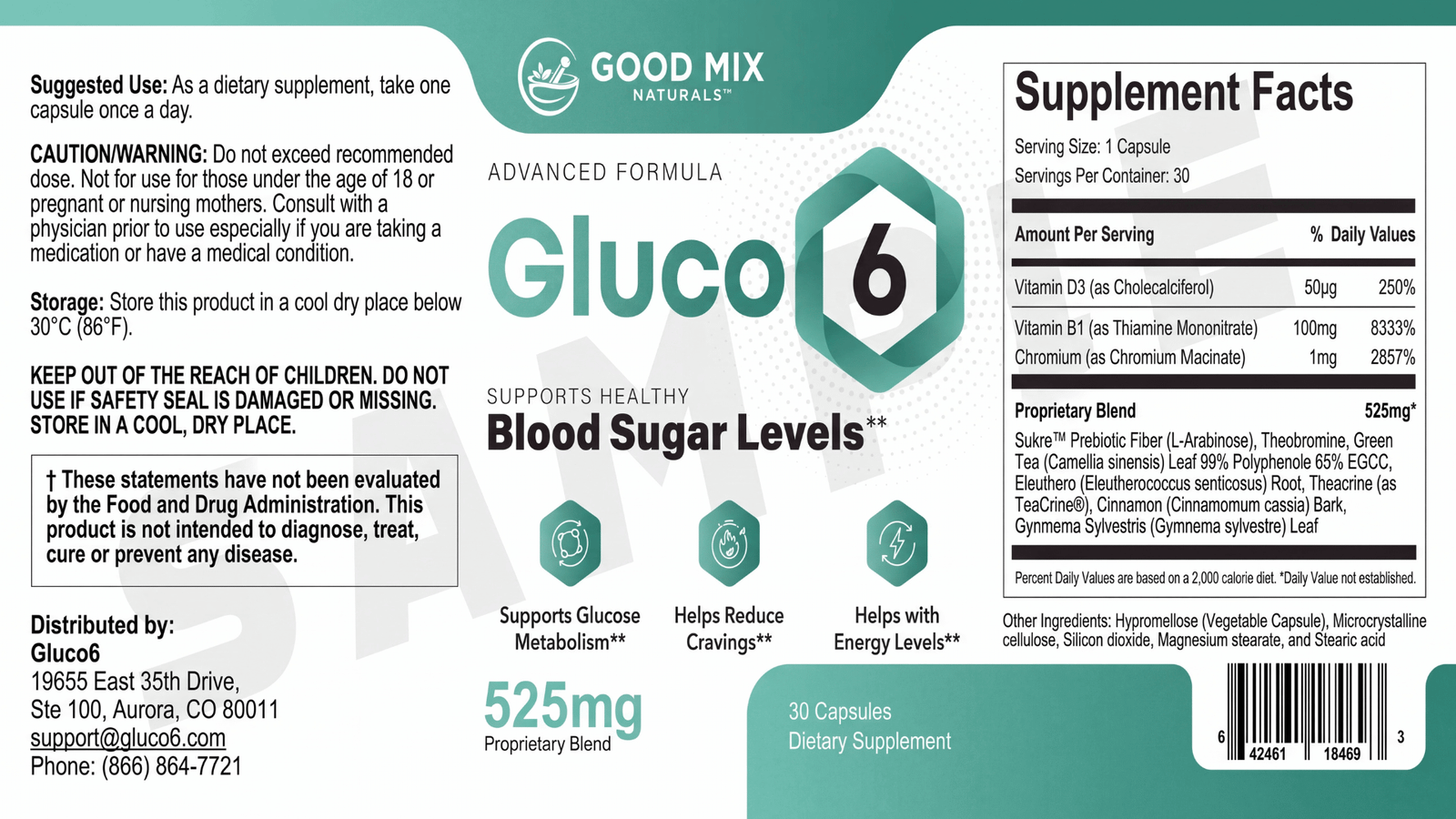
The reviewed physical label shows one capsule per serving and 30 servings per bottle. Vitamin D3, vitamin B1 and chromium are individually quantified, while seven additional ingredients share one 525 mg proprietary blend. The strongest ingredient-level human evidence is for L-arabinose reducing acute glucose and insulin responses when taken with sucrose, but those studies used gram-level L-arabinose exposures while the entire Gluco6 proprietary blend is only 525 mg. Chromium has mixed clinical evidence, Gymnema and cinnamon have suggestive but heterogeneous research, and no finished-product randomized clinical trial of the current Gluco6 formula was identified in PRM’s targeted searches.
Gluco6 Research: Quick Answers
The reviewed physical label lists one capsule per serving and 30 servings per container.
Seven named blend ingredients share one total amount, so their individual doses cannot be determined from the label.
The live checks showed $9.95 shipping on 2 bottles and free shipping on 3 and 6 bottles.
Ingredient studies should not be presented as proof of the complete current formula.
What Sources Did Pro Review Metric Verify?
The physical Supplement Facts panel controls serving size, listed ingredients, botanical species wording and declared amounts. The current seller funnel, affiliate materials, package presentation and supplied ClickBank checkout record were used to document positioning, prices, shipping, bonuses, refund language and purchase structure. Seller-controlled commercial terms can change.
What Does the Gluco6 Label Actually Disclose?
| Label item | Declared detail | What the label supports | Important boundary |
|---|---|---|---|
| Serving Size | 1 capsule; 30 servings per container | The labeled daily serving and approximately 30 labeled daily servings per bottle. | Serving information does not establish a glucose, A1C or weight-loss outcome. |
| Vitamin D3 | 50 mcg · 250% DV, as cholecalciferol | Declared vitamin D exposure in one serving. | The label does not establish a Gluco6-specific glucose-control effect from this amount. |
| Vitamin B1 | 100 mg · 8,333% DV, as thiamine mononitrate | Declared thiamin exposure in one serving. | High %DV is not evidence that additional B1 improves blood sugar in this finished formula. |
| Chromium | 1 mg · 2,857% DV, as chromium macinate | A fully disclosed 1,000 mcg elemental-chromium line. | Most clinical literature uses other chromium forms; glycemic findings are mixed and medication interactions matter. |
| Proprietary Blend | 525 mg total | The combined amount for seven named ingredients. | No internal dose split is disclosed, so dose matching against ingredient trials is not possible. |
| Sukre Prebiotic Fiber | L-arabinose · inside 525 mg blend | Presence of L-arabinose in the proprietary blend. | Even if the entire blend were L-arabinose—which it is not—the maximum would be 525 mg, below the 1 g lowest L-arabinose dose in the 2011 seller-cited human study. |
| Theobromine | Inside 525 mg blend | Presence on the physical label. | Individual amount and contribution to Gluco6 outcomes are unknown. |
| Green Tea Leaf | 99% polyphenol · 65% EGCG · inside 525 mg blend | Presence plus the printed standardization wording. | Individual milligram amount is unknown; concentrated green-tea-extract safety and efficacy are dose dependent. |
| Eleuthero Root | Eleutherococcus senticosus · inside 525 mg blend | Presence and botanical identity. | This is not one of the seller’s six headline ingredients and no individual dose is disclosed. |
| Theacrine / TeaCrine | Inside 525 mg blend | Presence of theacrine branded as TeaCrine. | Human TeaCrine studies use known doses; Gluco6 does not disclose its dose. Theacrine research also describes psychostimulatory / caffeine-like activity, so PRM does not treat “No Stimulants” as a simple independently verified label fact. |
| Cinnamon | Cinnamomum cassia bark · inside 525 mg blend | The physical product identifies cassia cinnamon. | The seller page currently uses “Ceylon cinnamon” language; PRM follows the physical label. |
| Gymnema Sylvestre | Leaf · inside 525 mg blend | Presence of Gymnema leaf. | Individual dose and extract standardization are not disclosed, limiting transfer from Gymnema trials. |
| Other ingredients | Hypromellose, microcrystalline cellulose, silicon dioxide, magnesium stearate, stearic acid | Current non-active ingredient list. | Excipients are not efficacy evidence. |
How Transparent Is the Gluco6 Formula?
These three lines have individual amounts on the physical label.
The proprietary blend has a clear total amount but no internal dose split.
Presence is disclosed; individual exposure is not.
The proprietary blend prevents reliable dose-by-dose comparison with published human research.
Does Gluco6 Work? What the Evidence Actually Supports
Short answer: Gluco6 contains ingredients with human research relevant to post-meal glucose response and glycemic control, but that is not the same as proving the current finished formula works as advertised. The strongest direct ingredient bridge is L-arabinose, yet the seller-cited human studies used gram-level L-arabinose exposures while the entire Gluco6 proprietary blend totals 525 mg. No randomized clinical trial of the current finished Gluco6 formula was identified in PRM’s targeted searches.
| Seller positioning | Evidence status | PRM interpretation |
|---|---|---|
| “GLUT-4 Overwhelm” / “GLUT-4 Relief” | Mechanism framing is not validated for the finished product | The seller-cited L-arabinose human literature primarily supports intestinal sucrase inhibition and altered acute post-sucrose glucose/insulin responses. It does not demonstrate that Gluco6 “relieves” GLUT-4 receptors as a finished-product mechanism. |
| Supports healthy blood sugar / glucose metabolism | Ingredient-level context exists | L-arabinose, chromium, Gymnema and cinnamon have relevant research, but preparation, dose and outcome differences prevent automatic transfer to Gluco6. |
| Large A1C reductions | Not established for Gluco6 | No finished-product trial was identified. Chromium findings are mixed and Gymnema evidence is heterogeneous; the proprietary blend also prevents dose matching. |
| Major weight loss / fat-storage reversal | Not established for Gluco6 | The reviewed seller reference set does not provide direct finished-product evidence for the dramatic weight-loss outcomes used in promotional copy. |
| “No Stimulants” | Label creates a terminology problem | The physical label contains theacrine and theobromine. Published theacrine literature describes caffeine-like / psychostimulatory activity. PRM therefore avoids presenting “stimulant-free” as a simple independently verified fact. |
| Ceylon cinnamon | Conflicts with physical label | The current Supplement Facts panel identifies Cinnamomum cassia bark. Physical-label species wording controls this dossier. |
Has the Current Gluco6 Formula Been Clinically Tested?
Direct randomized clinical evidence for the current Gluco6 formula: not identified in PRM’s targeted PubMed / ClinicalTrials.gov searches.
Ingredient-level human evidence: yes.
Best evidence anchor: L-arabinose for acute post-sucrose glycemic response.
Major transfer limitation: the entire proprietary blend is 525 mg, while seller-cited L-arabinose human trials used gram-level L-arabinose exposures.
What Does Research Say About Gluco6’s Ingredients?
The source record below prioritizes human trials, systematic reviews and current NIH / NCCIH guidance. It distinguishes biological plausibility from evidence that can reasonably transfer to the current one-capsule Gluco6 formula.
L-arabinose / Sukre — strongest direct ingredient bridge
L-arabinose with sucrose in healthy adults and people with type 2 diabetes
Finding: adding L-arabinose to sucrose-containing test foods reduced acute post-sucrose glucose and insulin responses in small crossover experiments.
Transfer limit: the intervention used gram-level or percentage-by-weight L-arabinose with sucrose. Gluco6 does not disclose its L-arabinose amount and the whole blend is only 525 mg.
View the studyDose-response effects of L-arabinose on intestinal sucrase and postprandial glucose
Finding: 4% L-arabinose (3 g) produced an 11% lower glucose peak and a 33% lower, delayed insulin peak versus sucrose alone; the mechanistic work supported sucrase inhibition.
Transfer limit: even the study’s lowest 1 g dose exceeds the maximum possible L-arabinose amount in Gluco6’s entire 525 mg blend.
View PubMedRare sugars and cardiometabolic effects in humans
Finding: the review found several acute L-arabinose crossover trials with beneficial postprandial glycemic effects, but not every study reproduced the effect and long-term evidence was limited.
Transfer limit: most L-arabinose evidence concerns acute co-ingestion with sucrose rather than an unspecified sub-525 mg dose in a once-daily multi-ingredient capsule.
View the systematic reviewL-arabinose in adults with impaired fasting glucose
Finding: a single L-arabinose treatment reduced glucose and insulin peaks after a sucrose-rich drink, but the benefit did not extend to glycemic variability during a controlled diet with mixed meals and snacks.
Why it matters: this newer trial strengthens acute L-arabinose plausibility while also showing that the effect is context dependent.
View PubMedChromium — fully dosed on the label, but clinical conclusions remain mixed
Chromium and glycemic control
Current evidence context: NIH ODS notes mixed trial results. Some analyses show small improvements in fasting glucose or HbA1c in people with diabetes, but clinical significance is uncertain and routine chromium supplementation is not clearly supported for glycemic control.
Gluco6-specific issue: the label provides 1,000 mcg as chromium macinate. Many cited clinical trials used chromium picolinate or other forms, so form-specific transfer is uncertain.
View NIH ODSGymnema and cinnamon — relevant literature, limited product transfer
Gymnema sylvestre and glycemic outcomes in type 2 diabetes
Finding: a meta-analysis of 10 studies / 419 participants reported improvements in fasting glucose, postprandial glucose and HbA1c.
Important limitation: statistical heterogeneity was very high across outcomes, and Gluco6 does not disclose the Gymnema amount or extract standardization. This makes trial matching weak.
View PubMedCinnamon and diabetes research
Finding: NCCIH describes cinnamon results as conflicting and says research does not clearly support cinnamon for a health condition. Some meta-analyses suggest reductions in fasting glucose, but study quality, species, dose and formulation vary.
Gluco6-specific issue: the physical label says cassia cinnamon, while the sales page has used Ceylon-cinnamon wording.
View NCCIHGreen tea and TeaCrine — secondary formula context
Green tea usefulness and safety
Evidence context: green-tea and green-tea-extract research spans many outcomes, but blood-glucose results are not consistently established. Gluco6’s label gives a polyphenol / EGCG standardization but not an individual milligram amount.
Safety context: concentrated green-tea extracts have uncommon reports of liver injury and may interact with medicines.
View NCCIHTheacrine over eight weeks
Finding: in healthy adults, 200–300 mg/day TeaCrine for eight weeks did not produce clinically meaningful adverse changes in the measured safety markers.
Transfer limit: Gluco6 does not disclose its theacrine dose. Published literature also describes theacrine as a purine alkaloid with caffeine-like / psychostimulatory activity, so this evidence does not validate a blanket “no stimulants” message.
View PubMedWhat Are the Biggest Evidence Gaps?
- Ingredient evidence is not finished-product evidence. No Gluco6 randomized clinical trial was identified in PRM’s targeted searches.
- The proprietary blend prevents dose matching. Seven ingredients share 525 mg, and the internal split is unknown.
- L-arabinose is the clearest mechanistic anchor, but the dose gap is material. Seller-cited human studies used at least 1 g, while the entire Gluco6 blend is 525 mg.
- Acute sucrose-response evidence is not the same as long-term A1C control. Short postprandial studies cannot establish a multi-month finished-product HbA1c effect.
- Seller mechanism language goes beyond the cited L-arabinose mechanism. The strongest human evidence concerns sucrase inhibition and delayed sucrose digestion, not a demonstrated finished-product “GLUT-4 relief” effect.
- Species / formulation mismatches matter. The physical label says cassia cinnamon, while seller copy has used Ceylon wording; chromium form also differs from many published trials.
- Weight-loss and Type 2 disease claims require a much higher evidentiary bar. They are not established by the current physical label or by the seller’s repeated L-arabinose references.
Where Do the Gluco6 Product Facts Come From?
Gluco6 physical Supplement Facts panel
Supports: one-capsule serving, 30 servings, vitamin D3 50 mcg, vitamin B1 100 mg, chromium 1 mg, 525 mg proprietary blend, ingredient identities, warnings and other ingredients.
Does not prove: blood-glucose, A1C, weight-loss or disease outcomes.
Official Gluco6 sales funnel
Supports: current seller positioning, package ladder, promotional ingredient story, bonuses and seller claims.
Does not prove: that promotional health outcomes have been demonstrated by the finished formula.
View the seller siteCurrent Gluco6 “Scientific References” list
Supports: the seller links to L-arabinose research.
Important limitation: the main reference section repeatedly cycles the same three sources—two human L-arabinose studies and one rat L-arabinose study—rather than providing distinct finished-product or six-ingredient evidence for every marketing claim.
View the current reference sectionOfficial Gluco6 affiliate center
Supports: affiliate rules, 75% front-end commission positioning and current promotional materials.
Boundary: affiliate copy includes aggressive A1C, medication-replacement and weight-loss language; PRM does not treat affiliate promotional copy as clinical substantiation.
View the affiliate centerCurrent U.S. ClickBank checkout record
Supports: observed totals, shipping presentation, current 60-day refund language and one-time purchase behavior.
Does not prove: product effectiveness or that prices, shipping, bonuses and policy terms will remain unchanged.
Open the current offerHow Strong Is Gluco6’s Seller Reference Set?
Reference count is not the same as evidence breadth. The current main Gluco6 reference section presents many numbered links, but the visible list repeatedly reuses the same three unique sources: a 2000 human L-arabinose study, a 2015 rat metabolic-syndrome study and a 2011 human L-arabinose dose-response study.
The apparent long list is largely repetition rather than a broad set of independent studies.
They support acute sucrose-response effects, not Gluco6 finished-product outcomes.
Animal findings cannot establish human A1C, weight-loss or Type 2 outcomes for Gluco6.
The main list does not independently validate the six spotlight ingredients, the complete formula or the more dramatic disease / weight claims.
How Much Does Gluco6 Cost?
60-day supply. $9.95 shipping and $0.00 tax were shown in the observed U.S. checkout.
90-day supply. Free shipping and $0.00 tax were shown in the observed U.S. checkout. Current bonus set: Neuro Nourish + Sweety Slim.
180-day supply. Free shipping and $0.00 tax were shown in the observed U.S. checkout. Current bonus set: Neuro Nourish + Sweety Slim.
Controlling refund record: the current observed ClickBank checkout and current main offer materials show a 60-day money-back guarantee. Some alternate / legacy seller page variants still contain 180-day language, so PRM uses the live transaction path as the controlling commercial record for this dossier.
Is Gluco6 Safe?
Short answer: Gluco6 is sold as a dietary supplement, but it should not be described as universally safe. The current label advises medical consultation for people taking medication or managing a medical condition and excludes use under age 18 and during pregnancy or nursing. Its 1,000 mcg chromium dose, cassia cinnamon and concentrated green-tea extract make medication, liver and kidney context especially relevant for some users.
The label advises physician consultation especially for people taking medication or managing a medical condition, and excludes use under age 18 and during pregnancy / nursing.
NIH ODS notes that chromium may add to the glucose-lowering effects of insulin or antidiabetes drugs and may interfere with levothyroxine absorption. Kidney or liver disease warrants added caution with high amounts.
NCCIH notes that cassia cinnamon contains variable coumarin and large amounts may worsen liver disease in susceptible people.
NCCIH reports uncommon liver injury with concentrated green-tea extracts and interactions with some medicines.
Vitamin D3 and thiamin amounts
Gluco6 provides 50 mcg vitamin D3, which is below the U.S. adult UL of 100 mcg/day. The Food and Nutrition Board has not established a UL for thiamin because adverse effects from high oral intakes have not been well documented, although absence of a UL is not proof that unlimited intake is desirable.
View NIH ODS vitamin DHow this dossier was prepared
The Pro Review Metric Editorial Team compared the physical Supplement Facts panel, current seller and affiliate materials, current package presentation and supplied U.S. ClickBank checkout record with current NIH Office of Dietary Supplements guidance, NCCIH evidence / safety summaries, PubMed-indexed studies, systematic reviews and targeted searches for finished-product Gluco6 clinical evidence.
Seller claims remain seller claims. Ingredient research was not presented as proof of the finished formula. Dose, preparation, botanical species, standardization, population and endpoint differences were treated as evidence-transfer limits.
Pro Review Metric did not conduct a firsthand Gluco6 product-use trial, laboratory assay, manufacturing audit, physical batch inspection or independent chemical verification of the label.
Last updated: September 15, 2026. This dossier is reviewed when product details, pricing, labeling or material evidence changes.