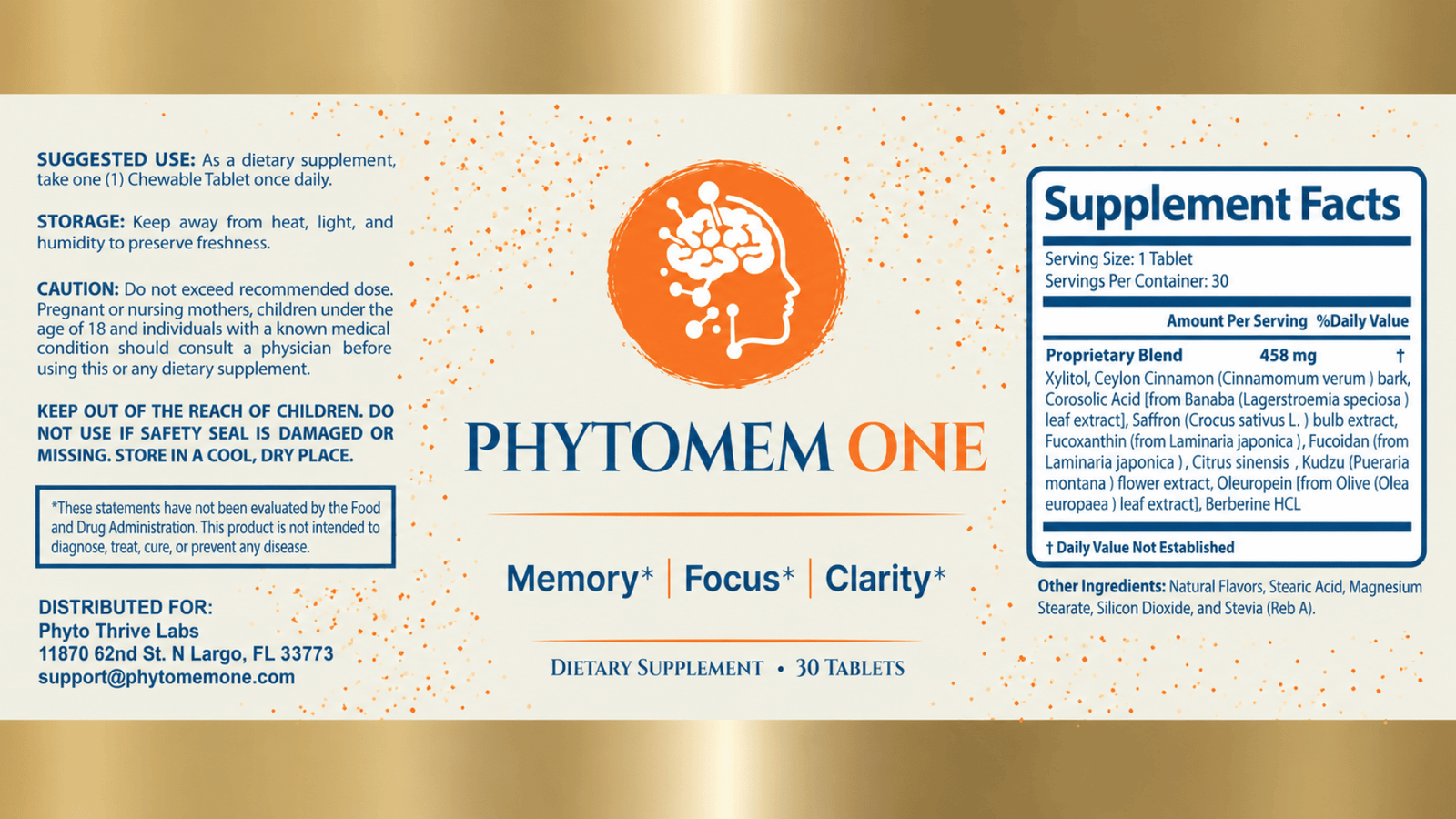
The reviewed physical label shows one chewable tablet per serving, 30 servings per bottle and a single 458 mg proprietary blend containing ten named active entries. Human cognition research is most relevant for saffron and emerging fucoxanthin interventions, while berberine, cinnamon and corosolic-acid research is stronger for glucose and insulin-related outcomes. Several seller mechanism claims go further than the current human evidence: microplastics have been detected in human brain tissue, but causation and treatment implications remain unresolved; “type 3 diabetes” is a research concept rather than a formal diabetes diagnosis. No independent randomized clinical trial of the complete current Phytomem One formula was identified in the source record reviewed for this dossier.
Phytomem One Research: Quick Answers
The reviewed physical label directs one chewable tablet once daily and lists 30 servings per container.
All ten active entries share a single combined amount, so the individual ingredient doses cannot be determined from the label.
The 2-bottle checkout added $9.95 shipping; the observed 3- and 6-bottle U.S. paths showed free shipping.
Human research exists for selected ingredients, but that is not the same as a trial of the current complete product.
What Sources Did Pro Review Metric Verify?
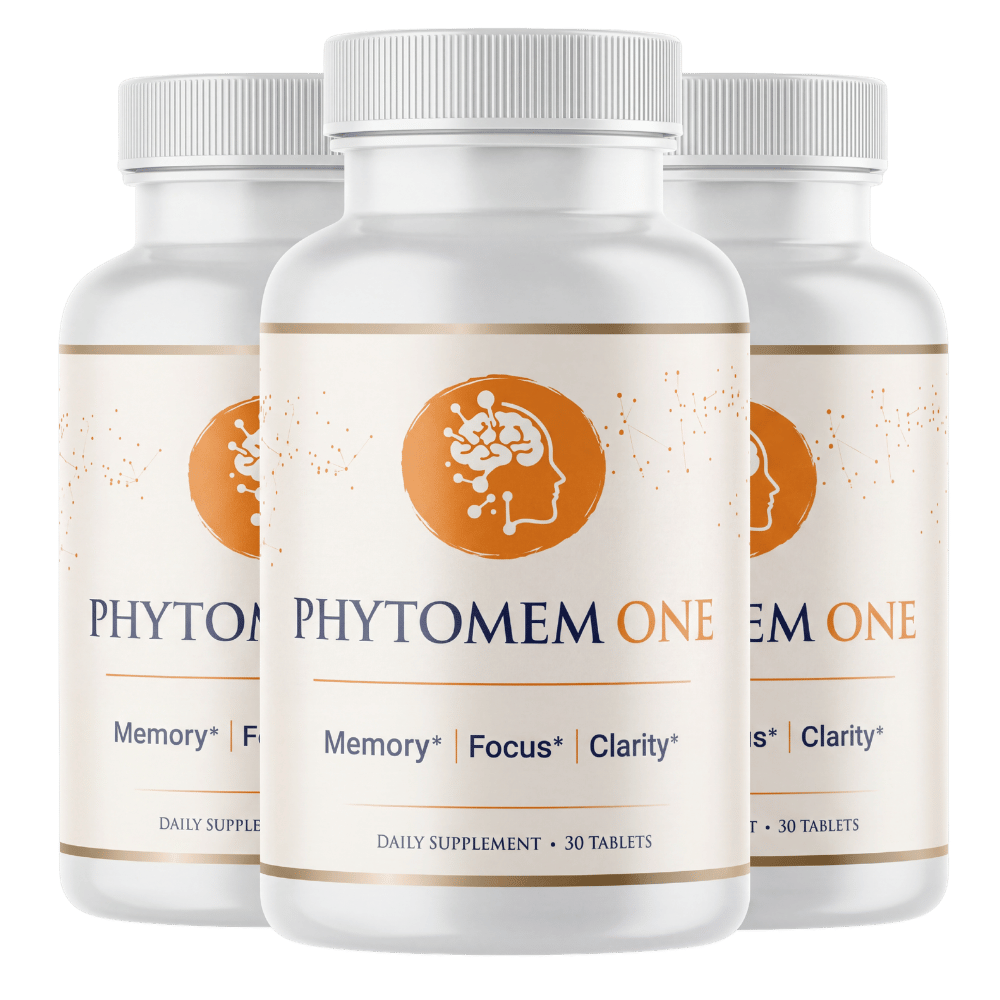
The physical Supplement Facts panel controls serving size, dosage form, listed ingredients, the 458 mg blend amount and printed warnings. The current seller funnel, affiliate resource record, package presentation and live U.S. ClickBank checkout paths were used to document seller positioning, prices, shipping, bonuses, guarantee language and purchase structure. Independent research was used to test whether the ingredient and mechanism claims transfer to the finished formula. Seller-controlled commercial terms can change.
What Does the Phytomem One Label Actually Disclose?
| Label item | Declared detail | What the label supports | Important boundary |
|---|---|---|---|
| Serving Size | 1 tablet; 30 servings per container | One labeled daily serving and approximately 30 labeled daily servings per bottle. | The label specifies a chewable tablet; a seller FAQ separately uses the word “capsule.” PRM follows the physical label. |
| Proprietary Blend | 458 mg total | The combined amount for ten named active ingredients. | The internal dose split is not disclosed, preventing direct study-dose matching. |
| Xylitol | Inside 458 mg blend | Presence as the first listed active entry in the blend. | The label does not establish a cognition or “clean brain fuel” outcome from xylitol. |
| Ceylon Cinnamon | Cinnamomum verum bark, inside 458 mg blend | Species/plant-part identification and presence in the formula. | Individual dose is unknown; cinnamon research varies substantially by species, preparation and endpoint. |
| Corosolic Acid | From Banaba (Lagerstroemia speciosa) leaf extract | Presence of a glucose-metabolism-oriented compound from banaba. | Human metabolic evidence does not establish a direct Phytomem One memory effect. |
| Saffron | Crocus sativus L. bulb extract | Presence of a saffron-derived ingredient. | Published cognition trials commonly study saffron preparations derived from other plant material / preparations; the current label does not establish equivalence to those interventions. |
| Fucoxanthin | From Laminaria japonica | Presence of a brown-seaweed-derived carotenoid source. | Recent cognition RCTs used defined Phaeodactylum tricornutum microalgae extracts containing known fucoxanthin doses, not this undisclosed Laminaria-derived amount. |
| Fucoidan | From Laminaria japonica | Presence of a sulfated-polysaccharide source from brown seaweed. | Neuroprotective literature is still dominated by mechanistic and preclinical work rather than direct cognition trials of this finished product. |
| Citrus sinensis | Inside 458 mg blend | Presence of a sweet-orange-derived active entry. | The physical label does not identify Morosil®, a standardized Moro blood-orange extract, or disclose an amount that can be matched to Morosil trials. |
| Kudzu flower extract | Pueraria montana flower extract | Presence and species stated on the panel. | A frequently cited human Pueraria-flower trial used Pueraria thomsonii for obesity outcomes, not cognition and not the exact labeled species. |
| Oleuropein | From Olive (Olea europaea) leaf extract | Presence of an olive-leaf polyphenol source. | Human cognition evidence is limited and formulation-specific; dose is not disclosed. |
| Berberine HCl | Inside 458 mg blend | Presence of berberine hydrochloride. | Berberine has substantial glucose/insulin research, but the product does not disclose whether its dose approaches studied clinical exposures. |
| Other Ingredients | Natural flavors, stearic acid, magnesium stearate, silicon dioxide, stevia (Reb A) | Non-active formulation ingredients printed on the panel. | These should not be counted as additional active ingredients. |
How Transparent Is the Phytomem One Formula?
Short answer: ingredient identity is relatively transparent, but dosing transparency is low. The physical panel names ten active entries and identifies several botanical species or source materials, yet all ten share one 458 mg proprietary-blend amount. That prevents a reviewer or buyer from knowing how much saffron, fucoxanthin, berberine, cinnamon, corosolic acid or any other active is delivered per tablet.
The label is useful for identifying the intended formula components and several botanical source details.
No individual active amount is provided, which is the main limitation for evidence transfer.
The seller presents Morosil® and specific research narratives, while the panel uses broader names such as Citrus sinensis.
Fucoxanthin and saffron are the clearest examples where human studies do not cleanly establish equivalence to the ingredient form shown on this panel.
Does Phytomem One Work? What the Evidence Actually Supports
Short answer: Phytomem One has several ingredients with legitimate human research, but the evidence is not uniform and does not establish that the current 458 mg finished formula improves memory, reverses cognitive decline or treats dementia. Saffron has the clearest direct human cognition literature, and defined fucoxanthin-containing microalgae extracts have emerging cognition trials. Berberine, corosolic acid and cinnamon are better supported for metabolic endpoints. The proprietary blend and preparation mismatches prevent clean transfer of those findings to the complete tablet.
| Product / seller idea | Evidence status | PRM interpretation |
|---|---|---|
| Memory, focus and clarity support | Some ingredient-level human context | Saffron and emerging fucoxanthin research create a real cognition research layer, but the complete finished formula has not been established by a randomized trial. |
| “Plastic Stranglehold” / microplastic mechanism | Human brain presence documented; causal clinical pathway unresolved | Micro- and nanoplastics have been measured in human brain tissue. Current evidence does not show that Phytomem One removes brain plastics, reverses plastic-related damage or improves memory through such removal. |
| “Type 3 Diabetes” / brain-fuel mechanism | Insulin-resistance research is relevant; terminology is conceptual | Brain glucose and insulin-signaling abnormalities are active Alzheimer research areas, but “type 3 diabetes” is not a formal diabetes diagnosis and should not be treated as a proven cause that this supplement corrects. |
| Metabolic ingredient layer | Meaningful human metabolic research | Berberine and banaba/corosolic acid have human glucose-related evidence; cinnamon evidence is mixed. Metabolic effects do not automatically become memory effects. |
| Morosil® / citrus “amplifier” story | Human weight-management trials exist for defined Moro extracts | Those trials concern standardized Moro blood-orange extracts and weight/body-composition outcomes. The label only states Citrus sinensis and does not disclose a Morosil dose or cognitive endpoint. |
Has the Current Phytomem One Formula Been Clinically Tested?
Direct randomized clinical evidence for the current Phytomem One formula: not identified in the reviewed source record.
Ingredient-level human evidence: yes, with the strongest direct cognition relevance from saffron research and emerging fucoxanthin-containing interventions; metabolic human evidence is stronger for berberine and corosolic-acid / banaba research.
Major transfer limitation: ten ingredients share one 458 mg proprietary blend, and several studied preparations differ from the labeled ingredient form or species.
Clinical boundary: ingredient studies should not be presented as proof that the finished product treats memory loss, mild cognitive impairment, Alzheimer’s disease or dementia.
What Does Research Say About Phytomem One’s Ingredients?
The evidence record below prioritizes randomized human trials, systematic reviews, federal safety guidance and high-quality peer-reviewed reviews. Each result is carried only as far as the studied ingredient, preparation, dose, population and endpoint allow.
Saffron — the clearest direct human cognition research, with an important preparation mismatch
Saffron and cognitive function
Finding: the review found promising cognitive signals in people with mild cognitive impairment or Alzheimer’s disease and one cognitively normal population, while emphasizing study limitations and risk of bias.
Boundary: these are defined saffron interventions, not Phytomem One. The current physical panel specifically lists Crocus sativus bulb extract and does not disclose its dose, so equivalence to the preparations used in cognition trials cannot be assumed.
View PubMed recordSaffron for mild cognitive impairment and dementia
Finding: pooled results reported favorable cognitive-scale signals, but the authors concluded that evidence remained insufficient for clinical recommendations because larger, higher-quality trials were needed.
Boundary: disease-population trials do not establish prevention or treatment effects from an undisclosed amount of a differently described saffron ingredient inside a multi-ingredient chewable.
View PubMed recordFucoxanthin — emerging human cognition evidence, but not from the same source material
Fucoxanthin-containing microalgae extract in older adults with perceived cognitive decline
Finding: the study reported some cognitive signals across memory, attention and executive-function measures after 12 weeks, although many differences were over time rather than clear between-group effects.
Boundary: the intervention was a defined Phaeodactylum tricornutum microalgae extract; Phytomem One labels fucoxanthin from Laminaria japonica and does not disclose the amount. Sponsor-affiliated researchers were also listed among the trial authors.
View PubMed recordSix-month microalgae extract trial in age-associated memory impairment
Finding: there were no between-group differences for the primary cognitive outcome or other cognitive parameters, although selected within-group changes and a reduction in hs-CRP were reported.
Boundary: the mixed result reinforces why a fucoxanthin research signal should not be converted into a guaranteed memory benefit, especially when Phytomem One uses a different source and undisclosed dose.
View PubMed recordFucoidan + oleuropein — biologically interesting, but the cognition evidence is much less direct
Fucoidan in central nervous system disorders
Finding: the review describes antioxidant, anti-inflammatory and neuroprotective mechanisms across central-nervous-system models.
Boundary: this is not evidence that a human Phytomem One user will experience better recall or that the product “clears toxic protein buildups.” Product dose, molecular characteristics and clinical outcomes remain unestablished.
View PubMed recordOlive polyphenols in mild Alzheimer’s disease
Finding: a small study reported stabilization or improvement across measured neurocognitive parameters during a regimen containing oleuropein plus S-acetyl glutathione.
Boundary: the intervention combined ingredients, the sample was very small, and it was not the Phytomem One formula. This is a signal for further research, not direct finished-product proof.
View PubMed recordBerberine + corosolic acid + Ceylon cinnamon — the strongest evidence is metabolic
Berberine and glycemic / insulin-related outcomes
Finding: berberine improved several glucose and insulin-related measures, including fasting glucose, HbA1c, fasting insulin and HOMA-IR, across randomized trials.
Boundary: those findings do not establish a memory benefit. Clinical studies commonly use hundreds of milligrams per dose; Phytomem One places all ten actives together inside only 458 mg and does not disclose the berberine amount.
View PubMed recordCorosolic acid and glucose metabolism
Finding: the review describes human and experimental evidence for banaba / corosolic acid in glucose and lipid metabolism, including reports of glucose-lowering effects.
Boundary: this is metabolic evidence. The Phytomem One dose is undisclosed, and the source does not establish that corosolic acid improves human memory through a “brain fuel” mechanism.
View PubMed recordCinnamon and cognitive function
Finding: the review found a large preclinical literature but only two clinical studies, with one positive and one null cognitive result.
Boundary: NCCIH separately notes that cinnamon research is difficult to interpret because species and plant parts often differ. The current product uses Ceylon cinnamon bark, but its dose is hidden.
View PubMed recordCitrus sinensis / “Morosil” + kudzu — human trials exist, but mainly for body-composition outcomes
Standardized Moro blood-orange extract in overweight adults
Finding: a standardized Moro blood-orange extract was studied for weight and body-composition outcomes over six months.
Boundary: this does not establish a cognitive “neural amplifier” effect. More importantly, the Phytomem One physical panel says only Citrus sinensis; it does not identify Morosil®, standardization or an individual dose.
View PubMed recordPueraria flower extract and visceral fat
Finding: 12 weeks of Pueraria flower extract was evaluated in obese adults and reported changes in BMI and visceral-fat area.
Boundary: the study endpoint was obesity, not cognition, and the Phytomem One label identifies Pueraria montana. Species, dose and endpoint mismatches prevent direct transfer.
View PubMed recordXylitol — present on the label, but not a primary cognition-evidence anchor
Xylitol’s role in this formula is not established as a memory intervention
Finding: the physical panel places xylitol first inside the proprietary blend, confirming its presence as an active entry.
Boundary: PRM did not identify strong human evidence establishing xylitol supplementation as a meaningful memory, focus or cognitive intervention. The seller’s “clean fuel” framing should therefore be treated as positioning rather than a demonstrated product outcome.
What Are the Biggest Evidence Gaps?
- No finished-product randomized trial identified. The current product is supported by ingredient-level and mechanism-level research, not direct clinical proof of the complete formula.
- All ten actives share only 458 mg. Without individual amounts, the label cannot show whether studied exposures are approached for saffron, fucoxanthin, berberine, cinnamon, corosolic acid or the other ingredients.
- Some ingredient forms do not match the most relevant trials. The panel lists saffron bulb extract, Laminaria-derived fucoxanthin, broad Citrus sinensis and Pueraria montana; key human studies use different preparations, source organisms or species.
- Microplastic detection is not a treatment pathway. Human brain studies establish presence, not that Phytomem One neutralizes, removes or reverses microplastic-related damage.
- “Type 3 diabetes” is a research metaphor / hypothesis, not a formal product diagnosis. Brain insulin resistance is scientifically relevant, but it does not establish a disease mechanism corrected by this tablet.
- Metabolic evidence should not be relabeled as direct memory evidence. Berberine, corosolic acid, cinnamon, Moro orange and Pueraria trials largely answer glucose, insulin, weight or body-composition questions.
- Seller naming and label naming are not always identical. The clearest example is Morosil® on the seller page versus Citrus sinensis on the physical panel.
- PRM did not independently verify manufacturing, batch potency, raw-material identity, organic handling, third-party testing or a certificate of analysis.
Do the “Plastic Stranglehold” and “Type 3 Diabetes” Claims Match Current Science?
Short answer: both narratives are built around legitimate areas of research, but the commercial story is more specific than the evidence allows. Human brain tissue research has documented micro- and nanoplastics, and brain insulin / glucose dysfunction is an active Alzheimer’s research field. Neither finding demonstrates that Phytomem One removes microplastics, repairs microplastic injury, restores neuronal glucose uptake or treats Alzheimer’s disease.
Micro- and nanoplastics have been measured in human brain tissue
Finding: the study detected micro- and nanoplastics in human kidney, liver and brain samples, with higher concentrations in brain tissue and increases between the 2016 and 2024 samples.
Boundary: the authors did not establish that the plastics caused dementia or that a dietary supplement can remove them. Later scientific discussion has also emphasized analytical uncertainty and the need for better methods.
View Nature Medicine articleAlzheimer’s disease is not formally “Type 3 Diabetes”
Finding: insulin resistance, glucose metabolism and Alzheimer’s biology overlap in important ways, and researchers sometimes use “type 3 diabetes” as a conceptual description.
Boundary: the Alzheimer’s Association states that characterizing Alzheimer’s as “Type 3 Diabetes” is inaccurate and misleading. The term is not a formal diabetes classification and cannot serve as proof that a glucose-oriented supplement treats memory loss or Alzheimer’s disease.
View Alzheimer’s Association statementBrain glucose metabolism is a legitimate Alzheimer’s research target
Finding: NIA summarizes research showing altered glucose metabolism in brain cells in Alzheimer’s disease and ongoing work on how these metabolic changes relate to pathology and brain function.
Boundary: a real research connection between metabolism and Alzheimer’s does not establish the seller’s full causal chain or a Phytomem One treatment effect.
View NIA research summaryHow Much Does Phytomem One Cost?
Approximately 60 labeled daily servings. The observed U.S. checkout added $9.95 shipping before any destination-dependent tax.
Approximately 90 labeled daily servings. The observed U.S. path showed free shipping and three digital bonus guides.
Approximately 180 labeled daily servings. The observed U.S. path showed free shipping and three digital bonus guides.
The reviewed seller / ClickBank path was presented as a one-time purchase with no recurring subscription. Commercial terms can change.
Where Do the Phytomem One Product and Offer Facts Come From?
Phytomem One physical Supplement Facts panel
Supports: serving size, 30 servings, chewable-tablet dosage form, 458 mg proprietary blend, ten named active entries, other ingredients, suggested use and printed caution language.
Boundary: a label confirms declared composition; it does not prove clinical effectiveness, raw-material identity, batch potency or manufacturing quality.
Current Phytomem One seller funnel
Supports: the current dual-defense / microplastic / “Type 3 Diabetes” positioning, package ladder, bonus presentation, one-time-purchase statement and seller-advertised 60-day guarantee.
Does not prove: that the finished tablet has demonstrated the seller’s neurological, microplastic-removal or metabolic brain outcomes in a controlled clinical trial.
View the seller pageCurrent Phytomem One affiliate resource record
Supports: seller-provided promotional angles and the affiliate record stating that the offer can be promoted through SEO, while requiring review/disclosure clarity and prohibiting misleading or unsubstantiated advertising, testimonials / before-after assets and bypassing the seller funnel to the cart.
Boundary: affiliate promotional copy is not independent clinical substantiation.
Open the affiliate resource URLCurrent U.S. ClickBank checkout record
Supports: observed U.S. totals, shipping presentation and transaction behavior for the 2-, 3- and 6-bottle checks.
Does not prove: product effectiveness or that price, shipping, tax, bonuses and policy terms will remain unchanged.
Open the current offerHow Strong Is Phytomem One’s Seller Evidence?
Seller materials are useful for documenting how Phytomem One is positioned and sold, but several claims require narrower interpretation when compared with the physical label and independent research. The largest gaps concern the leap from microplastic detection to product treatment, the use of “Type 3 Diabetes” as a consumer-facing mechanism, undisclosed doses and several ingredient-form mismatches.
The current evidence base is ingredient-level, metabolic and mechanistic rather than direct finished-product clinical proof.
Human tissue evidence supports concern and further research, not a conclusion that the tablet “neutralizes” or clears brain plastics.
The seller names Morosil® and research narratives that cannot be confirmed as equivalent from the broader Citrus sinensis or other ingredient wording on the panel.
Without individual doses, the most important human studies cannot be matched cleanly to the current formula.
Is Phytomem One Safe?
Short answer: Phytomem One should not be described as universally safe. The physical label says not to exceed the recommended dose, excludes use by pregnant or nursing mothers and children under 18, and advises people with a known medical condition to consult a physician before use. Berberine creates an additional medication-interaction reason to review suitability, and cinnamon products can also interact with medicines depending on species, preparation and dose.
The printed panel excludes pregnancy / nursing and use under 18 and advises physician consultation for people with a known medical condition.
NCCIH notes gastrointestinal side effects, possible medicine interactions and advises against berberine during pregnancy and breastfeeding.
NCCIH notes that cinnamon products vary by species and plant part; medicinal amounts may cause gastrointestinal or allergic effects and may interact with medicines.
Ingredient safety guidance does not establish a complete long-term safety profile for this multi-ingredient 458 mg blend.
NCCIH — Berberine / diabetes supplements
Supports: clinically relevant berberine interaction, gastrointestinal and pregnancy / breastfeeding safety context.
Boundary: the Phytomem One berberine dose is not disclosed, so its exposure cannot be matched to the doses summarized by NCCIH.
View NCCIH guidanceNCCIH — Cinnamon
Supports: species / preparation variability, common side effects and potential medicine-interaction context for cinnamon supplements.
Boundary: Ceylon cinnamon generally contains much less coumarin than cassia, but the current product still does not disclose its cinnamon dose.
View NCCIH guidanceHow this dossier was prepared
The Pro Review Metric Editorial Team used the physical Phytomem One Supplement Facts panel as the controlling formula source, then compared it with the current seller funnel, affiliate resource record, package presentation and live U.S. ClickBank checkout evidence. Independent evidence was prioritized toward PubMed-indexed randomized trials and systematic reviews, National Institute on Aging material, Nature Medicine human-tissue research, Alzheimer’s Association terminology guidance and NCCIH safety information.
Seller claims remain seller claims. Ingredient research was not presented as proof of the finished formula. Dose, preparation, plant part, species, source organism, population, disease context, endpoint and co-ingredient differences were treated as evidence-transfer limits.
Pro Review Metric did not conduct a firsthand Phytomem One product-use trial, laboratory assay, manufacturing audit, independent batch test, raw-material authentication, organic-certification audit or certificate-of-analysis verification.
Last updated: September 18, 2026. This dossier is reviewed when product details, pricing, labeling, seller claims, affiliate requirements or material evidence changes.