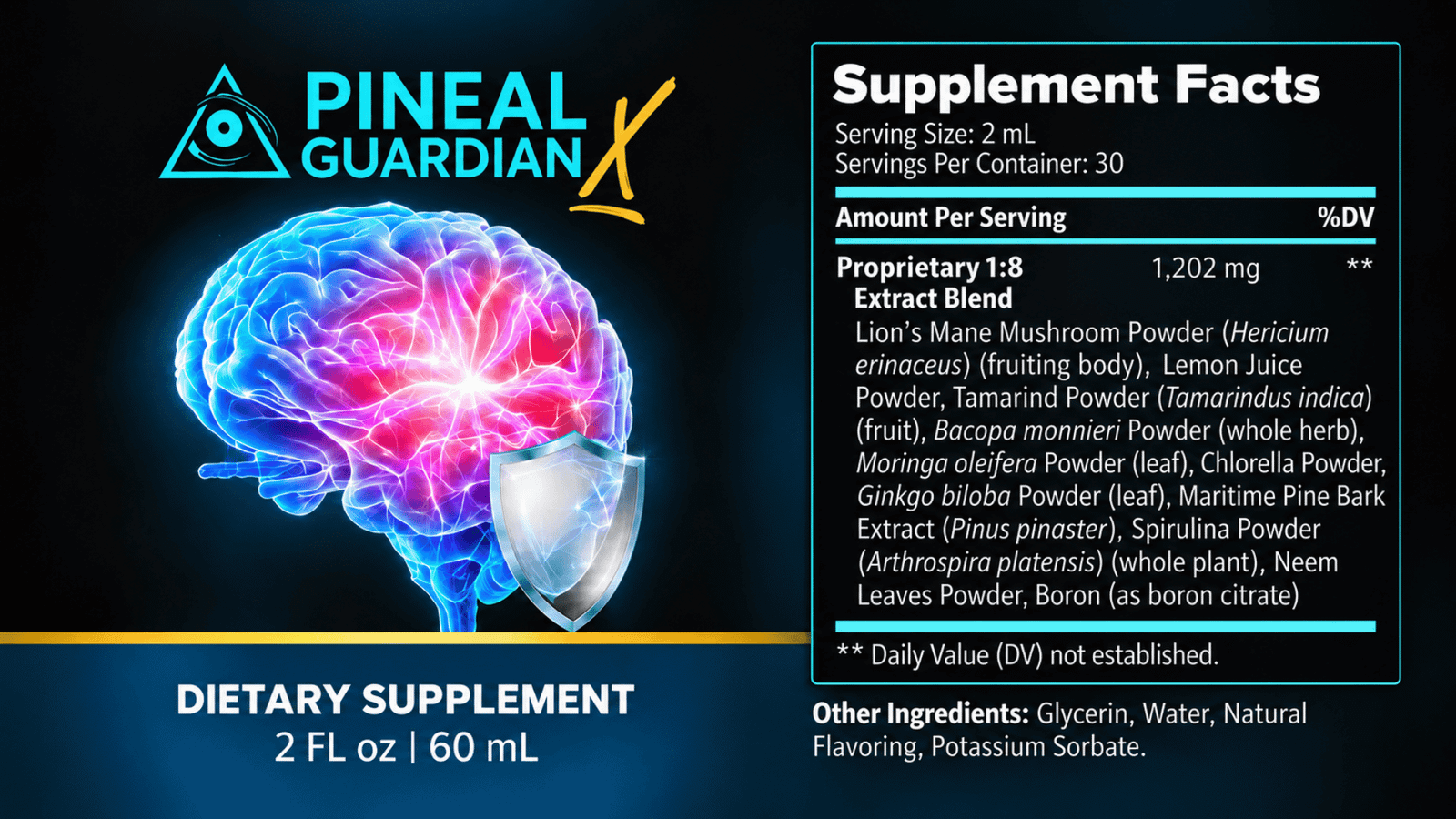
The supplied physical panel shows a 2 mL serving, 30 servings per bottle and one 1,202 mg proprietary blend containing eleven named components. Human cognition research is most relevant for Lion’s Mane and Bacopa, while Ginkgo, maritime pine bark, spirulina and boron have more preparation-, population- or endpoint-specific evidence. The label does not reveal any individual ingredient dose. Research confirms that fluoride can accumulate in aged human pineal tissue, but PRM identified no clinical evidence showing that Pineal Guardian X removes deposited fluoride, restores pineal function or reverses memory loss through that mechanism. No randomized clinical trial of the complete current Pineal Guardian X formula was identified in the evidence record reviewed for this dossier.
Pineal Guardian X Research: Quick Answers
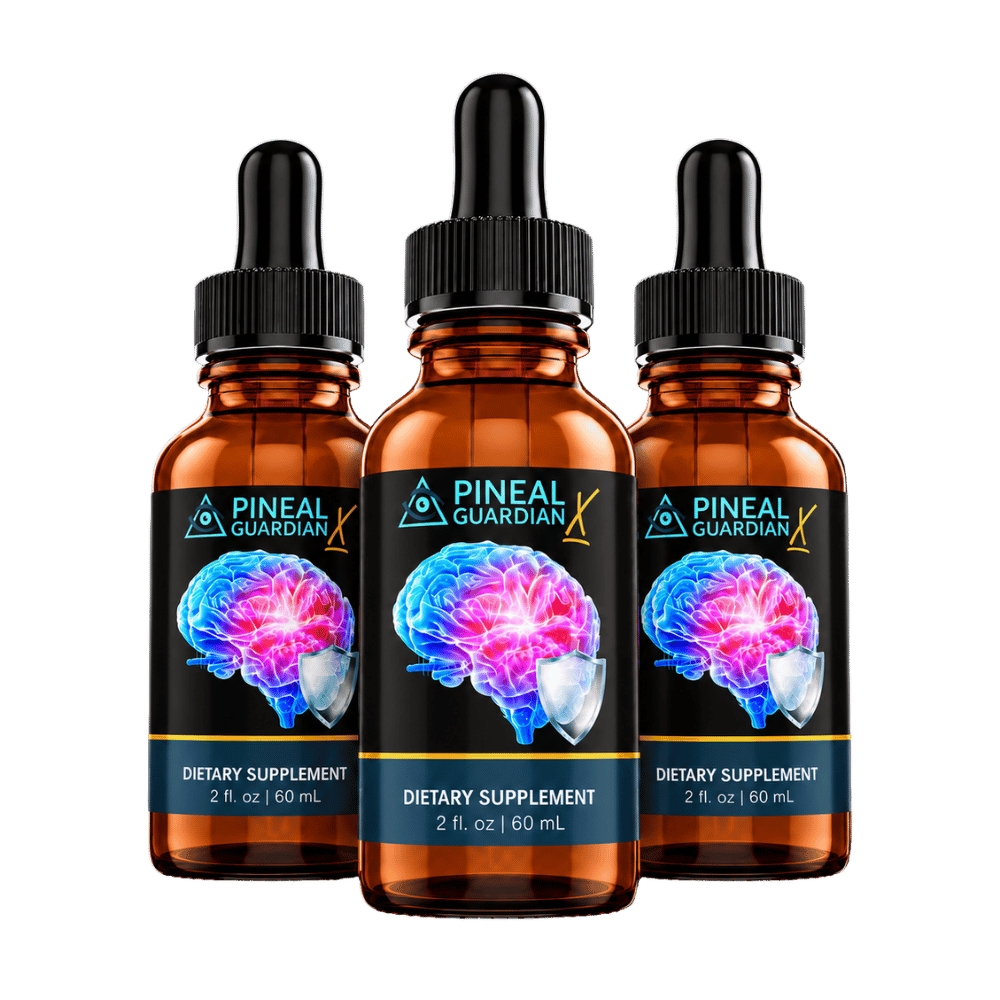
The supplied Supplement Facts panel lists a 2 mL serving and 30 servings in each 60 mL bottle.
Ingredient identity is visible, but the amount assigned to each component is not.
The one-bottle checkout added $9.99 shipping. The observed three- and six-bottle U.S. paths showed free shipping.
Human research exists for selected ingredients, but that is not the same as a clinical trial of the complete current liquid formula.
What Sources Did Pro Review Metric Verify?
The supplied physical Supplement Facts panel controls serving size, formula composition, botanical identity wording, blend weight and other ingredients. The current seller funnel, affiliate terms, product presentation and live U.S. ClickBank checkout checks were used to document seller positioning, package prices, shipping, bonuses, guarantee language and purchase structure. Independent research was used to test how far the ingredient and fluoride / pineal-gland claims can reasonably be carried. Seller-controlled commercial terms can change.
What Does the Pineal Guardian X Label Actually Disclose?
| Label item | Declared detail | What the label supports | Important boundary |
|---|---|---|---|
| Serving Size | 2 mL · 30 servings per container | One labeled serving and 30 labeled servings in a 60 mL bottle. | Serving size does not establish a memory, focus, fluoride-removal or melatonin outcome. |
| Proprietary 1:8 Extract Blend | 1,202 mg total | The combined amount for eleven named blend components. | No internal dose split is disclosed, so ingredient-by-ingredient clinical-dose matching is not possible. |
| Lion’s Mane Mushroom | Hericium erinaceus · fruiting body powder | Presence of Lion’s Mane fruiting-body powder in the blend. | Individual dose is unknown. Human cognition trials use defined Lion’s Mane preparations and exposures that cannot be assumed from this blend. |
| Lemon Juice Powder | Inside 1,202 mg blend | Presence as a named formula component. | The label does not establish a direct cognition, fluoride-detox or melatonin-restoration effect. |
| Tamarind | Tamarindus indica fruit powder | Presence and botanical identity. | PRM did not identify strong direct human cognition evidence that can be transferred cleanly to this undisclosed amount. |
| Bacopa Monnieri | Whole-herb powder | Presence of Bacopa monnieri in the proprietary blend. | Major human trials and reviews commonly use standardized Bacopa extracts at defined doses. This label specifies whole-herb powder and no individual amount. |
| Moringa Oleifera | Leaf powder | Presence and plant part. | Nutritional and preclinical research should not be converted into a demonstrated Pineal Guardian X memory effect. |
| Chlorella | Powder · inside 1,202 mg blend | Presence in the current formula. | The label does not establish removal of heavy metals or other toxins from human brain tissue. |
| Ginkgo Biloba | Leaf powder | Presence of Ginkgo biloba leaf material. | Ginkgo cognition research generally evaluates standardized extracts at known doses; this formula provides neither a standardized-extract claim nor an individual amount. |
| Maritime Pine Bark Extract | Pinus pinaster | Presence of a French maritime-pine-derived bark extract. | Much of the human literature uses the standardized branded Pycnogenol® preparation. Pineal Guardian X does not identify its ingredient as Pycnogenol® or disclose standardization or dose. |
| Spirulina | Arthrospira platensis · whole-plant powder | Presence of spirulina powder. | A relevant human cognition trial studied a 70% ethanol extract of Spirulina maxima, not this undisclosed amount of Arthrospira platensis powder. |
| Neem Leaves | Powder · inside 1,202 mg blend | Presence of neem leaf powder. | PRM did not identify robust direct human cognition evidence establishing memory restoration from this ingredient in the current formula. |
| Boron | As boron citrate | Presence of boron in a stated chemical form. | The amount is hidden. Older dietary-boron research does not establish a Pineal Guardian X-specific cognitive effect. |
| Other Ingredients | Glycerin, Water, Natural Flavoring, Potassium Sorbate | The listed non-active formulation ingredients. | These should not be counted as additional active components or efficacy evidence. |
How Transparent Is the Pineal Guardian X Formula?
Short answer: ingredient identity is reasonably transparent, but dosing transparency is low. The physical panel names eleven components and identifies several species and plant parts, yet all eleven share one 1,202 mg proprietary-blend amount. That prevents a reviewer or buyer from determining how much Lion’s Mane, Bacopa, Ginkgo, spirulina, maritime pine bark, boron or any other component is delivered in one serving.
The label gives useful identity information for the mushroom, herbs, algae and boron source.
No individual component amount is disclosed.
Standardized Bacopa, standardized Ginkgo, Pycnogenol® and extracted Spirulina interventions are not automatically equivalent to the forms printed here.
The formula contains recognizable research ingredients, but the hidden dose split prevents confident clinical matching.
Does Pineal Guardian X Work? What the Evidence Actually Supports
Short answer: Pineal Guardian X contains several ingredients with legitimate human cognition research, particularly Lion’s Mane and Bacopa. That gives the formula a real ingredient-level evidence layer. However, the complete product has not been shown in a randomized trial to improve memory or focus, and the undisclosed individual doses prevent clean comparison with the preparations and exposures used in published research. The seller’s broader fluoride-removal and melatonin-restoration mechanism requires a separate and substantially higher evidentiary leap.
| Seller positioning | Evidence status | PRM interpretation |
|---|---|---|
| Memory, focus and cognitive support | Meaningful ingredient-level human context exists | Lion’s Mane and Bacopa are the clearest human cognition anchors. The current product does not disclose their individual doses and has not itself been tested in a randomized trial. |
| “Flushes toxic fluoride” from the pineal gland | Human pineal fluoride deposition has been documented; supplement removal has not | A small post-mortem study detected fluoride in aged human pineal glands. That does not establish that Pineal Guardian X removes deposited fluoride or reverses calcification. |
| Restores natural melatonin production | Pineal calcification and melatonin biology are real research areas; product restoration is unproven | Post-mortem work has linked pineal calcium deposition, age and lower nighttime melatonin measures. It does not show that this product reverses that process or that fluoride is the controlling cause. |
| Reverses memory loss or early Alzheimer’s disease | Not established for Pineal Guardian X | Ingredient studies do not establish reversal of Alzheimer’s disease, and no randomized finished-product trial supporting this seller claim was identified. |
| Neurogenesis / neuroprotection narrative | Biological and ingredient-level evidence exists, but transfer varies widely | Several ingredients have neurobiological, antioxidant or cognition-related research. Mechanistic or isolated-ingredient findings should not be presented as proof that the complete 1,202 mg blend creates the same clinical outcome. |
Has the Current Pineal Guardian X Formula Been Clinically Tested?
Direct randomized clinical evidence for the current Pineal Guardian X formula: not identified in PRM’s targeted evidence searches.
Ingredient-level human evidence: yes, with the clearest cognition relevance from Lion’s Mane and Bacopa and more conditional evidence for Ginkgo, spirulina and maritime pine bark preparations.
Major transfer limitation: all eleven components share one 1,202 mg proprietary blend, and several of the most relevant human trials use standardized or otherwise different preparations.
Mechanism boundary: evidence that fluoride can accumulate in pineal tissue is not evidence that this oral blend removes fluoride, restores pineal melatonin production or reverses cognitive decline.
What Does Research Say About Pineal Guardian X’s Ingredients?
The evidence record below prioritizes randomized human trials, systematic reviews and current federal evidence summaries. Each result is carried only as far as the studied ingredient, preparation, dose, population and endpoint allow.
Lion’s Mane — one of the formula’s strongest human cognition anchors
Hericium erinaceus supplementation and human cognitive outcomes
Finding: the review identified human trials reporting cognitive and neuropsychological signals with Lion’s Mane preparations, while also showing that the clinical literature remains much smaller than the broader preclinical literature.
Boundary: the current Pineal Guardian X panel lists fruiting-body powder but no individual dose. Preparation, exposure and population differences prevent treating those trials as direct evidence for the finished liquid blend.
View PubMed recordYamabushitake in adults with mild cognitive impairment
Finding: a small randomized trial in adults aged 50–80 with mild cognitive impairment reported improved cognitive-scale scores during supplementation.
Boundary: that trial used approximately 3 g/day of Yamabushitake powder. One entire Pineal Guardian X serving contains only 1,202 mg of all eleven ingredients combined, so its per-serving Lion’s Mane exposure cannot match the 3 g Lion’s Mane exposure used in that trial.
View PubMed recordBacopa Monnieri — meaningful human cognition evidence, but preparation and dose matter
Bacopa and cognitive performance in adults
Finding: the review identified six 12-week randomized trials of Bacopa preparations in adults, with memory as the most consistently studied cognitive domain.
Boundary: Pineal Guardian X lists whole-herb Bacopa powder, not a standardized extract, and provides no individual Bacopa amount. Trial equivalence therefore cannot be established.
View PubMed recordBacopa and Ginkgo cognition trials in healthy adults
Finding: the analysis reported stronger working-memory and short-term-memory signals for higher-dose Bacopa interventions than for placebo and the Ginkgo nodes evaluated.
Boundary: the analysis grouped defined Bacopa exposures, including a high-dose category of at least 600 mg/day. Pineal Guardian X does not disclose its Bacopa dose or demonstrate equivalence to the studied extracts.
View PubMed recordGinkgo Biloba — familiar brain-health positioning, but healthy-adult cognition evidence is not consistently positive
Ginkgo did not show a measurable cognitive-enhancement effect in healthy participants
Finding: pooled randomized-trial results were close to zero for memory, executive function and attention in healthy participants.
Boundary: other Ginkgo research addresses different populations, including dementia or cognitive impairment. Those disease-population results should not be converted into a general Pineal Guardian X memory claim.
View PubMed recordGinkgo evidence remains condition- and preparation-dependent
Evidence context: NCCIH states that there is no conclusive evidence that Ginkgo is useful for any health condition, that evidence for dementia symptoms is inconsistent, and that it has not been shown to prevent or slow dementia progression.
Safety context: Ginkgo may increase bleeding risk with anticoagulants such as warfarin and may interact with other medicines.
View NCCIH guidanceSpirulina — a human memory trial exists, but the studied intervention does not match this label
Spirulina maxima extract in older adults with mild cognitive impairment
Finding: the study reported improvements in selected visual-learning, working-memory and vocabulary measures after a defined Spirulina intervention.
Boundary: the trial used a 70% ethanol extract of Spirulina maxima. Pineal Guardian X lists Arthrospira platensis whole-plant powder at an undisclosed amount. Species, preparation and dose therefore do not match.
View PubMed recordMaritime Pine Bark — human research exists, but much of it concerns standardized Pycnogenol®
Pycnogenol® French maritime pine bark research
Finding: the review summarizes randomized human studies of Pycnogenol® across cardiovascular, cognitive and several other outcome categories.
Boundary: Pineal Guardian X says only “Maritime Pine Bark Extract (Pinus pinaster).” It does not identify Pycnogenol®, standardization or an individual amount, so the branded-extract literature cannot be assumed to describe the current ingredient.
View PubMed recordPycnogenol® and cognition in healthy professionals
Finding: a small controlled study reported improvements in selected cognitive, attention and mental-performance measures.
Boundary: this was a specific standardized Pycnogenol® exposure combined with a health plan, not Pineal Guardian X and not an unspecified maritime-pine-bark dose.
View PubMed recordBoron — older human nutrition research suggests a brain-function role, but product transfer is weak
Dietary boron and cognitive performance
Finding: controlled dietary manipulation studies in older adults reported poorer performance on several cognitive and psychomotor tasks during low-boron intake compared with higher intake.
Boundary: these were dietary-boron experiments, not a clinical trial of boron citrate inside a multi-ingredient liquid supplement. Pineal Guardian X also does not disclose the boron amount.
View PubMed recordMoringa, chlorella, tamarind, neem and lemon juice powder — formula components without a strong direct cognition bridge
Presence on the label does not automatically create a human memory or “brain detox” outcome
Finding: these ingredients have nutritional, traditional-use, antioxidant, mechanistic or preclinical research in various contexts.
Boundary: PRM’s targeted searches did not identify robust direct human cognition evidence that can cleanly validate the seller’s memory-restoration, neurodegeneration-prevention or fluoride-detox claims for these undisclosed amounts inside Pineal Guardian X.
What Are the Biggest Evidence Gaps?
- No finished-product randomized trial was identified. Pineal Guardian X is supported by ingredient-level and mechanism-level research rather than direct clinical proof of the complete current formula.
- All eleven components share one 1,202 mg amount. Without individual doses, Lion’s Mane, Bacopa, Ginkgo, spirulina, maritime pine bark and boron cannot be matched reliably to published clinical exposures.
- Several relevant studies use different preparations. Standardized Bacopa extracts, standardized Ginkgo extracts, branded Pycnogenol® and extracted Spirulina interventions are not equivalent by default to the powders and unnamed extract on this label.
- Fluoride accumulation is not a demonstrated detox pathway. Detecting fluoride in aged pineal tissue does not establish that a dietary supplement can remove it.
- Pineal calcification research does not establish the seller’s full causal chain. Age, calcium deposition and melatonin biology can be studied without proving that consumer fluoride exposure causes memory decline that this product reverses.
- Ingredient evidence should not be relabeled as Alzheimer’s-disease treatment evidence. Lion’s Mane, Bacopa and Ginkgo studies cannot establish that this finished blend reverses Alzheimer’s disease or early dementia.
- Several seller ingredient claims are broader than the direct human evidence. Claims involving toxin removal, neurogenesis and prevention of neurodegenerative damage often extend beyond the clinical evidence for the actual labeled preparation.
- PRM did not independently verify manufacturing, raw-material identity, batch potency, purity or a certificate of analysis.
Does the Pineal Guardian X “Fluoride Detox” Story Match Current Science?
Short answer: part of the biological background is real, but the commercial conclusion goes much further than the evidence. Fluoride has been measured in aged human pineal tissue, and human post-mortem research has examined links among age, pineal calcification and melatonin. Those findings do not demonstrate that Pineal Guardian X removes fluoride from the pineal gland, reverses calcification, restores melatonin production or improves adult memory through that pathway.
Fluoride was measured in aged human pineal glands
Finding: the study found fluoride in pineal tissue and reported a positive correlation between pineal fluoride and calcium concentration.
Boundary: the study did not test Pineal Guardian X, any dietary supplement, fluoride removal, melatonin restoration or memory improvement. It establishes deposition, not a clinically validated detox treatment.
View PubMed recordPineal calcium, age and melatonin biosynthesis
Finding: pineal calcium deposits increased with age, and nighttime calcium levels in the analyzed fraction were negatively correlated with melatonin content.
Boundary: this study evaluated calcium and melatonin, not fluoride-removal treatment. It does not establish that fluoride is the cause of age-related pineal calcification or that Pineal Guardian X can reverse it.
View PubMed recordFluoride and cognition require exposure- and population-specific interpretation
Finding: the NTP concluded with moderate confidence that higher fluoride exposure, such as levels above 1.5 mg/L, is associated with lower IQ in children.
Boundary: the NTP states that there were insufficient data to determine whether the 0.7 mg/L level recommended for U.S. community water affects children’s IQ and reports no evidence of adverse effects of fluoride exposure on adult cognition in its reviewed evidence. This does not validate an adult memory-loss pathway corrected by Pineal Guardian X.
View NTP evidence summaryHow Much Does Pineal Guardian X Cost?
30 labeled servings. The observed U.S. ClickBank checkout added $9.99 shipping and showed $0.00 tax.
Approximately 90 labeled servings. The public offer page displayed a $9.99 shipping charge, while the U.S. ClickBank checkout observed by PRM showed free shipping. Verify the live order summary.
Approximately 180 labeled servings. The observed U.S. checkout showed free shipping. The seller currently lists four digital bonuses and Free ShipSelect™ with this package.
The current checkout observed by PRM states “One-Time Fee, No Autoship.” The seller currently advertises a 365-day money-back window. Commercial terms can change.
Controlling commercial record: PRM uses the live buyer checkout as the controlling record for the totals and shipping actually observed on September 26, 2026. The public seller page currently shows a shipping discrepancy on the 3-bottle package, so the buyer should confirm the live final summary before payment.
Where Do the Pineal Guardian X Product and Offer Facts Come From?
Pineal Guardian X Supplement Facts panel
Supports: 2 mL serving, 30 servings per container, 1,202 mg proprietary blend, eleven named blend components and the current other-ingredient list.
Does not prove: clinical effectiveness, finished-product safety, raw-material identity, individual ingredient potency or seller mechanism claims.
Current Pineal Guardian X seller funnel
Supports: current fluoride / pineal / melatonin positioning, ingredient marketing narratives, package ladder, bonus presentation, seller-advertised 365-day guarantee and current public shipping language.
Does not prove: that Pineal Guardian X removes fluoride, restores pineal function, reverses memory loss or produces the seller’s neurological outcomes in a controlled clinical trial.
View the seller pageCurrent Pineal Guardian X affiliate terms
Supports: current restrictions against Meta traffic, branded PPC, direct linking to the order form, “scam” / “fraud” terminology and promotional language considered non-compliant under FTC / FDA requirements.
Operational note: PRM’s organic editorial path uses a managed seller-facing affiliate route rather than a direct order-form link.
Record discrepancy: the affiliate page also contains generic “rebills” language for affiliate earnings, while the current front-end buyer checkout observed by PRM states “One-Time Fee, No Autoship.” PRM uses the live transaction path as the controlling buyer-facing record.
View the affiliate termsCurrent U.S. ClickBank checkout record
Supports: observed U.S. totals, current shipping presentation, “One-Time Fee, No Autoship” wording and optional add-ons shown separately from the base product.
Does not prove: product effectiveness or that price, shipping, tax, bonuses and checkout terms will remain unchanged.
Open the current offerHow Strong Is Pineal Guardian X’s Seller Evidence?
Seller materials are useful for documenting what Pineal Guardian X claims and how it is sold, but the strongest commercial mechanism claims go materially beyond the independent evidence record. The central gaps are finished-product testing, individual-dose visibility and the jump from pineal fluoride deposition to a clinically demonstrated oral “detox” and memory-restoration effect.
The current evidence base is ingredient-level and mechanism-level rather than direct finished-product clinical proof.
A small human cadaver study supports the presence of fluoride in aged pineal tissue, not the claim that this blend flushes it out.
Calcification and melatonin have a legitimate research relationship, but Pineal Guardian X has not been shown to reverse pineal calcification or restore melatonin production.
The hidden internal dose split is the main barrier to translating the strongest ingredient research to the finished formula.
Is Pineal Guardian X Safe?
Short answer: Pineal Guardian X should not be described as universally safe. It combines multiple botanicals, mushroom material, algae and boron inside a proprietary blend without individual dose disclosure. The seller’s current disclaimer advises medical review during pregnancy or nursing, when taking medication or when managing a medical condition. Ginkgo creates a particularly relevant medication-interaction consideration, while Bacopa and Lion’s Mane also have preparation-specific tolerability and interaction considerations.
The current seller disclaimer advises consulting a physician during pregnancy or nursing, when using medication or when a medical condition is present.
NCCIH notes that Ginkgo may increase bleeding risk with anticoagulants such as warfarin and may interact with other drugs.
Bacopa is generally well tolerated in research, but gastrointestinal effects and medication / condition interactions have been reported. The Pineal Guardian X dose is unknown.
Ingredient safety information does not establish a complete safety profile for this eleven-component proprietary blend.
NCCIH — Ginkgo
Supports: interaction, bleeding-risk and pregnancy-safety context relevant to a formula that contains Ginkgo.
Boundary: this is ingredient-level guidance, not a complete Pineal Guardian X safety assessment.
View NCCIH guidanceHuman Lion’s Mane literature reports generally limited adverse effects
Supports: available human research and reported tolerability context, including occasional stomach discomfort, headache or allergic reactions.
Boundary: safety of an isolated Lion’s Mane intervention is not the same as safety of the full eleven-component Pineal Guardian X blend.
View PubMed recordHow This Dossier Was Prepared
The Pro Review Metric Editorial Team used the supplied Pineal Guardian X Supplement Facts panel as the controlling formula source, then compared it with the current seller funnel, affiliate terms, package presentation and live U.S. ClickBank checkout evidence. Independent evidence was prioritized toward PubMed-indexed randomized trials and systematic reviews, National Toxicology Program fluoride evidence and NCCIH safety guidance.
Seller claims remain seller claims. Ingredient research was not presented as proof of the finished formula. Dose, preparation, botanical species, plant part, extract standardization, population, disease context and endpoint differences were treated as evidence-transfer limits.
Pro Review Metric did not conduct a firsthand Pineal Guardian X product-use trial, laboratory assay, manufacturing audit, independent batch test, raw-material authentication, fluoride-removal experiment, melatonin assay or certificate-of-analysis verification.
Last updated: September 28, 2026. This dossier is reviewed when product details, pricing, labeling, seller claims, affiliate requirements or material evidence changes.