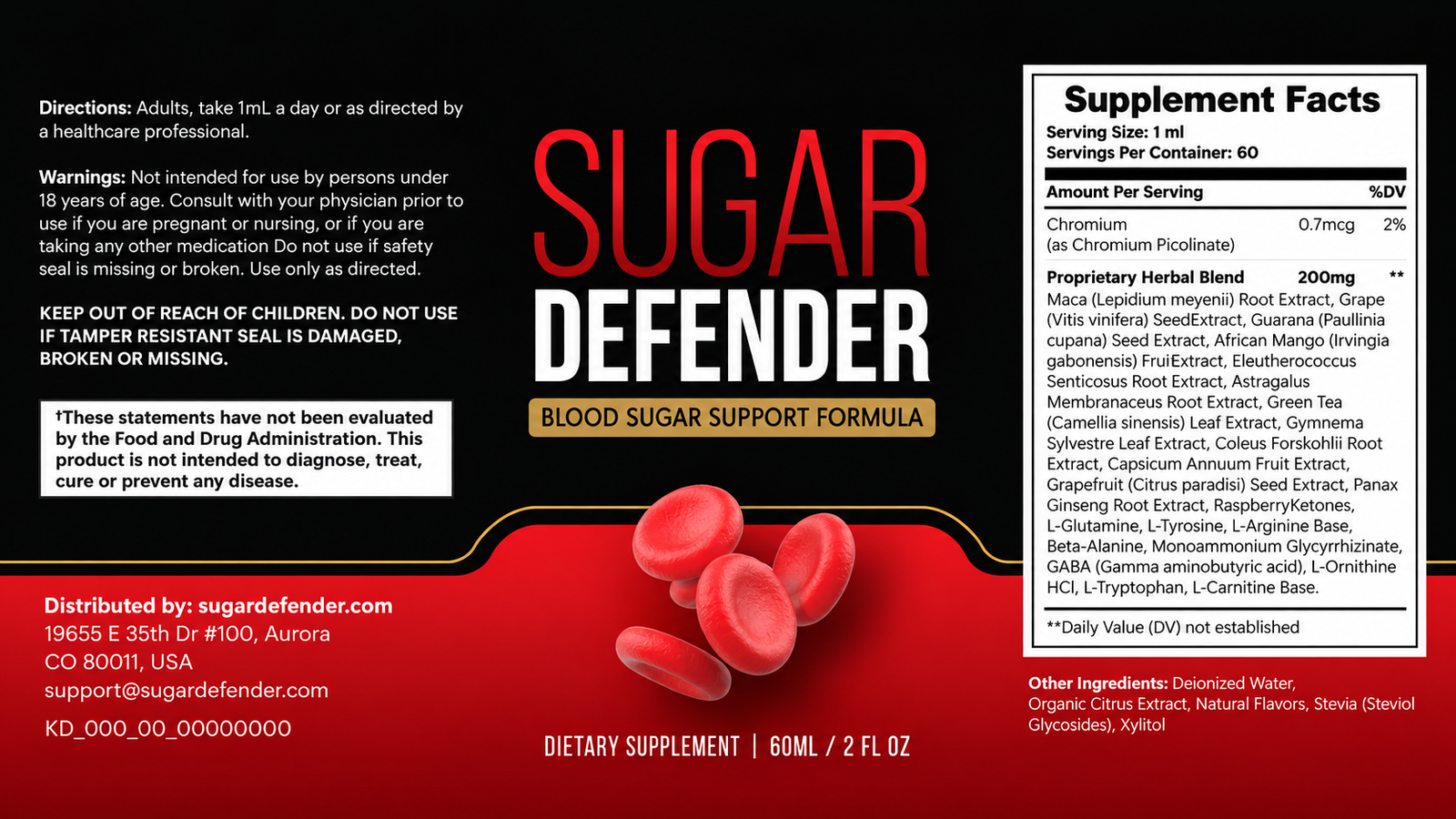
The current Supplement Facts panel lists a 1 mL serving, 0.7 mcg of chromium and a 200 mg proprietary blend containing 22 additional components. Human research gives ingredients such as Gymnema sylvestre and Panax ginseng genuine metabolic relevance, while African mango and Coleus have more limited weight-management evidence. The central evidence boundary is dose: most active ingredients have no individual amount disclosed, and we did not identify a peer-reviewed human clinical trial of the complete Sugar Defender formula.
Sugar Defender Research: Quick Answers
The supplied current label lists a 1 mL serving and 60 labeled servings per 60 mL bottle.
Chromium is individually quantified. Twenty-two other components share one 200 mg proprietary blend.
The research record located for this dossier is ingredient-level rather than a clinical trial of the commercial Sugar Defender formula.
Both have human glucose-related research, but the product does not disclose their individual doses.
What Sources Did Pro Review Metric Verify?
The supplied current Supplement Facts panel controls composition, serving size and label directions. Current seller pages document positioning and promotional claims. The current public offer page and the U.S. ClickBank checkout evidence document commercial terms. Affiliate materials document promotional restrictions. PubMed-indexed studies, NIH and NCCIH sources were used for independent evidence and safety context.
What Does the Sugar Defender Label Actually Disclose?
Short answer: the label clearly identifies the full set of named dietary ingredients, but it provides an individual amount for chromium only. The other 22 active components share a single 200 mg total.
| Label item | Declared detail | What the label supports | Evidence boundary |
|---|---|---|---|
| Serving size | 1 mL | A once-daily 1 mL labeled serving with 60 servings per container. | Seller FAQ language currently uses “two full droppers,” which is not the same unit. PRM does not convert that wording into a dose. |
| Chromium | 0.7 mcg · 2% DV · chromium picolinate | Presence, chemical form and amount of chromium. | Much of the chromium clinical literature uses tens to hundreds of micrograms per day, substantially above the labeled 0.7 mcg amount. |
| Proprietary Herbal Blend | 200 mg total | Presence of 22 named botanical, amino-acid and supporting components. | The label does not reveal how the 200 mg total is divided among the individual components. |
| Botanical components | Maca, grape seed, guarana, African mango, eleuthero, astragalus, green tea, Gymnema, Coleus, capsicum, grapefruit seed and Panax ginseng | A broad multi-botanical formula with metabolic-, energy- and weight-related research directions. | Species, extract standardization and individual dose are not fully characterized for study matching. |
| Additional blend components | Raspberry ketones, L-glutamine, L-tyrosine, L-arginine, beta-alanine, monoammonium glycyrrhizinate, GABA, L-ornithine, L-tryptophan and L-carnitine | Presence as part of the 200 mg combined blend. | No individual contribution is disclosed, limiting meaningful dose-specific inference. |
| Other ingredients | Deionized water, organic citrus extract, natural flavors, stevia and xylitol | The non-active formulation base disclosed on the supplied panel. | These lines do not establish the effectiveness of the active formula. |
How Transparent Is the Sugar Defender Formula?
Ingredient identity is relatively transparent; dose transparency is not. The current panel names chromium and every component of the proprietary blend, but the 22 blend ingredients share only one combined amount. This allows ingredient identification while preventing study-matched dose comparisons.
The key formula number is 200 mg
Sugar Defender does not contain 200 mg of each blend ingredient. The entire set of 22 blend components shares that 200 mg total. Any study using hundreds of milligrams of a single isolated ingredient therefore cannot be assumed to represent the exposure delivered by this finished formula.
Does Sugar Defender Work?
There is credible ingredient-level research, but that is not the same as finished-product proof. Gymnema has the clearest glucose-oriented human evidence among the featured botanicals. Panax ginseng has relevant but preparation- and timing-dependent data. Chromium research is mixed and generally uses doses far above the 0.7 mcg listed on Sugar Defender. African mango and Coleus add weight-management research, but with important quality and dose-transfer limits.
The dossier found ingredient studies and seller-cited literature, not a peer-reviewed randomized trial of the current complete product.
Randomized trials and meta-analyses report potentially relevant glycemic effects, although dose and preparation matter.
Human studies report glucose effects in some settings, while systematic reviews remain cautious.
Sugar Defender lists 0.7 mcg. Clinical literature commonly studies much higher supplemental exposure.
Has the Finished Sugar Defender Formula Been Clinically Tested?
Not in a peer-reviewed human trial that Pro Review Metric could identify in the current search. Searches using the product name did not locate an independent randomized clinical trial evaluating the complete commercial formulation.
Finished-product evidence status: not identified
This does not mean every ingredient lacks evidence. It means that evidence from an isolated ingredient, a standardized extract or a different dose cannot be automatically upgraded into clinical proof of Sugar Defender as sold.
- No verified clinical trial of the current 1 mL Sugar Defender serving was identified.
- No study identified by PRM tested the complete 22-component 200 mg proprietary blend.
- No independent assay or certificate of analysis was reviewed to verify batch-level potency.
- Ingredient studies remain useful for plausibility and context when their preparation and dose are kept explicit.
What Does Human Research Say About Sugar Defender’s Blood-Sugar Ingredients?
The strongest human research signals come from Gymnema, Panax ginseng and chromium. Each source below answers a narrower question than “does Sugar Defender work,” because the studied preparation and exposure are not the same as the finished proprietary blend.
600 mg/day Gymnema improved several glycemic markers in impaired glucose tolerance
Finding: the randomized double-blind trial reported reductions in 2-hour oral-glucose-tolerance glucose, HbA1c, body weight, BMI and LDL cholesterol, with improved insulin-sensitivity index in the Gymnema group.
What transfers: Gymnema sylvestre has plausible human relevance to glucose-related outcomes.
What does not transfer: Sugar Defender does not disclose how many milligrams of Gymnema are present. Its entire 22-component blend totals 200 mg, so the trial’s 600 mg/day Gymnema exposure cannot be assumed for this product.
View PubMed recordMeta-analysis found glycemic signals, with substantial heterogeneity
Finding: the review reported improvements in fasting glucose, postprandial glucose, HbA1c and several lipid markers.
Important limitation: heterogeneity was very high across key outcomes, reflecting variation in study design, population, preparation and exposure.
Transfer to Sugar Defender: useful as support for Gymnema’s research relevance, not as evidence that an undisclosed portion of a 200 mg multi-ingredient blend reproduces the pooled results.
View PubMed recordA recent human trial found timing-dependent post-meal glucose effects
Finding: when the ginseng preparation was taken 90 minutes before a standardized breakfast, postprandial glucose incremental area under the curve was 29% lower than placebo. No glucose effect was observed when the preparation was taken immediately before the meal.
What transfers: Panax ginseng has current human evidence relevant to postprandial glucose regulation.
What does not transfer: Sugar Defender does not disclose the amount of Panax ginseng, its ginsenoside standardization, or an equivalent study-timed exposure.
View PubMed recordChromium evidence is mixed — and Sugar Defender’s labeled amount is unusually small
Finding: published reviews include trials reporting improvements in some glycemic markers, but results across the chromium literature remain inconsistent. NIH notes that studies in diabetes have produced mixed results and that clear benefit has not been established.
A 2024 systematic review described randomized-trial doses ranging from approximately 50 to 1,000 mcg/day. Earlier meta-analytic work has also commonly evaluated exposures above 200 mcg/day.
Transfer boundary: Sugar Defender lists only 0.7 mcg. Research using hundreds of micrograms per day cannot be used to imply a comparable chromium effect from the labeled Sugar Defender amount.
View NIH Chromium Fact SheetView 2024 systematic review
What Does the Research Say About Sugar Defender’s Weight and Metabolism Ingredients?
African mango and Coleus are the two featured ingredients most directly connected to the seller’s weight- and fat-burning language. Both have human research, but neither provides strong finished-product evidence for Sugar Defender.
Irvingia gabonensis trials show a signal, but study quality is a major limitation
Finding: the pooled analysis reported reductions in body weight, body fat and waist circumference.
Quality boundary: four of the five included trials were rated at high risk of bias, and the single low-risk-of-bias trial did not show significant weight-related differences.
Transfer to Sugar Defender: African mango has human weight-management research, but the product does not disclose the amount, preparation or standardization of its African mango extract.
View PubMed recordA 12-week trial used 500 mg/day of Coleus extract with a hypocaloric diet
Finding: the study reported favorable changes in insulin concentration and insulin resistance in the Coleus group, while reductions in waist and hip circumference occurred in both intervention and placebo groups. All participants were also advised to follow a hypocaloric diet.
Transfer boundary: the studied Coleus exposure alone was 500 mg/day. Sugar Defender’s complete 22-component blend totals only 200 mg, with the Coleus share undisclosed.
View PubMed recordWhat Are the Main Sugar Defender Evidence Gaps?
Ingredient evidence cannot establish the effect of the complete commercial blend.
This is the main obstacle to comparing Sugar Defender with ingredient-specific clinical studies.
Seller copy currently says “24 proven ingredients.” The supplied label directly accounts for chromium plus 22 blend components.
The physical label states 1 mL daily. Current seller FAQ language says “two full droppers.” Dropper volume is not established by that wording.
How Do Sugar Defender’s Main Seller Claims Compare With the Evidence?
Seller claims are documented here as claims, then compared with the independent evidence record. Ingredient relevance is not treated as proof of the complete commercial product.
| Seller claim | Current seller positioning | Independent evidence context | PRM assessment |
|---|---|---|---|
| Blood-sugar support | Seller materials describe Sugar Defender as supporting healthy blood sugar and blood-glucose control. | Gymnema and Panax ginseng have relevant human evidence. Chromium has a mixed evidence base. Individual Sugar Defender blend doses are not disclosed. | Ingredient-level rationale exists. Finished-product clinical effectiveness has not been established by a trial identified in this review. |
| Fat burning / natural weight loss | Seller pages connect African mango and Coleus with fat-burning and weight-related benefits and promote natural weight loss. | African mango trials are limited by risk of bias. Coleus trials use specific extracts and exposures much larger than the total Sugar Defender blend. | Research relevance is limited and preparation-specific. The evidence does not establish a Sugar Defender weight-loss effect. |
| Energy and metabolism | Ginseng, guarana, maca and eleuthero are marketed around energy, fatigue and metabolism. | These ingredients have varying research bases. Guarana and green tea can contribute caffeine, but total caffeine exposure is not disclosed. | Plausible ingredient-level rationale. Exact finished-product exposure and effect magnitude remain unresolved. |
| “24 proven ingredients” | The current main seller page uses a 24-ingredient headline. | The controlling supplied Supplement Facts panel directly identifies chromium plus 22 proprietary-blend components. | The current label does not directly reproduce the seller’s 24-ingredient count. PRM therefore does not present 24 as a verified label fact. |
How Much Does Sugar Defender Cost?
Commercial terms are mutable. PRM compared the current public seller presentation with the U.S. ClickBank checkout observed through the PRM affiliate path on October 7, 2026. A pricing discrepancy currently exists on the 2-bottle offer.
The public offer page checked October 7 currently displays $69 per bottle. The PRM ClickBank checkout observed earlier the same day showed a $158 product subtotal, $9.95 shipping and a $167.95 total. Confirm the live final order summary.
$69 per bottle. Current public seller materials and the PRM-observed U.S. checkout both show $207 with free U.S. shipping. Two digital ebooks are currently advertised.
$49 per bottle. Current seller materials and the PRM-observed U.S. checkout show free U.S. shipping. Two digital ebooks are currently advertised.
Current seller materials state that there are no future payments. PRM did not observe an autoship in the pre-purchase ClickBank checkout.
Why the 2-bottle numbers differ
The current public seller page is displaying a lower 2-bottle promotional subtotal than the ClickBank checkout captured through the PRM path earlier on October 7. PRM does not silently reconcile seller-page variants with transaction evidence. The live checkout shown to the buyer should control the final purchase decision.
Where Do the Sugar Defender Product and Offer Facts Come From?
Current Sugar Defender Supplement Facts panel
Supports: 1 mL serving, 60 servings per container, 0.7 mcg chromium, 200 mg proprietary blend, 22 named blend components, other ingredients and current label directions.
Does not prove: finished-product effectiveness, individual blend doses, extract standardization, clinical outcome magnitude or independent batch potency.
Sugar Defender official seller materials
Supports: current blood-sugar, energy, metabolism and weight-related seller positioning; featured-ingredient marketing; guarantee language; package framing; and seller directions.
Does not prove: that the finished formula produces the seller’s advertised physiological outcomes.
View the seller sitePublic seller offer + U.S. ClickBank checkout observation
Supports: the current 2-, 3- and 6-bottle structure, observed package totals, shipping presentation, digital bonuses, one-time purchase structure and current 60-day guarantee language.
Current discrepancy: the public seller page displays a $138 2-bottle subtotal plus shipping, while the PRM-route ClickBank checkout observed a $158 subtotal plus $9.95 shipping. Commercial terms should be confirmed live.
Open the current Sugar Defender offerCurrent Sugar Defender affiliate terms
Supports: the requirement not to bypass the seller website, restrictions on misleading pricing, restrictions on representing an affiliate as the seller, and current FTC / advertising-compliance requirements.
PRM therefore uses the managed Sugar Defender affiliate route rather than exposing a direct checkout link.
View affiliate termsCurrent return and shipping policy record
Supports: a 60-day return procedure, return authorization requirements, buyer-paid return shipping and current instructions for returning product.
The current shipping policy also states that bottles associated with the order must be returned for a full refund. Buyers should review the live policy before initiating a return.
View return policyView shipping policy
How Strong Is Sugar Defender’s Seller Evidence?
The seller does provide a list of scientific references, and several ingredients genuinely have human research behind them. The main limitation is not the absence of all science. It is the gap between ingredient studies and the specific doses, combination and outcomes of the commercial Sugar Defender formula.
The current evidence record is ingredient-level rather than direct finished-product clinical proof.
Gymnema and Panax ginseng provide the clearest glucose-oriented human research anchors.
Individual ingredient amounts cannot be matched to trial exposures when 22 components share 200 mg.
Sugar Defender lists 0.7 mcg, while clinical chromium research commonly evaluates tens to hundreds of micrograms per day.
Is Sugar Defender Safe?
There is not enough finished-product evidence to describe Sugar Defender as universally safe for every user. The formula contains multiple botanicals, glucose-relevant ingredients and ingredients that can contribute stimulant exposure. The current label advises medical review when pregnancy, nursing or medication use applies.
NIH notes that chromium supplements can interact with insulin and other diabetes medications. The clinical significance of Sugar Defender’s very small 0.7 mcg chromium amount is not established by that general guidance.
NCCIH notes that Asian ginseng may lower blood sugar in some people and can interact with medications.
Guarana and green tea are present, but the label does not disclose their individual amounts or total caffeine exposure.
Ingredient safety information cannot establish the complete safety profile of the full proprietary blend.
Chromium: evidence and medication-interaction context
Supports: current federal evidence context for chromium, including mixed findings on glycemic control and potential interactions with insulin, diabetes medications and levothyroxine.
Boundary: general chromium interaction guidance does not quantify the risk from Sugar Defender’s labeled 0.7 mcg amount.
View NIH guidanceAsian ginseng: usefulness, side effects and interactions
Supports: evidence that ginseng may affect blood sugar, that insomnia is a commonly reported side effect, and that medication interactions should be considered.
Boundary: this is ingredient-level guidance and does not establish a complete Sugar Defender safety profile.
View NCCIH guidanceHow Was This Sugar Defender Research Dossier Prepared?
The Pro Review Metric Editorial Team used the supplied current Sugar Defender Supplement Facts panel as the controlling composition record. Seller pages were used only to document seller-controlled claims, package framing and promotional language. Current U.S. ClickBank checkout evidence was used for transaction details.
Independent research was prioritized toward PubMed-indexed randomized trials, systematic reviews and meta-analyses, along with NIH and NCCIH guidance for evidence and safety context.
Ingredient evidence was not converted into proof of the finished formula. Preparation, dose, standardization, population, intervention duration, study endpoint and timing were treated as evidence-transfer boundaries.
Pro Review Metric did not conduct a firsthand Sugar Defender use trial, laboratory assay, manufacturing audit, independent batch test, raw-material authentication, caffeine assay or certificate-of-analysis verification.
Last updated: October 7, 2026. This dossier should be reviewed when labeling, seller claims, pricing, package structure, return terms or material independent evidence changes.