Disclosure: We may earn a commission if you purchase through links on this page, at no additional cost to you. Our editorial conclusions are developed independently.
Inside the NeuroVera formula
What ingredients are in NeuroVera?
NeuroVera contains six labeled active ingredients per two-capsule serving: Lion’s Mane (500 mg), Schisandra (250 mg), Gotu Kola (200 mg), Bacopa monnieri (100 mg), Shilajit (75 mg), and a DHA 10% line listed at 25 mg. Each amount is disclosed separately, with Lion’s Mane leading the formula by labeled weight.
That is a useful starting point. Instead of guessing how a proprietary blend is divided, you can see where NeuroVera places its emphasis.
But if you’re considering spending money on a brain-support supplement, the ingredient names alone probably aren’t enough.
You want to know what you’re getting, why those ingredients were chosen, and whether the amounts in the capsules make sense when compared with the research.
That’s where NeuroVera becomes more interesting to examine. Its disclosure makes a meaningful comparison possible—even when the findings raise questions worth understanding before buying.
Amounts come from the physical Supplement Facts panel documented in the PRM NeuroVera Review and Research Dossier . All values are per two-capsule serving.
Start with what the label confirms
NeuroVera Supplement Facts: all six active doses explained
NeuroVera’s formula has a clear hierarchy. Lion’s Mane leads by weight, followed by Schisandra, Gotu Kola, Bacopa, Shilajit and the DHA label line. Here’s exactly what the reviewed panel discloses.
| Active ingredient | Amount | Label detail |
|---|---|---|
| Lion’s Mane | 500 mg | Hericium erinaceus fruiting-body powder. |
| Schisandra | 250 mg | Fruit extract, 10:1 ratio. |
| Gotu Kola | 200 mg | Centella asiatica whole-herb powder. |
| Bacopa monnieri | 100 mg | Whole-herb extract; no bacoside standardization stated on the reviewed panel. |
| Shilajit | 75 mg | Gum/resin extract standardized to 40% fulvic acid. |
| DHA 10% | 25 mg | DHA (Docosahexaenoic Acid) 10% as printed; pure-DHA amount not independently established. |
Serving size: two capsules. Servings per container: 30. Other ingredients listed separately: HPMC (vegetable capsule), magnesium stearate, olive oil and silicon dioxide.
This level of disclosure matters because ingredient amounts can change how you interpret an otherwise convincing supplement description.
For example, a formula may contain a familiar ingredient without providing the same preparation or dose used in clinical research.
Knowing the amount lets you make that distinction before you buy.
The comparison that matters most
Do NeuroVera’s ingredient doses match those used in human studies?
Some of NeuroVera’s ingredients have been studied in humans. That’s more useful than a formula story built entirely around tradition or speculation.
But the comparison becomes less straightforward once you examine the amounts.
Lion’s Mane and Bacopa, the formula’s clearest cognition-relevant research ingredients, illustrate why.
Lion’s Mane / dose comparison
500 mg on the label versus about 3,000 mg in a human trial
NeuroVera provides 500 mg of Lion’s Mane fruiting-body powder.
One small randomized study used approximately 3,000 mg daily of a Hericium preparation for 16 weeks.
That’s about six times the weight listed in a NeuroVera serving.
Buyer insight: The ingredient is research-relevant, but the trial did not test NeuroVera’s serving.
Bacopa / dose comparison
100 mg on the label versus 300 mg in major studies
NeuroVera provides 100 mg of Bacopa extract.
Major human studies examined characterized extracts at 300 mg daily.
That’s three times the listed weight, with extract composition creating another important difference.
Buyer insight: The ingredient is familiar in cognition research, but the studied preparations cannot be treated as equivalent.
Milligrams alone do not establish whether one preparation is better than another. Form, standardization, study duration and population also influence how research can be interpreted.
Still, the comparison gives you a practical choice: do you prefer a broader disclosed formula, or are you specifically looking for a single ingredient closely matched to a studied intervention?
Human-study references: Mori et al., Lion’s Mane · Saitsu et al., Lion’s Mane · Calabrese et al., Bacopa .
The formula’s main anchor
Lion’s Mane 500 mg: what makes this NeuroVera ingredient worth examining?
Lion’s Mane is the most prominent active ingredient in NeuroVera by labeled weight.
Its 500 mg amount and fruiting-body powder form are stated directly, so you aren’t left guessing which part of the mushroom the label identifies.
That is a practical transparency advantage.
Lion’s Mane also has a stronger cognition-related human research history than several of the formula’s supporting ingredients.
In a small placebo-controlled study, Mori and colleagues examined a Hericium preparation in 30 older adults with mild cognitive impairment.
The supplemented group performed better than placebo on the study’s cognitive scale at several assessment points.
Another 12-week study reported a positive between-group result on the Mini-Mental State Examination, though not across every cognitive measure.
Both studies used approximately 3–3.2 g daily rather than NeuroVera’s 500 mg.
So why does Lion’s Mane matter in this formula? Because it gives NeuroVera a clearly identifiable research-relevant centerpiece.
The important distinction is that you are considering a multi-ingredient product containing Lion’s Mane, not purchasing the exact preparation tested in those studies.
If Lion’s Mane is your primary reason for shopping, you can use that information to decide whether this combination matches what you had in mind.
A second ingredient with human research
Bacopa monnieri 100 mg: why the type of extract matters
Bacopa gives NeuroVera another recognizable ingredient with a history of cognition-related research.
But two Bacopa extracts can differ in their composition, even when the plant name matches.
NeuroVera lists 100 mg of extract without specifying a bacoside percentage on the reviewed panel.
Several important human trials used characterized Bacopa extracts at 300 mg per day.
Some trials reported improvements in selected cognitive outcomes. The evidence is not uniformly positive.
A 2025 placebo-controlled trial in adults aged 40–70 found no significant treatment advantage on its primary measures of verbal learning, attention and working memory.
Certain secondary stress and fatigue outcomes favored Bacopa, but they should not be confused with a positive primary cognitive result.
The buying implication: Bacopa adds scientific relevance to NeuroVera’s ingredient list. However, its undisclosed bacoside standardization limits how closely you can compare this inclusion with particular clinical extracts.
That difference becomes important if you are choosing NeuroVera mainly because you recognize Bacopa from research headlines.
Sources: Calabrese et al., 2008 · Lopresti et al., 2025 .
Four more pieces of the formula
What do Schisandra, Gotu Kola, Shilajit and DHA contribute?
These ingredients broaden the formula beyond Lion’s Mane and Bacopa. Each has a stated label amount, but the human evidence reviewed by PRM is less directly applicable to NeuroVera’s cognition claims.
250 mg / 10:1 extract
Schisandra
Schisandra is the second-largest listed active ingredient.
Its 10:1 extract ratio gives useful information about the ingredient preparation.
What to know: the ratio does not establish equivalence with human studies of other preparations. The reviewed record did not establish a close-match independent cognitive benefit for this inclusion.
200 mg / whole-herb powder
Gotu Kola
NeuroVera includes 200 mg of Gotu Kola whole-herb powder.
A human study investigated 1,000 mg daily of Gotu Kola extract alongside structured exercise.
What to know: the study did not establish a clear additional overall cognitive advantage from Gotu Kola over exercise alone. The preparation and amount also differed.
75 mg / 40% fulvic acid
Shilajit
The label specifies a 40% fulvic-acid standardization.
That gives buyers more characterization than a generic Shilajit label would.
What to know: the human trials reviewed involved higher exposures and outcomes such as hormones or physical performance—not NeuroVera’s cognitive effectiveness.
25 mg label line / DHA 10%
DHA
DHA is a familiar nutrient in the broader brain-health conversation.
NeuroVera’s label prints “DHA (Docosahexaenoic Acid) 10% — 25 mg.”
What to know: this line does not establish the amount of pure DHA delivered. Human cognition studies using much larger quantified DHA doses cannot be directly matched to it.
Together, these ingredients make NeuroVera a broader formula than a single-ingredient Lion’s Mane product.
That’s a real difference in composition. Whether it is the right difference for you depends on what you value: the convenience of a combined formula or closer alignment with specific research interventions.
Research: Gotu Kola trial · Shilajit trial · DHA cognition trial .
One label question worth resolving
Why does the NeuroVera website mention nine ingredients when the label lists six?
The NeuroVera seller FAQ describes the product as containing nine natural ingredients.
The physical Supplement Facts panel documented by PRM, however, lists six active ingredient lines.
Both statements deserve to be examined rather than silently treated as interchangeable.
Seller FAQ
Nine natural ingredients mentioned
The promotional FAQ uses the number nine when describing the formula.
The examined statement does not identify three additional active ingredients that reconcile that description with the physical Supplement Facts panel.
Reviewed physical label
Six active amounts disclosed
The documented label names Lion’s Mane, Schisandra, Gotu Kola, Bacopa, Shilajit and the DHA line.
Other ingredients appear separately, but the available record does not establish how the seller arrived at its nine-ingredient count.
Before ordering, compare the label presented in the current offer with the version discussed in this Guide.
If the ingredient panel has changed, make your decision using that updated information rather than assuming the two versions match.
Compare the NeuroVera seller FAQ and the PRM Research Dossier .
A formula should earn your confidence
You shouldn’t have to buy a supplement just to find out what you’re really getting.
Maybe your days are full of meetings, family plans, small details to remember and decisions that seem to arrive all at once.
When a brain-support supplement promises a simple routine, it’s understandable to pay attention.
You might like the idea of having several familiar ingredients in one product instead of comparing separate bottles.
NeuroVera offers exactly that kind of convenience: a two-capsule serving with six labeled active amounts.
But convenience isn’t the whole decision.
You’re also deciding whether the formula makes sense for your expectations and whether the purchase is worth part of your budget.
That’s why the label matters. It lets you choose based on what is actually disclosed—not simply on how appealing the product sounds.
And if the evidence doesn’t meet your personal standards, walking away is also an informed choice.
What the formula offers in practice
What makes NeuroVera worth considering as a formula?
The clearest commercial case for NeuroVera comes from its combination of disclosure, ingredient structure and convenience.
None of those characteristics requires an exaggerated claim about cognitive results.
Value 01 / Clarity
You can see how the formula is allocated
Six separately disclosed amounts let you identify which ingredients carry the largest share by labeled weight.
That’s more useful for comparison than an active proprietary blend with no individual quantities.
Value 02 / Formula focus
Lion’s Mane gives it a recognizable centerpiece
NeuroVera doesn’t leave its leading ingredient to guesswork.
The 500 mg fruiting-body powder line provides a concrete point of comparison with alternative brain-support formulas.
Value 03 / Convenience
One multi-ingredient daily serving
Each bottle provides 30 servings at two capsules each.
That may appeal to buyers who prefer one combined supplement routine rather than managing multiple separate products.
These are tangible reasons someone might shortlist NeuroVera.
The trade-off is equally tangible: combining several ingredients does not guarantee that their amounts match individually studied preparations.
In other words, NeuroVera’s advantage is an inspectable, convenient combination— not a demonstrated clinical advantage over alternatives.
Match the formula to your priorities
Is NeuroVera’s ingredient profile the right fit for you?
Two people can read the same ingredient panel and reasonably reach different buying decisions.
The difference often comes down to what each person values most.
Worth considering if…
You value a broader, clearly disclosed formula
- You prefer knowing each active ingredient amount.
- You want Lion’s Mane to lead a multi-ingredient brain-support formula.
- You appreciate a simple two-capsule routine.
- You understand that ingredient-level studies are not product-level proof.
- The formula and purchase terms fit your priorities.
Consider alternatives if…
Direct study matching matters more to you
- You require a clinical trial of the exact finished product.
- You want Lion’s Mane doses comparable to the studies discussed here.
- You need Bacopa extract standardization to be specified.
- You require a quantified pure-DHA amount.
- The unexplained six-versus-nine ingredient wording remains a concern.
That is the essential buying decision: whether the convenience and disclosure meet your standards despite the limits of direct clinical evidence.
Ready to evaluate the current offer?
The ingredient decision should be clearer now.
You know exactly which six active ingredients appear on the reviewed label.
You can see where NeuroVera puts the greatest weight, how Lion’s Mane and Bacopa compare with human studies, and which label questions remain open.
If you value a straightforward multi-ingredient formula, NeuroVera may deserve a place on your shortlist.
The next step is not to assume a result. It’s to verify the current offer and decide whether the product and price are right for you.
Check that the seller’s latest ingredient panel matches the formula discussed here and review the final order terms before paying.
Frequently asked questions
NeuroVera ingredients and dosages: common questions
What are the ingredients in NeuroVera?
The reviewed Supplement Facts panel lists Lion’s Mane 500 mg, Schisandra extract 250 mg, Gotu Kola 200 mg, Bacopa extract 100 mg, Shilajit extract 75 mg, and a DHA 10% line listed at 25 mg. Amounts are per two-capsule serving.
What is the main ingredient in NeuroVera?
Lion’s Mane is the largest active ingredient by labeled weight at 500 mg per serving. The reviewed label identifies it as Hericium erinaceus fruiting-body powder.
How much Bacopa is in NeuroVera?
The reviewed label lists 100 mg of Bacopa monnieri extract per serving. It does not state the extract’s bacoside standardization.
Does NeuroVera contain six or nine ingredients?
The reviewed physical panel lists six active ingredient lines. The seller FAQ mentions nine natural ingredients but does not clearly identify three additional actives that reconcile those counts.
Does NeuroVera use clinically studied ingredient doses?
Some NeuroVera ingredients have human research, but the cited preparations and amounts differ. For example, relevant Lion’s Mane studies used roughly 3–3.2 g daily, compared with NeuroVera’s 500 mg serving.
Does Schisandra 10:1 mean ten times the clinical effectiveness?
No. The 10:1 notation describes an extract ratio. It does not establish clinical effectiveness or equivalence to any particular study intervention.
Does NeuroVera contain 25 mg of pure DHA?
The reviewed panel prints a DHA 10% line at 25 mg. It does not establish how much pure DHA that line represents. PRM therefore does not treat it as 25 mg of pure DHA.
Is NeuroVera clinically proven to improve memory?
PRM did not identify a clinical trial demonstrating cognitive effectiveness for the finished NeuroVera formula. Evidence from individual ingredients does not directly establish the finished product’s effects.
How many NeuroVera capsules are in a bottle?
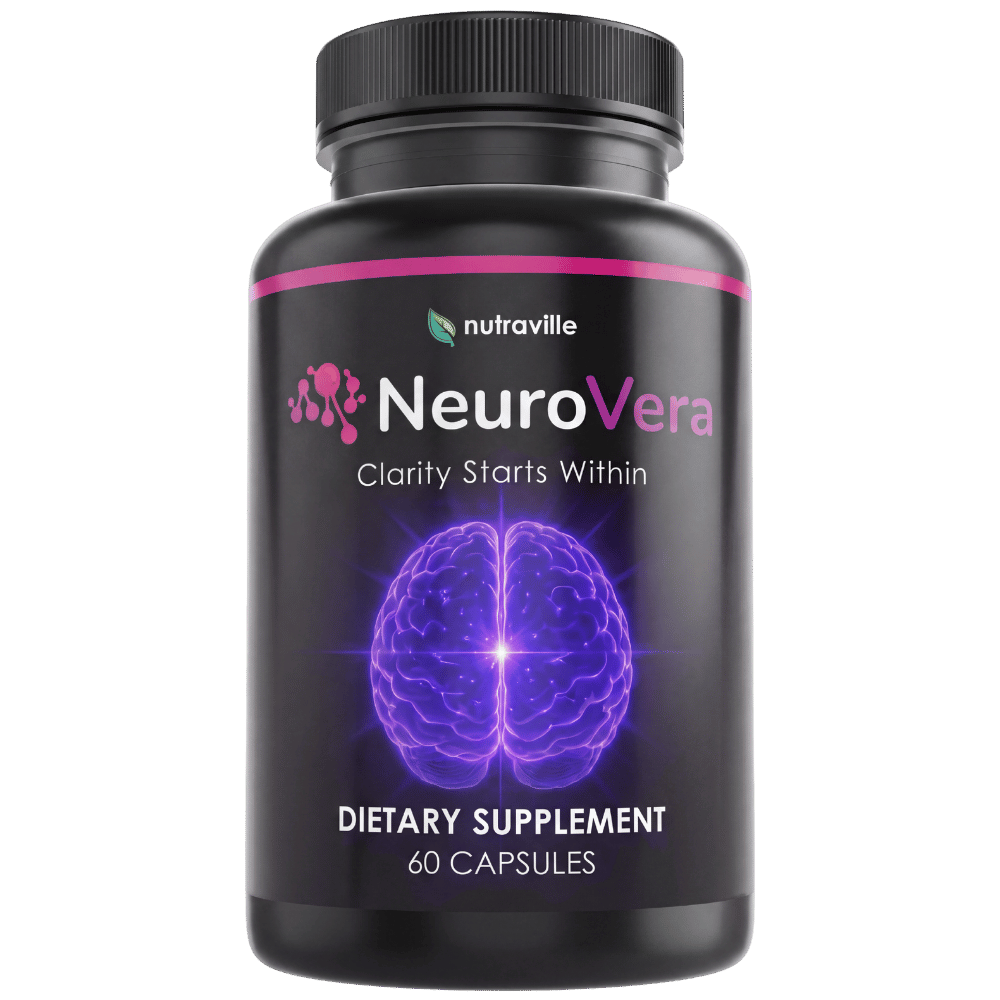
The reviewed label lists 60 capsules, a two-capsule serving, and 30 servings per container.
Is NeuroVera suitable for everyone?
No supplement should be assumed appropriate for everyone. People who are pregnant, nursing, taking medication or managing a medical condition should follow the seller’s physician-consultation guidance. Individual ingredient safety is covered separately from this formulation analysis.
Our editorial verification
How we evaluated NeuroVera’s ingredients
Pro Review Metric used the reviewed physical Supplement Facts panel as the controlling source for ingredient names, amounts, forms, standardizations and serving size.
We compared the disclosed ingredients with human studies, checking the actual study product, daily exposure, population, duration and reported outcomes.
Both favorable and non-significant cognitive findings were considered. Ingredient studies were not represented as clinical trials of NeuroVera.
We also examined the seller’s reference to nine natural ingredients against the six active lines documented on the physical panel.
PRM did not perform an independent laboratory assay, authenticate raw-material suppliers, test a NeuroVera batch or conduct a finished-product clinical trial.
For a more detailed evaluation of each research source, visit the NeuroVera Research Dossier . For the broader product and purchase evaluation, see the full NeuroVera Review .
Sources reviewed October 19, 2026: PRM Research Dossier · NeuroVera seller FAQ · Mori et al., Lion’s Mane · Saitsu et al., Lion’s Mane · Calabrese et al., Bacopa · Lopresti et al., Bacopa · Gotu Kola trial · DHA cognition trial .