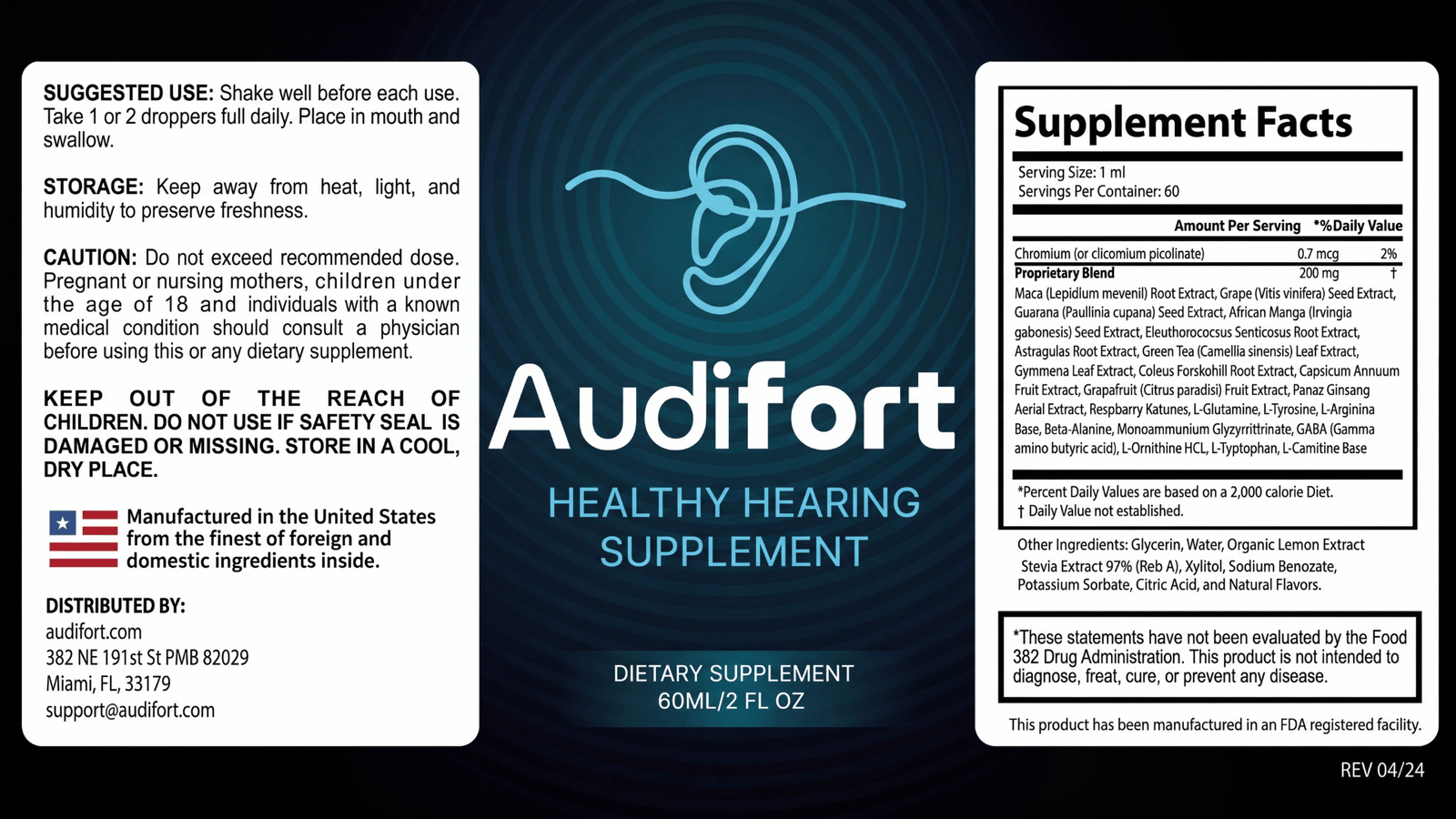
Audifort is a liquid dietary supplement whose physical label lists chromium separately plus 22 named ingredients inside one 200 mg proprietary blend. The label provides strong name-level disclosure but weak dose-level disclosure for the blend. Human tinnitus research gives limited context for Korean red ginseng and multicomponent antioxidant strategies, but the reviewed evidence does not establish the finished Audifort formula as a clinically proven hearing or tinnitus intervention.
Audifort Research: Quick Answers
60 labeled servings per container.
The seller FAQ describes a two-dropper routine, while the physical label permits either one or two.
The 22 proprietary-blend ingredients share one combined 200 mg amount.
No clinical trial of the finished Audifort formula was identified in the research performed for this dossier.
What Sources Did Pro Review Metric Verify?
Used to document hearing-support positioning, seller directions, promotional claims, shipping statements, guarantee language and the seller’s scientific-reference list. Seller claims remain seller claims.
Used to verify the current 2-, 3- and 6-bottle totals, the reviewed one-time purchase structure and seller-controlled shipping and guarantee presentation.
What Does the Audifort Label Actually Disclose?
The physical label is the controlling source for formula facts. It does not support assigning an individual dose to any of the 22 proprietary-blend ingredients.
| Label line | Amount / instruction | What can be established | What remains unresolved |
|---|---|---|---|
| Chromium | 0.7 mcg · 2% DV | Chromium is listed separately from the proprietary blend. | The label line does not establish a hearing-specific clinical contribution. |
| Proprietary Blend | 200 mg total | All 22 component names are disclosed. | Individual ingredient amounts, dose ratios and dose matching to human studies cannot be established. |
| Serving | 1 ml · 60 servings per container | The labeled serving size and container count are explicit. | Package-duration math depends on whether one or two droppers are used daily. |
| Suggested use | “Take 1 or 2 droppers full daily” | The physical label permits two daily-use patterns. | Seller package durations are built around the two-dropper routine, so they do not describe every label-permitted use pattern. |
| Other ingredients | Not listed by amount | Glycerin, water, organic lemon extract, stevia extract 97% (Reb A), xylitol, sodium benzoate, potassium sorbate, citric acid and natural flavors are named. | No ingredient-specific inactive-component quantities are disclosed. |
The 22 ingredients named inside the 200 mg proprietary blend
- Maca (Lepidium meyenii) Root Extract
- Grape (Vitis vinifera) Seed Extract
- Guarana (Paullinia cupana) Seed Extract
- African Mango (Irvingia gabonensis) Seed Extract
- Eleutherococcus senticosus Root Extract
- Astragalus Root Extract
- Green Tea (Camellia sinensis) Leaf Extract
- Gymnema Leaf Extract
- Coleus forskohlii Root Extract
- Capsicum annuum Fruit Extract
- Grapefruit (Citrus paradisi) Fruit Extract
- Panax ginseng Aerial Extract
- Raspberry Ketones
- L-Glutamine
- L-Tyrosine
- L-Arginine Base
- Beta-Alanine
- Monoammonium Glycyrrhizinate
- GABA (Gamma aminobutyric acid)
- L-Ornithine HCL
- L-Tryptophan
- L-Carnitine Base
The central transparency limit
The label is transparent about which 22 ingredients are present, but not about how much of each one is present. PRM therefore does not calculate, estimate or reverse-engineer individual doses from the 200 mg blend total.
How Transparent Is the Audifort Formula?
| Component / issue | Label transparency | Evidence-transfer consequence | PRM treatment |
|---|---|---|---|
| Chromium | Individual amount disclosed: 0.7 mcg. | Separate disclosure does not create hearing-specific efficacy evidence. | Recorded as a product fact, not an evidence anchor. |
| 22-ingredient proprietary blend | Names disclosed; individual amounts hidden inside 200 mg total. | A studied dose for one ingredient cannot be matched to Audifort. | Ingredient relevance may be discussed, but trial-matched dose claims are not made. |
| Panax ginseng aerial extract | Present by name; dose not individually disclosed. | The Audifort material is not equivalent to Korean red ginseng at 1,500–3,000 mg/day. | Distant tinnitus context only. |
| Grape seed extract | Present by name; dose and standardization not individually disclosed. | A multicomponent antioxidant trial cannot be attributed to grape seed alone or dose-matched to Audifort. | Antioxidant / tinnitus context only. |
| Highlighted seller ingredients | Maca, grape seed, green tea, capsicum, Gymnema and GABA are all present by name. | Seller benefit language is not converted into independent proof. | Formula-characterization facts remain separate from efficacy conclusions. |
Does Audifort Work? What the Evidence Actually Supports
Short answer: Audifort contains ingredients and antioxidant strategies with some human research relevant to tinnitus or auditory health, but that is not the same as proving the finished product works for hearing support. The entire 22-ingredient proprietary blend totals 200 mg, individual doses are not disclosed, and no clinical trial of the finished Audifort formula was identified in the research performed for this dossier. The table below separates seller positioning from what the evidence can actually support.
| Seller position / claim | Source type | Independent evidence status | PRM interpretation |
|---|---|---|---|
| “360 Degree Hearing Support” / “Improve Your Hearing Naturally” | Seller marketing language | No finished-product Audifort clinical trial was identified in the research performed for this dossier. | Hearing-support positioning, not an independently established Audifort treatment outcome. |
| Grape-seed antioxidants “protect the ear” | Seller ingredient claim | Human antioxidant tinnitus studies exist, but the reviewed interventions are not Audifort and do not isolate the Audifort grape-seed dose. | Conceptual rationale only. |
| Green tea “improves blood flow to the ears” | Seller ingredient claim | No close-match human hearing/tinnitus trial for Audifort’s undisclosed green-tea exposure was identified in the targeted review used for this dossier. | Do not present as a demonstrated Audifort outcome. |
| Gymnema “supports hearing” | Seller ingredient claim | No close-match human hearing/tinnitus trial was identified in the targeted review used for this dossier. | Seller positioning remains unverified at the Audifort product level. |
| “Precise ratios required to support healthy hearing” | Seller formula claim | The physical label discloses only one 200 mg blend total rather than the individual ratios. | The claimed ratios are not independently auditable from the label. |
| Results beginning in the first week / best results with longer use | Seller FAQ claim | No finished-product Audifort clinical trial supporting those time-to-result statements was identified in the reviewed research. | Do not convert seller timing claims into expected outcomes. |
Has the Current Audifort Formula Been Clinically Tested?
No clinical trial of the finished Audifort formula was identified in the research performed for this dossier. The available evidence is ingredient-level, combination-level or clinical-management context, so it should not be presented as finished-product proof. This is a record of the reviewed search, not a universal claim that no study could exist anywhere.
How Strong Is Audifort’s Seller Reference Set?
The official seller material includes a “Scientific References” section with 14 listed entries. The existence of a reference list is not, by itself, evidence that the finished Audifort formula was clinically tested.
The cited materials span tinnitus, hearing, phytochemicals, vitamins and broader basic-science topics rather than a clinical trial of the current 22-ingredient Audifort formula.
Examples include rat tinnitus work, cochlear supporting-cell biology and cortical tinnitus mapping. These can inform mechanisms without proving Audifort outcomes.
The list includes hearing-loss associations, tinnitus epidemiology, phytochemical reviews, B-vitamin material and general herbal topics that do not test Audifort.
That book is not a clinical hearing study. Its presence reinforces why PRM evaluates each cited source by relevance and design rather than treating the seller’s bibliography as a single evidence block.
What this audit means
The seller’s bibliography can explain the ideas used in the marketing narrative. It does not substitute for a randomized clinical trial of Audifort, does not reveal hidden proprietary-blend doses and does not establish that the finished formula reproduces outcomes from unrelated studies.
What Does Research Say About Audifort’s Ingredients?
The sources below were selected for direct relevance to the evidence question, not because they appear in seller marketing. Each record states the transfer limit explicitly.
No finished-product Audifort clinical trial identified
What this supports: cautious wording that PRM did not identify a clinical trial of the finished Audifort formula in the research performed for this dossier.
Important limit: this is a record of the reviewed search, not a universal claim that no Audifort trial could exist anywhere.
Korean red ginseng in chronic tinnitus
Participants received Ginkgo biloba 160 mg/day or Korean red ginseng at 1,500 or 3,000 mg/day. The 3,000 mg/day group improved from baseline on Tinnitus Handicap Inventory scores, while tinnitus VAS changes were not statistically significant.
Transfer limit: Audifort lists Panax ginseng aerial extract inside a 200 mg blend shared with 21 other ingredients. Its individual dose is unknown, and the preparation is not equivalent to Korean red ginseng at 1,500–3,000 mg/day.
View PMID 26413574Randomized multicomponent antioxidant supplementation in tinnitus
The antioxidant group showed improvements in several tinnitus measures relative to baseline and/or placebo. The intervention was a multicomponent antioxidant supplement and included standardized grape-seed extract among multiple vitamins, minerals and antioxidant compounds.
Transfer limit: the intervention was not Audifort, did not isolate grape seed and cannot be dose-matched to Audifort’s undisclosed grape-seed amount inside the 200 mg blend.
View PMID 31842394Preliminary antioxidant therapy in idiopathic tinnitus
The study reported reductions in oxidative markers and subjective tinnitus measures after treatment, but no significant change in audiometric threshold.
Transfer limit: the intervention did not contain Audifort’s formula and does not establish that Audifort improves hearing thresholds or tinnitus.
View PMID 17416295AAO-HNS clinical practice guideline for persistent bothersome tinnitus
The guideline recommends targeted clinical evaluation and, where appropriate, audiologic assessment, hearing-aid evaluation and cognitive behavioral therapy. It recommends against dietary supplements for treating persistent bothersome tinnitus.
Meaning for Audifort: this does not evaluate Audifort specifically, but it reinforces the boundary that a hearing-support supplement should not be presented as a treatment substitute for persistent bothersome tinnitus or documented hearing loss.
View PMID 25273878What Are the Biggest Evidence Gaps?
- Ingredient relevance is not finished-product evidence.
- A 200 mg proprietary-blend total does not reveal the dose of any of the 22 individual components.
- The same ingredient name does not establish the same preparation, extraction method or standardization used in a study.
- Korean red ginseng is not interchangeable with an undisclosed amount of Panax ginseng aerial extract.
- A multicomponent antioxidant result cannot be assigned to grape seed alone when the study does not isolate grape seed.
- Tinnitus symptom outcomes are not equivalent to restoration of hearing or improvement in audiometric thresholds.
- The physical label permits one or two droppers daily, while seller package durations assume two droppers daily.
- No independent certificate of analysis, batch assay or laboratory verification was included in the reviewed Audifort source set.
- PRM did not conduct firsthand product use, hearing testing, laboratory analysis or physical batch authentication for this dossier.
How Much Does Audifort Cost?
Short answer: the current seller presentation lists $158 for 2 bottles, $207 for 3 bottles and $294 for 6 bottles. The reviewed checkout path was a one-time purchase rather than autoship, and the 3- and 6-bottle packages currently show free U.S. shipping. Seller-controlled prices, shipping, bonuses and return procedures can change.
Seller presents this as a 60-day supply. Shipping is added on the reviewed offer presentation.
Seller presents this as a 90-day supply. Free U.S. shipping and two digital bonuses are currently shown.
Seller presents this as a 180-day supply. Free U.S. shipping and two digital bonuses are currently shown.
The reviewed checkout presentation is not an autoship subscription. The seller’s return policy remains seller-controlled.
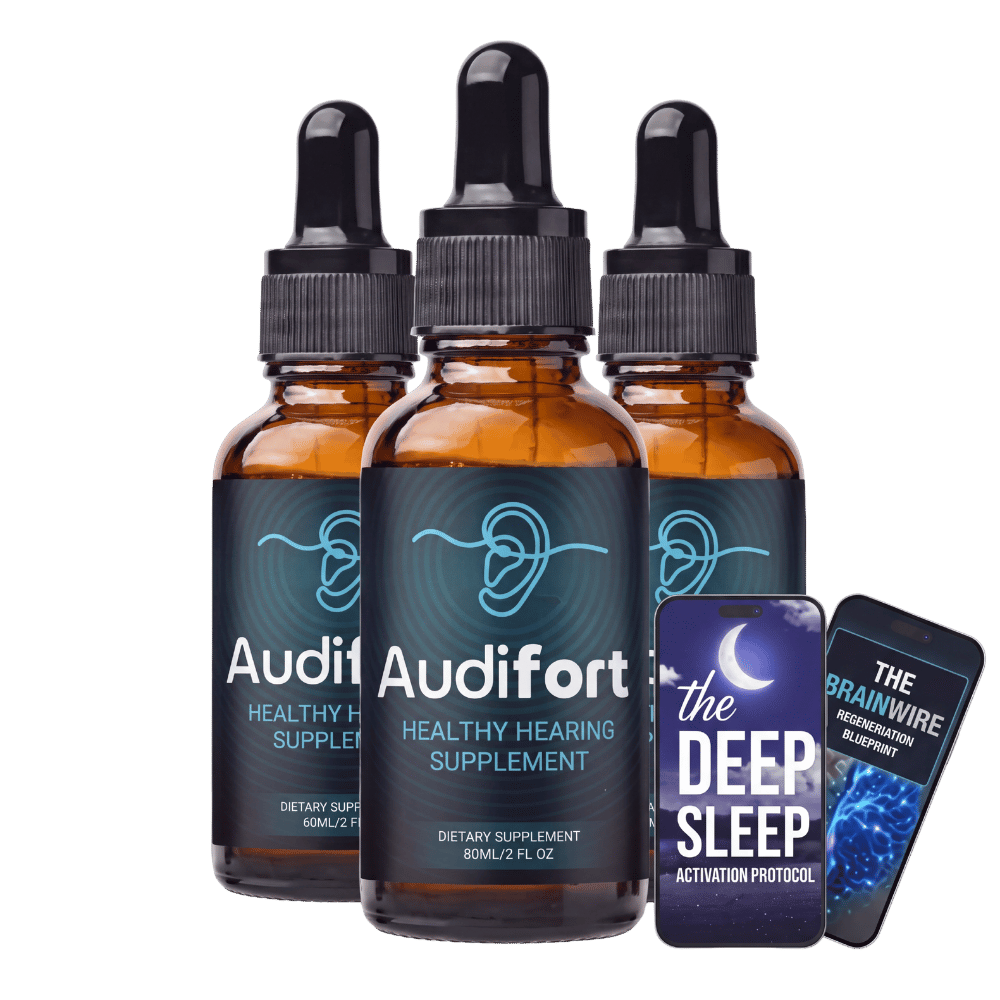
The 3- and 6-bottle packages currently display “The Deep Sleep Activation Protocol” and “The Brainwire Regeneration Blueprint” as digital downloads. The seller’s published return language states a 90-day window from the original purchase date, with returned product required and shipping/handling excluded. Confirm current terms before ordering.
Is Audifort Safe?
Short answer: “safe for everyone” would be too broad. Audifort contains 22 ingredients inside a 200 mg proprietary blend without individual dose disclosure, including grapefruit, Panax ginseng, green tea and L-tryptophan—ingredients that can matter for medication use, sensitivity or specific health conditions. The reviewed materials also do not establish a finished-product adverse-event rate, so people taking medication or managing a medical condition should review the complete label with a qualified healthcare professional.
Ingredient tolerability cannot be assumed to establish the safety profile of the complete 22-ingredient proprietary blend.
FDA guidance notes that grapefruit can alter blood levels of some medicines through effects on intestinal enzymes and transporters. Audifort does not disclose its individual grapefruit-extract amount.
Read FDA guidanceNCCIH notes possible insomnia, effects on blood sugar and blood clotting, medication interactions and pregnancy cautions for Asian ginseng. Audifort’s individual ginseng exposure is unknown.
Read NCCIH guidanceNCCIH notes caffeine, gastrointestinal effects, possible blood-pressure effects, rare liver injury reports with some green-tea extract products and medication interactions. Audifort does not disclose its green-tea dose or caffeine contribution.
Read NCCIH guidanceThe reviewed label advises against exceeding the recommended dose and directs people who are pregnant or nursing, under 18, or managing a known medical condition to consult a physician before use.
Audifort should not be used as a substitute for evaluation of sudden hearing changes, persistent or unilateral tinnitus, documented hearing loss or other concerning auditory symptoms. See the Medical Disclaimer.
How Was This Audifort Dossier Prepared?
The Pro Review Metric Editorial Team compared the physical Audifort Supplement Facts panel, official seller and affiliate materials, package presentation and reviewed checkout information with the independent human tinnitus studies and federal or clinical guidance listed above.
Seller claims were recorded as seller claims. Study conclusions were carried only as far as the ingredient, preparation, dose, population, intervention and endpoint allowed. Combination-product findings were not assigned to one component, tinnitus symptom changes were not rewritten as hearing restoration, and the proprietary blend was not reverse-engineered into estimated ingredient doses.
PRM did not conduct firsthand Audifort use, laboratory testing, raw-material authentication, hearing testing or a finished-product clinical trial. See the Methodology, Editorial Policy, Editorial Team, Affiliate Disclosure and Medical Disclaimer.
Last updated: September 15, 2026. This dossier is reviewed when product details, pricing, labeling or material evidence changes.