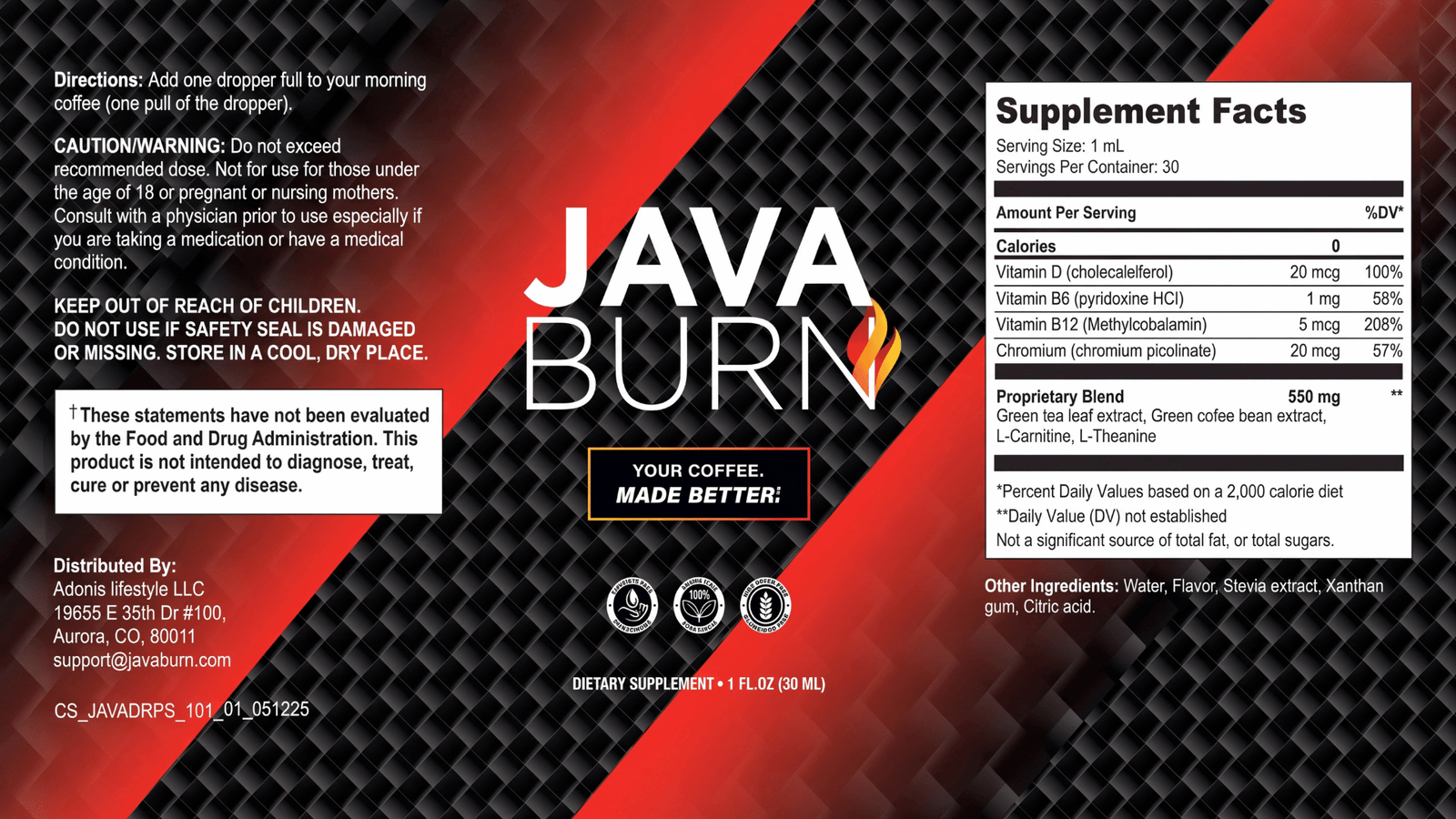
The reviewed Java Burn 2.0 label shows a 1 mL daily serving, 30 servings per bottle, four individually quantified micronutrients and a 550 mg proprietary blend containing green tea leaf extract, green coffee bean extract, L-carnitine and L-theanine. Human research exists for several of those ingredients, but the observed effects are generally modest, context dependent or studied at doses that cannot be matched to the current proprietary blend. No randomized clinical trial of the current finished Java Burn 2.0 liquid formula was identified in PRM’s targeted searches. The strongest evidence-based interpretation is therefore ingredient-level plausibility plus a very simple delivery ritual—not proof of the full metabolism, fat-burning, hunger or absorption story used in seller marketing.
Java Burn Research: Quick Answers
The current physical label directs users to add one dropper full to morning coffee.
Green tea, green coffee, L-carnitine and L-theanine share one total amount, so their individual doses are not visible.
The live checks showed $9.95 shipping on 2 and 3 bottles, and free shipping on 6 bottles.
Ingredient studies should not be treated as proof that the current liquid formula produces the seller’s full outcome claims.
What Sources Did Pro Review Metric Verify?
The current physical Supplement Facts panel controls serving size, listed ingredients, declared amounts and warning language in this dossier. The current seller funnel and Java Burn support center were used to document the morning-coffee positioning, liquid-format claims, package ladder and refund language. Supplied live U.S. ClickBank checkout screens were used to record observed totals and purchase structure. Seller-controlled pages and commercial terms can change.
What Does the Java Burn Label Actually Disclose?
| Label item | Declared detail | What the label supports | Important boundary |
|---|---|---|---|
| Serving Size | 1 mL; 30 servings per container | A one-dropper daily serving and approximately 30 labeled servings per bottle. | Serving convenience does not establish a weight-loss or metabolic outcome. |
| Vitamin D | 20 mcg · 100% DV, as cholecalciferol | A clearly quantified vitamin D line. | Clinical evidence does not support vitamin D supplementation as a weight-loss treatment. |
| Vitamin B6 | 1 mg · 58% DV, as pyridoxine HCl | A clearly quantified B6 line and normal nutrient-metabolism context. | Nutritional function is not proof of Java Burn-specific fat loss or energy outcomes. |
| Vitamin B12 | 5 mcg · 208% DV, as methylcobalamin | A clearly quantified B12 line. | B12 can correct deficiency-related problems, but the label does not establish a weight-loss effect from this dose. |
| Chromium | 20 mcg · 57% DV, as chromium picolinate | A fully disclosed chromium line in the current physical product. | NIH reviews describe only minimal weight effects and mixed glucose-related findings from chromium supplementation. |
| Proprietary Blend | 550 mg total | The combined amount for four named active ingredients. | No internal dose split is disclosed, so most trial-dose matching is not possible. |
| Green Tea Leaf Extract | Inside 550 mg blend | Presence of green tea extract. | Individual dose, catechin content and caffeine contribution are not disclosed. |
| Green Coffee Bean Extract | Inside 550 mg blend | Presence of green coffee bean extract. | The label does not state the chlorogenic-acid dose or the ingredient’s individual milligram amount. |
| L-Carnitine | Inside 550 mg blend | Presence of L-carnitine. | Published weight-management meta-analyses commonly evaluate gram-level L-carnitine exposure; the entire Java Burn blend is only 550 mg. |
| L-Theanine | Inside 550 mg blend | Presence of L-theanine. | The strongest current human literature centers on cognition, mood and stress rather than direct weight-loss proof. |
| Other ingredients | Water, flavor, stevia extract, xanthan gum, citric acid | The current inactive ingredient list. | These ingredients are not efficacy evidence. |
How Transparent Is the Java Burn Formula?
These four label lines have individual amounts.
The proprietary blend has a clear total but no internal dose split.
Presence is disclosed; individual exposure is not.
Because the individual amounts are hidden, most research doses cannot be mapped reliably to one Java Burn serving.
Does Java Burn Work? What the Evidence Actually Supports
Short answer: Java Burn has ingredients with human research relevant to metabolism, body weight, attention and energy, but that is not the same as proving the current finished Java Burn 2.0 formula works for weight loss. PRM did not identify a randomized clinical trial of the current liquid formula, and the 550 mg proprietary blend prevents exact dose matching for four core ingredients. The table below separates what is plausible at ingredient level from what remains unproven for the finished product.
| Seller positioning | Evidence status | PRM interpretation |
|---|---|---|
| “Scientifically proven” coffee + formula synergy | Finished-product proof not identified | Coffee, tea compounds and several Java Burn ingredients have relevant research, but PRM did not identify a randomized trial of the current Java Burn 2.0 liquid formula showing that the combination with coffee produces the seller’s claimed magnitude of metabolic or fat-loss effect. |
| Boost metabolism / promote fat burning | Ingredient-level support is modest and mixed | Green tea, green coffee and L-carnitine have human research relevant to weight or body composition. Reported effects are generally small, heterogeneous and dose dependent, and the proprietary blend prevents direct dose matching. |
| Reduce hunger | Direct support is weak for the current formula | The strongest recent L-theanine evidence concerns attention, stress, mood and cognition, not clinically meaningful hunger or weight-loss outcomes from Java Burn. |
| Faster absorption / superior bioavailability from liquid serum | Seller claim; product PK evidence not identified | The current support center makes rapid “sublingual and stomach absorption” and superior-bioavailability claims. PRM did not identify a Java Burn pharmacokinetic comparison showing that the liquid product materially outperforms the prior powder formulation. |
| Precision dosing delivers the science-backed amount | Cannot be verified from the label | The physical label discloses only the 550 mg blend total, not the amounts of the four core ingredients. That prevents independent confirmation that research-matched doses are present. |
| “100% safe” / “zero side effects reported” | Absolute wording is not independently supportable | The product label itself carries age, pregnancy, medication and medical-condition warnings. Green tea extracts also have dose-dependent safety considerations in the literature. |
Has the Current Java Burn 2.0 Formula Been Clinically Tested?
Direct randomized clinical evidence for the current Java Burn 2.0 liquid formula: not identified in PRM’s targeted PubMed / ClinicalTrials.gov searches.
Ingredient-level human evidence: yes, especially for green tea, green coffee / chlorogenic-acid preparations, L-carnitine and L-theanine.
Overall signal: biologically plausible ingredients with generally modest or context-dependent human effects.
Major transfer limitation: the four core ingredients share one 550 mg proprietary blend, so individual research-dose matching is mostly impossible.
What Does Research Say About Java Burn’s Ingredients?
The evidence record below prioritizes systematic reviews, meta-analyses and NIH guidance. It separates an ingredient having relevant literature from the much stronger claim that the current Java Burn 2.0 formula has been clinically validated.
Green tea — a real weight-management literature, but the average effect is small
Green tea supplementation and adiposity
Finding: pooled randomized trials reported small reductions in body weight, BMI, waist circumference and body-fat percentage.
Transfer limit: Java Burn does not disclose its green-tea dose, catechin concentration or EGCG exposure. A small average effect from green-tea trials is not proof of a Java Burn-specific fat-loss result.
View PubMedTea and coffee beverages for adult body weight
Finding: green tea showed a small weight-loss signal, but the certainty of evidence was low to very low and many trials had a high risk of bias.
Why it matters: this supports a restrained interpretation: green tea may contribute modestly, but the research does not support dramatic finished-product expectations.
View PubMedGreen coffee / chlorogenic acid — possible modest effect, with a major dose-transfer question
Chlorogenic acid in green coffee and body weight
Finding: the meta-analysis reported about a 1.3 kg greater body-weight reduction with green-coffee / chlorogenic-acid interventions of at least 500 mg/day.
Transfer limit: the whole Java Burn proprietary blend is 550 mg and also contains green tea, L-carnitine and L-theanine. The label therefore does not establish that Java Burn provides a research-matched 500 mg green-coffee / chlorogenic-acid exposure.
View PubMedGreen coffee extract and anthropometric outcomes
Finding: 15 RCTs / 897 participants showed modest average reductions in body weight, BMI and waist circumference, without a clear dose-response relation for chlorogenic acid.
Interpretation: there is a legitimate ingredient-level evidence base, but not a reliable path from that literature to the current undisclosed Java Burn blend dose.
View PubMedL-carnitine — the clearest dose mismatch
L-carnitine and weight / body composition
Finding: pooled trials reported modest reductions in body weight and BMI. The dose-response analysis suggested the maximum body-weight effect around 2,000 mg/day.
Java Burn-specific limit: the complete proprietary blend is only 550 mg, so Java Burn cannot provide a 2,000 mg L-carnitine dose in one labeled serving.
View PubMedCarnitine in weight-loss supplements
Current NIH context: carnitine may produce a modest reduction in body weight, but effects are not large and higher-dose use can cause gastrointestinal symptoms.
Why it matters here: Java Burn’s undisclosed L-carnitine amount makes it impossible to know how closely the product resembles the interventions behind that evidence.
View NIH ODSL-theanine — stronger evidence for attention and stress than for weight loss
Cognitive and affective effects of L-theanine
Finding: the review found some acute benefits in attention-related outcomes, including at a 200 mg dose, while the broader clinical relevance remained uncertain.
Java Burn-specific interpretation: this is relevant to the product’s calm-focus narrative, but it does not establish hunger reduction or meaningful weight loss from the finished Java Burn formula.
View PubMedL-theanine plus caffeine
Finding: pooled randomized trials found small-to-moderate signals on selected cognition and mood outcomes with L-theanine plus caffeine, but confidence intervals often showed substantial uncertainty.
Transfer limit: Java Burn’s L-theanine dose is unknown and the amount of caffeine in the user’s coffee is variable. This literature does not validate a standardized “coffee synergy” metabolic effect.
View PubMedChromium and vitamins — visible on the label, but not the main weight-loss evidence
Chromium and weight / glucose outcomes
Current NIH context: chromium trials show only a very small average weight effect of uncertain clinical relevance, while glucose-control findings are mixed.
Java Burn-specific point: the product supplies 20 mcg chromium, which is clearly disclosed. The presence of chromium makes the label more transparent, but it is not strong evidence for a material weight-loss effect.
View NIH ODSVitamin D and body weight
Finding: NIH ODS states that clinical trials do not support vitamin D supplementation as a way to promote weight loss.
Interpretation: Java Burn’s vitamin D is a legitimate nutrient line, but it should not be treated as evidence for the product’s weight-management promise.
View NIH ODSWhat Are the Biggest Evidence Gaps?
- Ingredient evidence is not finished-product evidence. No randomized trial of the current Java Burn 2.0 liquid formula was identified in PRM’s targeted searches.
- The proprietary blend blocks reliable dose matching. Four core ingredients share 550 mg and the internal split is unknown.
- L-carnitine creates a clear dose-transfer problem. Meta-analytic dose-response work points to gram-level daily exposure, which cannot fit inside the entire 550 mg Java Burn blend.
- Green coffee evidence does not establish Java Burn’s chlorogenic-acid dose. The label names green coffee bean extract but does not quantify chlorogenic acid.
- “Coffee synergy” remains a marketing-level proposition. Research on caffeine, tea compounds and L-theanine does not substitute for a trial of the current Java Burn + coffee combination.
- Liquid-format superiority is not established by the current evidence record. The seller claims faster absorption and higher bioavailability, but PRM did not identify a Java Burn pharmacokinetic comparison with the prior powder formulation.
- The current official support center conflicts with the physical label on chromium form. The support article lists chromium chloride, while the reviewed physical label lists chromium picolinate. PRM follows the physical label.
- Total caffeine exposure is not fully defined by the Java Burn label. Green tea and green coffee extracts may contain caffeine, and the product is designed to be used with coffee; individual sensitivity and coffee strength therefore matter.
Where Do the Java Burn Product Facts Come From?
Java Burn 2.0 physical Supplement Facts panel
Supports: 1 mL serving, 30 servings, vitamin D, B6, B12, chromium picolinate 20 mcg, 550 mg proprietary blend, ingredient identities, warnings and other ingredients.
Does not prove: metabolism, fat-burning, hunger, coffee-synergy or weight-loss outcomes.
View the reviewed labelCurrent Java Burn sales funnel
Supports: current package ladder, 60-day guarantee language, morning-coffee positioning and the seller’s ingredient / outcome claims.
Does not prove: that the finished Java Burn 2.0 formula has demonstrated those outcomes in a controlled clinical trial.
View the seller siteJava Burn 2.0 liquid ingredient article
Supports: the current 1 mL liquid format, 550 mg proprietary blend and named core ingredients.
Material discrepancy: the support article identifies chromium as chromium chloride, while the physical product label identifies chromium picolinate. PRM uses the physical label as the controlling product source.
View Java Burn supportWhy the seller changed Java Burn to liquid
Seller claims: faster absorption, superior bioavailability, precision dosing, longer shelf life and better mixability.
Evidence boundary: these are seller claims. PRM did not identify a published Java Burn pharmacokinetic study comparing the current liquid with the prior powder.
View Java Burn supportCurrent U.S. ClickBank checkout record
Supports: observed totals, shipping presentation and the current 60-day money-back framing.
Does not prove: product effectiveness or that prices and policy details will remain unchanged.
Open the current offerHow Reliable Are Java Burn’s Seller Materials?
Java Burn’s current seller ecosystem contains useful product information, but not every seller-controlled source is perfectly synchronized with the current physical product. That matters because formula form, ingredient form and refund conditions can change while older support or sales language remains live.
The physical panel is the controlling source for serving size, active ingredients, chromium form and the 550 mg blend.
The current liquid support article says chloride; the physical label says picolinate.
In the current rendered seller page available to PRM, a distinct bibliography mapping those numbers to studies was not exposed in the page text we reviewed.
Ingredient studies and seller citations cannot substitute for a controlled trial of the current proprietary liquid formula.
How Much Does Java Burn Cost?
60-day supply. $9.95 shipping and $0.00 tax were shown in the observed U.S. checkout.
90-day supply. $9.95 shipping and $0.00 tax were shown in the observed U.S. checkout.
180-day supply. Free shipping and $0.00 tax were shown in the observed U.S. checkout.
The current seller / ClickBank path presents a one-time purchase rather than a recurring subscription.
Refund-policy record
Stable point across the current sources: a 60-day money-back window is presented.
Operational details vary by source: the sales page uses broad “return even empty bottles” language tied to the original purchase, while the current support article says returns must be made within 60 days of delivery, allows up to two empty or partially used containers, requires the remaining containers to be unopened, and excludes shipping / handling.
PRM treatment: describe the offer as a current 60-day money-back policy, but direct buyers to verify the live checkout and seller support terms before relying on specific return conditions.
Is Java Burn Safe?
Short answer: Java Burn has a conventional dietary-supplement warning profile, but “safe for everyone” would be too broad. The current label says not to exceed the recommended dose, not to use it under age 18 or during pregnancy / nursing, and to consult a physician before use especially when taking medication or managing a medical condition. The undisclosed amounts of green tea and green coffee also make total stimulant exposure harder to quantify when the product is added to coffee.
Systematic reviews describe liver events as uncommon, but concentrated extract risk is dose dependent and the Java Burn green-tea amount is not disclosed.
The blend’s caffeine contribution is not stated, and the morning coffee itself can vary widely in caffeine content.
NIH notes possible medication interactions for chromium, including with insulin / diabetes medicines, although Java Burn’s chromium dose is much lower than doses used in many supplement trials.
The independent literature does not justify expecting large or automatic weight loss from the finished product without broader diet and lifestyle context.
Green-tea safety record
Liver-related safety of green tea extracts
Finding: liver-related adverse events were rare in randomized trials, but elevations in liver enzymes occurred more often in green-tea-extract groups than controls, with wide uncertainty.
Java Burn-specific limit: the product does not disclose its green-tea or EGCG dose, so this evidence cannot establish the risk level of one serving.
View PubMedWeight-loss supplement safety context
NIH summary: green tea extract has some safety concerns, green coffee extract contains caffeine, carnitine can cause gastrointestinal effects at higher doses, and chromium’s weight effect is minimal.
View NIH ODSHow this dossier was prepared
The Pro Review Metric Editorial Team used the current physical Java Burn 2.0 label as the controlling formula source, then compared it with the current seller funnel, official Java Burn support pages and supplied U.S. ClickBank checkout evidence. Independent evidence was prioritized toward systematic reviews, meta-analyses, randomized trials and NIH guidance. Ingredient research was not treated as finished-product proof, and seller claims were separated from what can be independently verified.
Pro Review Metric did not conduct a firsthand Java Burn product-use trial, laboratory assay, manufacturing audit, independent batch test or certificate-of-analysis verification. The dossier evaluates the materials and evidence available to us; it does not independently verify the contents of a specific production lot.
Last updated: September 14, 2026. This dossier is reviewed when product details, pricing, labeling or material evidence changes.