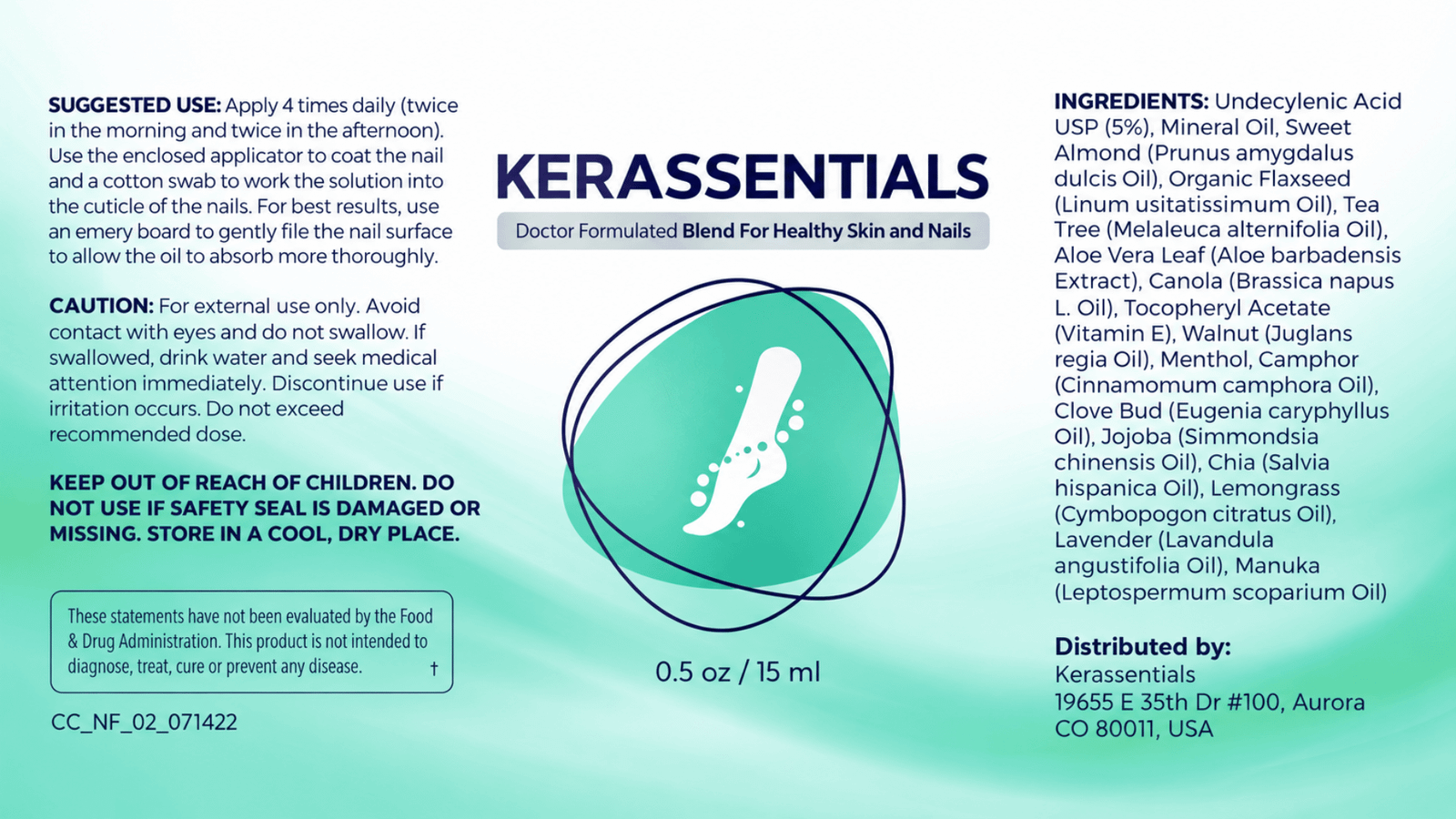
The physical label lists 17 ingredients in a 15 mL topical formula and discloses undecylenic acid at 5%. Human evidence is strongest at the ingredient level, especially for undecylenic-acid preparations and tea tree oil, while several other oils are supported mainly by laboratory or broader topical-use research. We did not identify an independent randomized clinical trial of the current complete Kerassentials formula in the reviewed evidence record. The sections below document where ingredient research is relevant—and where formulation, concentration or disease-setting differences limit direct transfer to Kerassentials.
Kerassentials Research: Quick Answers
The supplied physical label lists 17 ingredients and identifies undecylenic acid USP at 5%.
The physical label directs two applications in the morning and two in the afternoon, with product worked over the nail and cuticle.
All 17 ingredients are named. Only undecylenic acid has a disclosed concentration; the remaining ingredient levels are not listed.
Our review found ingredient-level and related-formulation evidence, but not an independent randomized trial of the current complete Kerassentials formula.
What Sources Did Pro Review Metric Verify?
The physical Kerassentials label controls the formula, concentration, product size, suggested-use directions and printed cautions. The current seller funnel documents positioning, featured ingredients, package structure and seller claims. Live ClickBank checkout checks document observed U.S. transaction totals and shipping. Independent sources were used to evaluate antifungal relevance, clinical context, safety and evidence-transfer limits.
What Does the Kerassentials Label Actually Disclose?
| Label item | Declared detail | What the label supports | Important boundary |
|---|---|---|---|
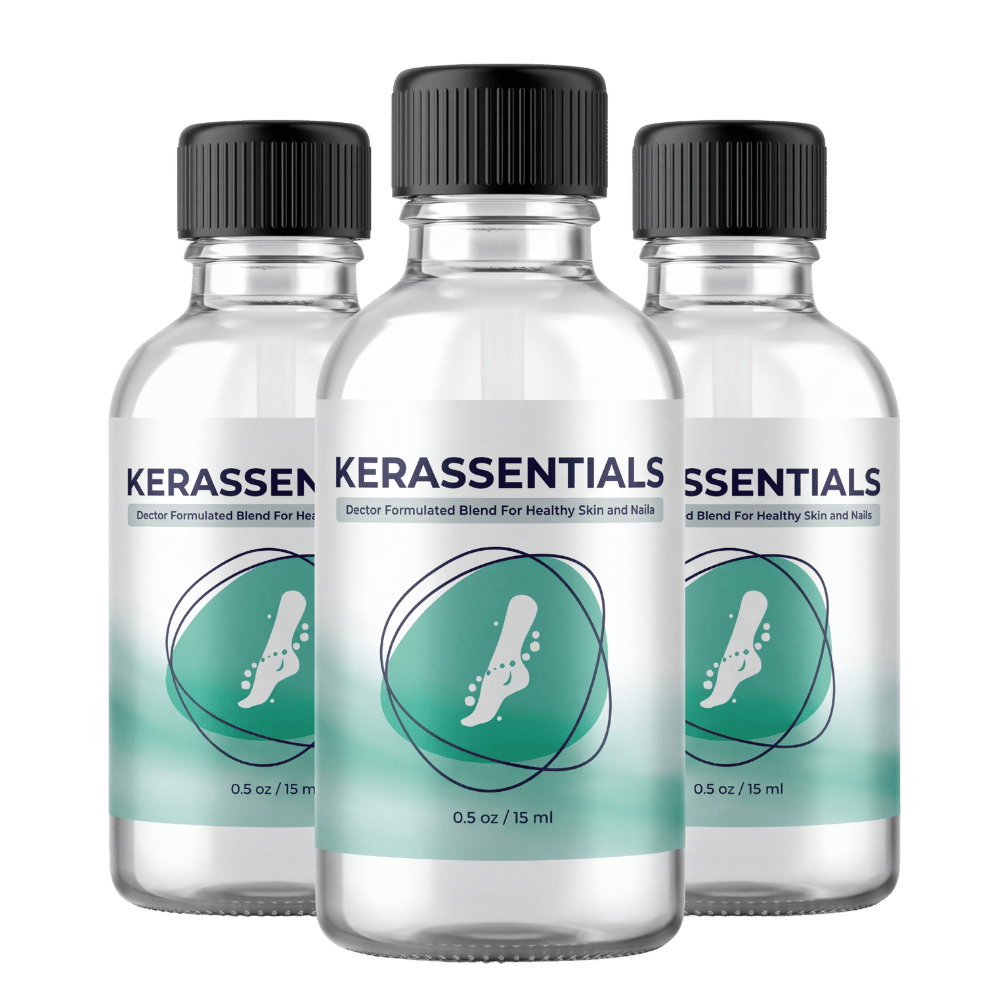
| Product format | Topical oil · 0.5 oz / 15 mL | A liquid external-use product intended for direct application around the nail and cuticle. | The label does not by itself establish treatment efficacy for onychomycosis. |
| Undecylenic Acid USP | 5% | Presence and concentration of the formula’s clearest antifungal-oriented ingredient. | Regulatory equivalence requires caution. A dedicated undecylenic-acid evidence section below explains how the 5% Kerassentials label concentration compares with the FDA OTC antifungal monograph. |
| Carrier / conditioning oils | Mineral, sweet almond, organic flaxseed, canola, walnut, jojoba, chia | A broad emollient oil base around the targeted ingredients. | Presence of an oil does not establish antifungal efficacy at the undisclosed amount used. |
| Botanical oils | Tea tree, camphor, clove bud, lemongrass, lavender, manuka | A multi-botanical topical layer with several ingredients that have antimicrobial or antifungal literature. | Most Kerassentials botanical concentrations are not disclosed, and much of the supporting literature is in vitro or uses different preparations. |
| Supporting components | Aloe vera leaf extract, tocopheryl acetate, menthol | Additional skin-care, sensory and formulation roles. | These ingredients should not be presented as proof that the complete formula cures fungal nail disease. |
| Suggested use | 4 times daily | Twice in the morning and twice in the afternoon; coat the nail, work solution into the cuticle and gently file the nail surface for better absorption. | The seller’s current FAQ page contains both broader everyday-after-showering language and a separate “best way to use” answer that matches the physical label’s four-times-daily instructions. The physical label remains the controlling use record for this dossier. |
| Caution | External use only | Avoid eyes, do not swallow, discontinue if irritation occurs, keep away from children and do not use if the seal is damaged. | A natural or botanical ingredient list is not the same as universal tolerability. |
How Transparent Is the Kerassentials Formula?
Short answer: Kerassentials is relatively transparent about ingredient identity and unusually specific about one ingredient concentration, but it is not fully dose-transparent. The physical label names 17 ingredients and discloses undecylenic acid at 5%; concentrations for the remaining oils, extracts and supporting components are not shown.
The complete panel is more informative than the seller’s shorter featured-ingredient presentation.
This is the strongest quantitative formula fact available from the supplied label.
Tea tree, lavender, lemongrass, manuka and the carrier oils cannot be matched precisely to study concentrations.
The label provides a four-times-daily routine and filing / cuticle instructions. The seller’s current “best way to use” FAQ now repeats those directions, although another answer on the same FAQ page still uses broader everyday-after-showering wording.
Does Kerassentials Work? What the Evidence Actually Supports
Short answer: Kerassentials contains ingredients with legitimate topical antifungal relevance, but the evidence is uneven and does not establish that the current complete formula treats or cures onychomycosis. Undecylenic acid and tea tree oil are the strongest evidence anchors. A small open study of a different vitamin-E / essential-oil nail formula is also relevant to the product concept, but it is not a Kerassentials trial.
| Product / seller idea | Evidence status | PRM interpretation | Boundary |
|---|---|---|---|
| Topical antifungal rationale | Supported at ingredient / topical-treatment level | Undecylenic acid, tea tree oil and topical onychomycosis research provide a credible rationale for a topical nail formula. | A rationale is not equivalent to a clinical trial of Kerassentials. |
| 5% undecylenic acid | Clearly disclosed on label | This gives the formula a concrete quantitative anchor. | The 5% Kerassentials label concentration is a useful quantitative fact, but study-dose and regulatory equivalence require separate evaluation; the dedicated undecylenic-acid section below addresses that comparison. |
| Tea tree for fungal nails | Human randomized evidence exists | Tea tree oil has direct human relevance to toenail onychomycosis research. | The major RCT used 100% tea tree oil, while Kerassentials does not disclose its tea-tree concentration. |
| Multi-oil formula | Plausible, but evidence varies by oil | The broader blend can support skin conditioning and adds several botanicals with antimicrobial literature. | Most of those studies are not human Kerassentials outcomes and cannot be added together as proof of the final product. |
Has the Current Kerassentials Formula Been Clinically Tested?
Independent randomized clinical evidence for the current complete Kerassentials formula: not identified in the reviewed source record.
Ingredient-level human evidence: yes. Undecylenic-acid preparations have controlled human antifungal evidence, tea tree oil has a randomized toenail onychomycosis trial, and a separate vitamin-E / essential-oil nail formula has small open-study data.
Major transfer limitation: the non-undecylenic ingredient concentrations are not disclosed, and the studied formulations differ from Kerassentials in composition, concentration, vehicle, regimen or disease setting.
Clinical boundary: ingredient and related-formulation studies should not be presented as proof that Kerassentials cures nail fungus, permanently eliminates spores or prevents recurrence.
What Does Research Say About Kerassentials’ Ingredients?
The evidence record below prioritizes human clinical studies, systematic reviews, regulatory sources and contemporary clinical guidance. Laboratory studies can support biological plausibility, but they are not treated as substitutes for human outcomes.
Undecylenic acid — genuine antifungal history, with a concentration boundary that matters
Undecylenic acid / undecylenate concentration standard
Finding: FDA’s topical-antifungal monograph recognizes undecylenic acid and certain undecylenate salts when the total undecylenate concentration is 10–25% for monograph-conforming OTC antifungal drug products.
Boundary: the Kerassentials physical label lists undecylenic acid USP at 5%. That does not prove the formula is ineffective; it means the 5% Kerassentials concentration should not be described as equivalent to a monograph-conforming undecylenic-acid OTC antifungal solely from this regulatory record.
View FDA monographTopical undecylenic acid in tinea pedis
Finding: a controlled trial of undecylenic-acid powder preparations in mycologically confirmed tinea pedis reported clinical and mycological cures in 53% of treated participants versus 7% in vehicle / untreated controls.
Boundary: this was athlete’s foot, not toenail onychomycosis, and it tested a different vehicle / preparation. It supports the ingredient’s antifungal relevance, not Kerassentials efficacy.
View PubMed recordUndecylenic acid inside a multi-component topical protocol
Finding: a one-year pilot study combined cyanoacrylate, undecylenic acid, hydroquinone and serial debridement; reported negative mycologic cultures varied substantially by baseline severity.
Boundary: the study did not test Kerassentials, used a very different multi-component protocol and was not a randomized placebo-controlled trial.
View PubMed recordTea tree oil — the strongest direct human nail-fungus evidence among the botanical oils
Tea tree oil versus clotrimazole in toenail onychomycosis
Finding: participants with culture-confirmed distal subungual onychomycosis used either 100% tea tree oil or 1% clotrimazole twice daily for six months. Culture cure was low in both groups, while partial / full clinical resolution was reported in roughly 60% of each group.
Boundary: Kerassentials does not disclose the concentration of tea tree oil, so the 100% tea-tree intervention cannot be dose-matched to the product.
View PubMed recordClinical evidence for alternative onychomycosis therapies
Finding: the review found preliminary evidence for several complementary therapies, including tea tree oil, but concluded that large randomized placebo-controlled trials are needed before those options can be broadly endorsed.
Boundary: this supports cautious interest in tea tree oil rather than a conclusion that any multi-oil product containing it is clinically proven.
View PubMed recordTea tree oil against onychomycosis-causing dermatophytes
Finding: multiple tea-tree oils inhibited clinical dermatophyte isolates, including Trichophyton rubrum, under laboratory conditions.
Boundary: in vitro inhibition is useful mechanism evidence but cannot establish real-world cure rates, nail penetration or Kerassentials outcomes.
View PubMed recordVitamin E + essential-oil nail formulas — relevant concept evidence, not Kerassentials proof
Vitamin E plus lime, oregano and tea tree oils
Finding: adults with mild-to-moderate distal subungual onychomycosis used a different topical nail oil once daily for six months and were followed for another six months. The report described high cure rates at the end of follow-up.
Boundary: the study was small and uncontrolled, and its formula used lime, oregano, tea tree and vitamin E rather than the Kerassentials composition. It supports the topical-oil concept, not finished-product equivalence.
View PubMed recordEssential oils as topical anti-infective agents
Finding: pooled clinical literature suggested some essential-oil preparations can perform similarly to standard treatment for certain topical fungal infections and better than placebo.
Boundary: the authors emphasized low quality and heterogeneity. The review does not validate Kerassentials’ specific combination, concentrations or four-times-daily regimen.
View PubMed recordLavender, lemongrass, clove, manuka, camphor and the broader oil layer — mostly supportive rather than decisive human evidence
Most supporting oils do not have Kerassentials-level clinical proof
Finding: several Kerassentials oils have antimicrobial or antifungal laboratory literature, and the seller reference list includes studies on lavender, clove, manuka, camphor, chia and aloe.
Boundary: laboratory inhibition, plant-extract research or studies in other fungal conditions should not be converted into a claim that each oil independently treats toenail fungus inside Kerassentials.
View seller reference libraryThe nail plate is a difficult topical barrier
Finding: a pharmaceutics review explains that poor nail-plate permeability is a central limitation of topical nail treatment and discusses physical / chemical methods used to improve drug permeation.
Boundary: an oil vehicle and filing instruction are conceptually relevant, but this source does not prove that the Kerassentials vehicle delivers its ingredients to an effective concentration in infected nail tissue.
View PubMed recordWhat Are the Biggest Evidence Gaps?
- No finished-product randomized trial identified. The current formula is supported by ingredient-level and related-formulation evidence rather than direct clinical proof of the complete Kerassentials product.
- Most ingredient concentrations are unknown. Only undecylenic acid is quantified at 5%, which prevents precise matching of tea tree and other botanical oils to studied concentrations.
- The 5% undecylenic-acid concentration is below the FDA OTC-monograph range for undecylenic-acid antifungal products. This is a regulatory / equivalence boundary, not a standalone verdict on product effectiveness.
- Several supporting-oil claims rely on laboratory studies. In vitro antifungal activity does not establish clinical cure, nail penetration or recurrence prevention in Kerassentials users.
- Seller FAQ language is internally inconsistent. One current FAQ answer describes everyday use after showering, while the dedicated “best way to use” answer matches the physical label’s four-times-daily instructions. PRM uses the physical label as the controlling physical-use record.
- No independent batch / concentration verification was reviewed. The dossier does not authenticate raw materials, manufacturing quality, essential-oil standardization or the amount of non-undecylenic ingredients in a purchased bottle.
Do the Seller’s “Fungus Resistance” and Permanent-Result Claims Match Current Science?
Short answer: antifungal resistance in dermatophytes is real, but the seller’s causal story and permanence claims are more specific than the evidence allows. Contemporary literature describes resistance as multifactorial and emphasizes correct diagnosis, appropriate antifungal selection, adherence, organism characteristics and stewardship. That does not establish that Kerassentials kills resistant fungus “for good,” removes residual spores or prevents future infection permanently.
Antifungal resistance in onychomycosis is real and multifactorial
Finding: resistance to terbinafine and itraconazole has been documented among Trichophyton species. Contributing factors include fungal adaptations, patient characteristics and diagnostic / treatment practices.
Boundary: this does not support a universal narrative that stopping treatment simply “makes fungus stronger,” nor does it prove that a previously unexposed multi-oil blend permanently overcomes resistance.
View PubMed recordNot every abnormal nail is fungal
Finding: confirmatory testing is recommended because nail dystrophy can have nonfungal causes and treatment decisions depend on disease severity, number of nails, matrix involvement and patient factors.
Boundary: seller language about “fungus” cannot diagnose the cause of every discolored, thickened or damaged nail seen by a consumer.
View clinical reviewTopical treatment has a role, but severity matters
Finding: topical treatment is recommended for mild or moderate nail infections, while moderate-to-severe disease generally requires systemic treatment when appropriate.
Boundary: a topical retail product should not be framed as a universal replacement for diagnosis or standard medical treatment across all onychomycosis severity levels.
View PubMed recordHow Much Does Kerassentials Cost?
Seller-presented 60-day supply. The live U.S. ClickBank path added $9.99 shipping before any destination-dependent tax.
Seller-presented 90-day supply. The observed U.S. path showed free shipping and a current surprise gift.
Seller-presented 180-day supply. The observed U.S. path showed free shipping, three digital bonus guides and a surprise gift.
The current official FAQ states no recurring shipments or charges. The refund policy requires all purchased bottles plus the packing slip to be returned, with return shipping paid by the buyer.
Shipping record note: the official shipping-policy page currently presents U.S. shipping as free, while the 2-bottle seller offer and live U.S. ClickBank checkout showed a $9.99 shipping charge on September 22, 2026. For transaction reporting, this dossier gives greater weight to the live observed checkout. Prices, shipping, bonuses and terms are seller-controlled and can change.
Where Do the Kerassentials Product and Offer Facts Come From?
Kerassentials physical product label
Supports: 15 mL format, 5% undecylenic acid, complete 17-ingredient list, four-times-daily use instructions, external-use cautions and distributor address.
Boundary: a label documents what is declared on the product; it does not independently verify clinical effectiveness or batch composition.
View reviewed label imageCurrent Kerassentials seller funnel
Supports: current fungus-resistance narrative, featured eight-ingredient presentation, package ladder, bonus presentation, seller claims, testimonials and 60-day money-back messaging.
Does not prove: permanent fungus elimination, finished-product clinical efficacy, future-infection prevention or equivalence between the complete formula and cited ingredient research.
View the seller pageCurrent Kerassentials scientific-reference page
Supports: that the seller links to onychomycosis reviews, tea-tree research, essential-oil studies, topical nail-oil studies and supporting ingredient literature.
Boundary: the page combines clinical, review, laboratory and general ingredient sources. Inclusion on a seller reference page does not make each source direct evidence for Kerassentials.
View seller referencesCurrent Kerassentials affiliate resource record
Supports: the seller’s affiliate narrative and rules prohibiting deceptive / unsubstantiated promotion, unauthorized testimonial / before-after use, deepfakes, Google brand bidding, seller-funnel bypass and false ownership representation.
Boundary: affiliate promotional language is not independent clinical substantiation.
Open affiliate resource pageCurrent U.S. ClickBank checkout record
Supports: observed U.S. totals, shipping presentation and transaction behavior for the 2-, 3- and 6-bottle checks.
Does not prove: product effectiveness or that price, shipping, taxes, bonuses and checkout terms will remain unchanged.
Open the current offerCurrent refund and shipping policies
Refund: the current policy uses a 60-day period starting at delivery, requires all purchased bottles plus the packing slip to be returned and states that return shipping is not covered.
Shipping: the general policy currently says U.S. shipping is free, which conflicts with the $9.99 2-bottle shipping charge observed in the live checkout.
View refund policyHow Strong Is Kerassentials’ Seller Evidence?
Seller materials are unusually rich in references, but the evidence still has to be classified by what each source actually tests. The strongest direct clinical relevance comes from onychomycosis / topical-antifungal research on tea tree, undecylenic-acid-containing approaches and other nail formulations. Several supporting ingredients are backed mainly by laboratory antimicrobial work or research unrelated to the complete Kerassentials formulation.
The evidence we reviewed is ingredient-level, related-formulation and clinical-context evidence rather than direct randomized finished-product proof.
A randomized trial exists, but it used 100% tea tree oil and cannot be concentration-matched to Kerassentials.
This is the clearest quantified ingredient in the formula. The dedicated undecylenic-acid section documents how that concentration relates to the relevant regulatory standard.
Resistance research does not prove that this formula kills resistant fungus permanently, clears spores or prevents recurrence forever.
Is Kerassentials Safe?
Short answer: the product should not be described as universally irritation-free. The physical label says external use only, avoid the eyes, do not swallow and discontinue if irritation occurs. Tea tree, lavender and other essential oils can trigger irritation or allergic contact dermatitis in susceptible users, and the formula contains sweet almond and walnut oils that may matter to people with known ingredient sensitivities.
Avoid eye contact, do not swallow and stop use if irritation occurs. Keep out of reach of children and do not use if the seal is damaged.
Frequent topical exposure increases the practical importance of tolerability, especially around irritated or damaged skin.
Tea tree and lavender are among essential oils reported in allergic contact dermatitis literature.
Confirmed onychomycosis treatment depends on severity, number of nails, matrix involvement and patient factors.
Tea tree oil can cause allergic contact dermatitis
Supports: a real, if not universal, risk of skin sensitization from tea tree oil and the importance of stopping a topical product if irritation develops.
Boundary: published patch-test prevalence does not predict an individual Kerassentials user’s risk because product concentration and exposure differ.
View PubMed recordTopical therapy has lower systemic risk, but diagnosis and severity still matter
Supports: topical therapy as an option in mild-to-moderate onychomycosis and confirms that oral therapy is generally more effective for appropriate patients.
Boundary: Kerassentials is not one of the topical prescription / OTC antifungals evaluated in the guideline’s cure-rate tables.
View clinical reviewHow this dossier was prepared
The Pro Review Metric Editorial Team used the supplied physical Kerassentials product label as the controlling formula and use-direction source, then compared it with the current seller funnel, seller scientific-reference page, affiliate resource page, shipping / refund policies and live U.S. ClickBank checkout checks.
Independent evidence was classified by study design and transferability. Human randomized trials and systematic reviews were weighted more heavily than in vitro experiments. Ingredient evidence was not presented as proof of the complete Kerassentials formula, and regulatory concentration standards were used only for the specific equivalence question they address.
Pro Review Metric did not conduct a firsthand Kerassentials product-use trial, fungal culture, laboratory assay, independent batch test, raw-material authentication, essential-oil concentration analysis, manufacturing audit or certificate-of-analysis verification.
Last updated: September 22, 2026. This dossier is reviewed when product labeling, formula details, seller claims, pricing, policies, affiliate requirements or material evidence changes.