The 30-serving powder combines a 2 g greens-and-antioxidant blend, 800 mg of botanical extracts, a 406 mg digestive complex and a 22.5 mg probiotic blend. Its named ingredients include green tea, ginger, inulin and five probiotic strains. Human research offers useful context for some of these components, while the published label and research record set clear limits on what can be concluded about the finished drink.
Nagano Tonic Research: Quick Answers
One powdered serving is intended to be mixed into water or another drink.
Combined blend amounts are shown, but none of the individual botanical or fiber doses is given.
The human studies below examine specific ingredients and doses, helping put the seller’s weight-related claims in context.
Greens and herbs share one scoop with prebiotic fiber, enzymes and five identified probiotic strains.
What Sources Were Used for This Nagano Tonic Dossier?
Four different source types answer four different questions. The supplied physical Supplement Facts panel controls ingredient identity and disclosed quantity. The seller’s website controls what the brand claims and advertises. Independent human studies and public-health guidance help assess the weight-related and digestive claims. Checkout records and seller policies are addressed later, in the buying-terms sections.
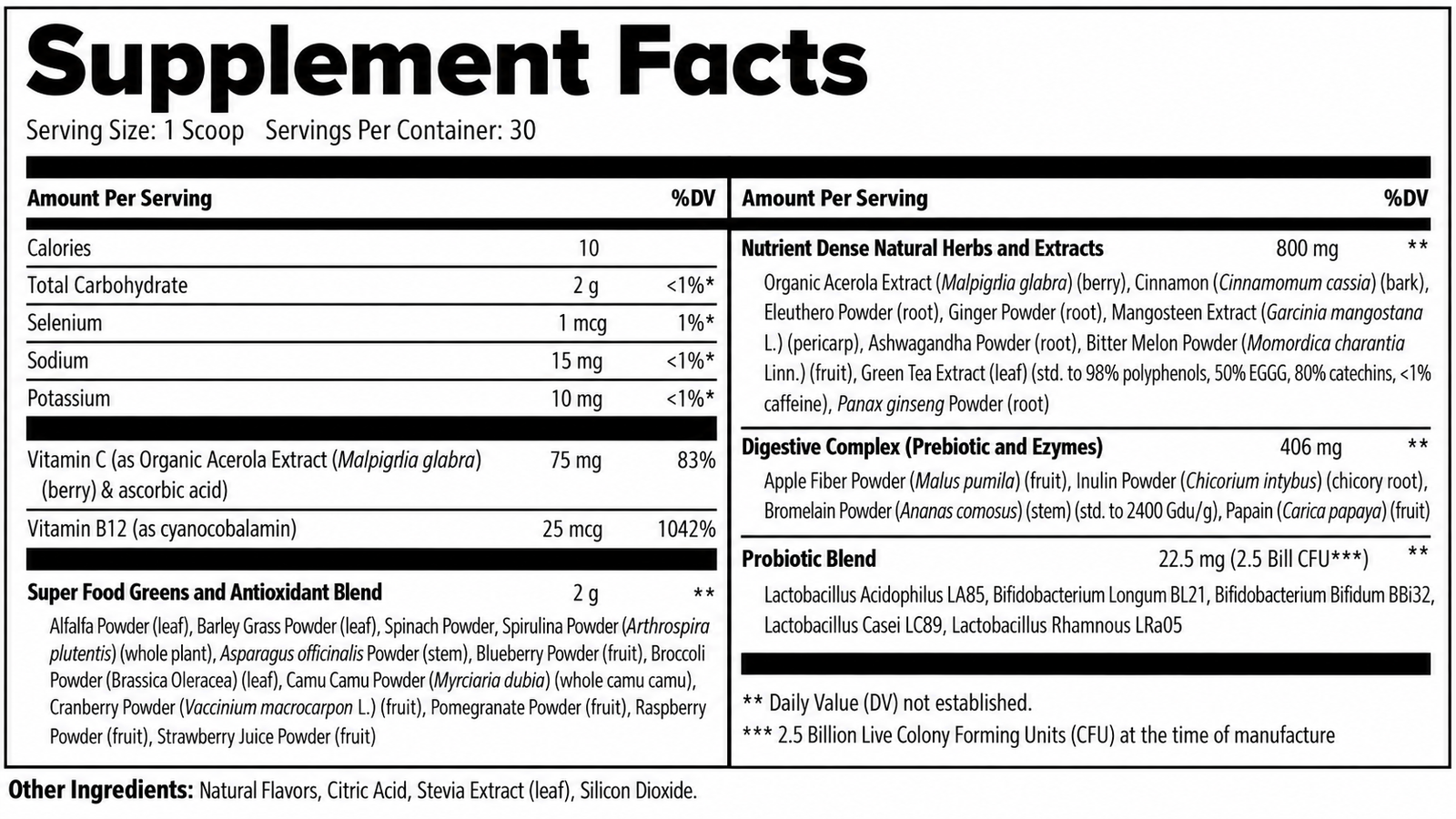
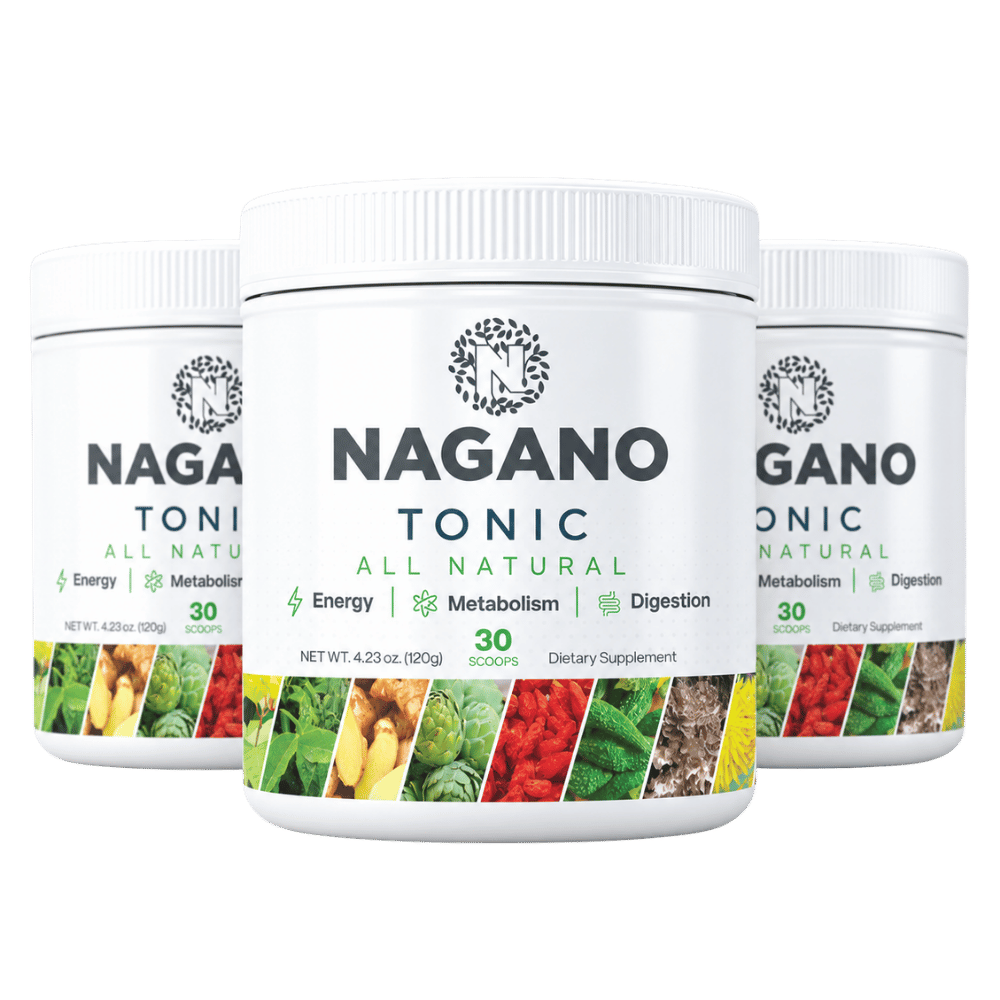
What Does the Nagano Tonic Supplement Facts Label Actually Say?
The Supplement Facts identifies one scoop, 30 servings and four measured blends, plus separately declared vitamins and minerals. The table records each blend’s named contents and what its disclosed amount actually means.
| Label group | Declared amount | Named contents | What can be concluded? |
|---|---|---|---|
| Serving & nutrients | 1 scoop; 30 servings; 10 kcal; carbohydrates 2 g | Vitamin C 75 mg; vitamin B12 25 mcg; selenium 1 mcg; sodium 15 mg; potassium 10 mg. | Nutrient quantities are specifically disclosed. They should not be confused with weight-loss efficacy measurements. |
| Super Food Greens and Antioxidant Blend | 2 g total | Alfalfa leaf, barley grass leaf, spinach, spirulina, asparagus stem, blueberry fruit, broccoli leaf, camu camu, cranberry, pomegranate, raspberry and strawberry juice powders. | Twelve components are named; the 2 g amount applies to their sum, not to any single fruit or green. |
| Nutrient Dense Natural Herbs and Extracts | 800 mg total | Organic acerola extract, cassia cinnamon bark, eleuthero root, ginger root, mangosteen pericarp extract, ashwagandha root, bitter melon fruit, standardized green tea leaf extract and Panax ginseng root. | Nine components share 800 mg. Concentration details for the green tea extract do not reveal its individual dose per scoop. |
| Digestive Complex | 406 mg total | Apple fiber powder, chicory-root inulin, bromelain powder (pineapple stem) and papain powder (papaya fruit). | The blend includes prebiotic and enzyme ingredients, but the inulin grams and enzyme activities delivered per scoop cannot be established from this panel. |
| Probiotic Blend | 22.5 mg; 2.5 billion CFU at manufacture | L. acidophilus LA85; B. longum BL21; B. bifidum BBi32; L. casei LC89; L. rhamnosus LRa05. | Five strains and a manufacturing-time total are identified. Neither individual-strain CFUs nor an expiration-date total are specified. |
| Other ingredients | No per-ingredient amounts stated | Natural flavors, citric acid, stevia leaf extract and silicon dioxide. | These are other formulation ingredients, not additional declared blend actives. |
How Transparent Is Nagano Tonic’s Four-Blend Formula?
The useful distinction is identity versus dose. The label tells readers which components are included and how much each blend weighs. It also provides green-tea extract standardization and probiotic strain codes. The details below show what can be compared with published studies—and what cannot.
Includes plant names, some plant parts, five probiotic strain codes and green tea standardization details.
2,000 mg, 800 mg, 406 mg and 22.5 mg describe the four separate blends.
The green tea extract states 98% polyphenols, 50% EGCG, 80% catechins and less than 1% caffeine; the extract’s weight is not provided.
Viability at purchase or use is a separate question from the manufacturing-time figure.
Can the individual doses be calculated from the blend weights?
No. Nine botanicals sharing 800 mg do not necessarily receive equal portions. Dividing 800 by nine would invent a dose that the label never states. For the same reason, the 406 mg digestive total cannot tell us how much inulin or enzyme activity one serving delivers. This distinction is important when comparing the product with a study using a specific intervention.
Does Nagano Tonic Work for Weight Loss? An Evidence-Led Answer
Short answer: the evidence is mixed and ingredient-specific. Trials of green-tea preparations generally report weight changes too small to matter clinically; a ginger meta-analysis found differences in some body-composition measures but not overall body weight; and an inulin trial tested a defined dietary-fiber intervention in adults with prediabetes. None is a direct test of Nagano Tonic.
| Seller / buyer question | Independent evidence | What transfers to Nagano Tonic? |
|---|---|---|
| “Kickstart dormant metabolism” | Metabolism is a measurable biological process. Some tea catechin and caffeine interventions are studied for energy expenditure, but this is not evidence of a dormant switch being activated. | No specific mechanism, energy-expenditure change or dose-response result for this finished product has been established. |
| Fat loss from EGCG | Cochrane’s randomized-trial synthesis found green tea preparation effects on weight to be very small and unlikely to matter clinically. | Green tea extract is present, but dose and preparation equivalence are unknown; the clinical findings cannot become a product weight-loss promise. |
| Ginger for body composition | A 2025 systematic review of 36 RCTs found modest effects on waist circumference and body-fat percentage, without overall improvement in body weight or BMI. | It supplies context for ingredient selection, not a predicted change for an undisclosed ginger quantity in this blend. |
| Inulin for fullness / appetite | An 18-week RCT enrolled 44 adults with prediabetes, included a dietitian-guided weight-loss phase and tested a defined inulin intervention against cellulose. | The entire Digestive Complex totals only 406 mg; the inulin fraction is unknown, so matching the studied intervention is unsupported. |
| Probiotics and weight | NIH ODS describes inconsistent weight-related outcomes across probiotic studies, dependent on strains and exposures. | Naming five strains is informative, but it does not confirm a product-specific weight benefit or remaining CFUs at use. |
What Do the Most Relevant Ingredient Studies Actually Show?
Study headlines can hide important differences. The source cards below identify who was studied, what was taken, what changed and whether the intervention resembles the Nagano Tonic label.
Green tea catechins and EGCG — the central weight-management research anchor
Green tea for weight loss and weight maintenance in overweight or obese adults
Finding: pooled weight changes from green tea preparations were very small and not statistically significant. No meaningful maintenance advantage was established.
Application: The blend label confirms a standardized green tea extract but not its individual quantity. The trial preparations cannot be assumed equivalent to a Nagano serving.
Read the Cochrane reviewGreen tea extract: possible modest effects, with safety distinctions
Finding: the NIH summary distinguishes brewed tea from concentrated extracts. It reports limited or modest weight-related effects and describes documented adverse events with some high-dose green tea extracts, including liver injury.
Application: The extract’s standardization percentages describe its composition, not the amount ingested per serving. Safety and efficacy should therefore not be inferred from those percentages alone.
Read NIH weight-loss supplement guidanceGinger — research on body-composition outcomes, not a finished-formula result
Ginger supplementation and obesity indices in adults
Finding: pooled findings showed small reductions in waist circumference (about 0.65 cm) and body-fat percentage (about 1.49 percentage points), with no overall significant improvement in body weight or BMI.
Application: Because trial doses and preparations vary, the reported effect sizes should not be treated as predictions for this herbal mixture.
View PubMed recordInulin — a defined fiber intervention with important context
Inulin, weight maintenance and ectopic fat in people with prediabetes
Finding: the study compared inulin with cellulose. Both groups received dietitian guidance during the first nine weeks; greater weight loss was reported in the inulin group during the later maintenance phase, alongside selected liver and muscle fat differences.
Application: the study involved a specific population, intervention and structured diet phase. Nagano Tonic’s entire fiber-and-enzyme blend is 406 mg and the inulin portion is undisclosed. The trial therefore cannot substantiate claims that this scoop reproduces the same appetite or body-composition effects.
View PubMed trialProbiotics — strain identity and viable count matter more than a headline number
What probiotic CFUs and strain labels can tell a buyer
Finding: NIH ODS emphasizes that outcomes vary by microorganism, strain and dose. Higher CFU figures alone do not guarantee stronger benefits. The number of viable organisms can decline during storage, making expiration-date counts more meaningful for comparison.
Application: Nagano Tonic names LA85, BL21, BBi32, LC89 and LRa05, which is more specific than listing a generic “probiotic mix.” However, the stated 2.5 billion CFU is a combined manufacturing-time count, not an individually dosed or shelf-life-guaranteed clinical intervention.
Read NIH probiotic guidanceWhat Are the Main Evidence Gaps?
Four missing data points would materially strengthen a product-level evaluation. Their absence does not invalidate the ingredient list; it limits conclusions about the finished formula.
Direct weight-related outcomes for the complete powder would be more informative than extrapolations from individual ingredients.
A milligram breakdown would allow direct comparison with human study protocols.
Energy-expenditure or comparable measurements would be needed to evaluate claims about metabolism.
An expiration-date count would clarify how many live organisms the buyer can expect at use.
How Should the Seller’s Metabolism, Appetite and Energy Claims Be Interpreted?
The official presentation links its ingredient blend to metabolism, weight, appetite, energy and digestion. The following comparison distinguishes measurable outcomes from promotional language, so readers can interpret those claims without mistaking them for clinical endpoints.
| Seller claim | What can be checked | PRM interpretation |
|---|---|---|
| “Dormant metabolism” or rapid fat burning | Human studies of particular tea, ginger and other ingredient preparations. | The phrase describes a marketing concept, not a clinically defined condition with a demonstrated treatment pathway. |
| Better energy or fewer cravings | Some ingredients have research on metabolic, appetite or fatigue-related endpoints; the formula declares B12. | Vitamin presence does not imply that the product reverses fatigue in people without deficiency; no finished-formula energy or cravings effect is established in this record. |
| Smoother digestion | Inulin, enzymes and five named probiotic strains are present on the label. | A real digestive-oriented ingredient set; effects depend on dose, organism and person, rather than ingredient names alone. |
| “Synergistic” fat-loss formula | The panel confirms simultaneous inclusion of four blends. | Coexistence of ingredients does not establish synergy, enhanced clinical outcomes or causality without direct comparative testing. |
| Testimonials and time-to-results stories | Testimonials are displayed on the seller’s site. | Seller-selected customer stories are not blinded trials or estimates of typical results; they are not used as clinical evidence here. |
How Much Does Nagano Tonic Cost in the U.S.?
These are documented transaction snapshots, not guaranteed future prices. They reflect supplied U.S. ClickBank cart captures taken through the Nagano Tonic affiliate route on October 9, 2026. Exact shipping and taxes must be confirmed in the final cart.
| Package | Listed subtotal | Shipping in observed cart | Observed U.S. total |
|---|---|---|---|
| 1 bottle / 30 servings | $79.00 ($79 per bottle) | $9.95 | $88.95 |
| 3 bottles / 90 servings | $177.00 ($59 per bottle) | $9.95 | $186.95 |
| 6 bottles / 180 servings | $234.00 ($39 per bottle) | Free U.S. shipping | $234.00 |
What Does the 180-Day Nagano Tonic Refund Policy Require?
The official seller policy provides a 180-day window measured from shipment. It is not a guarantee of a free return process: the buyer must contact support, receive confirmation and return all bottles, including empty ones, at the buyer’s postage cost.
Use the shipping confirmation or order paperwork to determine the return-window start.
Request a refund and wait for the seller’s confirmation before returning the order.
The policy requires all supplied bottles, whether empty, opened or unopened, and the buyer pays return postage.
Read the full official refund steps before relying on the guarantee.
Where Do Nagano Tonic’s Product and Offer Facts Come From?
The underlying commercial and scientific evidence is intentionally separated so that readers can tell which statements are labeling facts, seller representations, transaction observations or independent study findings.
Supplied Nagano Tonic Supplement Facts panel
Supports: 30 servings, four blend totals, 30 named blend components, vitamins, minerals, probiotic strains and the manufacture-time CFU qualifier.
Limit: a supplied label photograph is not a batch assay, independent lab test or confirmation that every future shipped lot uses an identical formula.
Official Nagano Tonic product presentation
Supports: what the seller promises and advertises—including a daily scoop, metabolism claims, one-/three-/six-bottle offers and bonuses.
Limit: promotional testimonials and ingredient narratives are not evidence of product-specific clinical efficacy.
Open the official product pageShipping and refund documentation
Supports: the published 180-day-from-shipment process and the seller’s shipping schedule.
Limit: the published three-bottle shipping statement differs from the documented affiliate-route cart total.
Open official refund termsThree U.S. ClickBank checkout captures
Supports: the three checkout totals reported above and the absence of a visible recurring-charge line in those particular carts.
Limit: a dated capture is not a current-price guarantee and does not independently prove future transaction behavior or payment processing.
Open the current seller offerIs Nagano Tonic Safe? What Should a Buyer Check?
Practical safety check: people vary in their tolerance of botanical extracts, fiber and probiotics. Concentrated green tea preparations have distinct safety considerations, while other herbs may interact with medications. Anyone managing a health condition should check suitability with a qualified healthcare professional before use.
NIH ODS reports rare but serious liver-safety concerns with some concentrated green tea extracts; the actual EGCG amount in this formula is unknown.
Prebiotic fiber and probiotics may cause gas or digestive discomfort, particularly in sensitive users.
Discuss botanical supplements with a clinician or pharmacist if you use prescriptions or manage a medical condition.
Pregnancy, breastfeeding, serious illness or immune compromise merit professional assessment before supplementation.
NIH ODS — Weight-loss supplements
Why relevant: explains variable efficacy, medicine-interaction concerns and reports of liver injury linked to some concentrated green tea extracts.
Use: a reference for assessing extract-related cautions and discussing relevant medical history before supplementation.
Open NIH ODS evidence and safety summaryNIH ODS — Probiotics
Why relevant: documents strain dependence, storage-related CFU losses and higher risk in seriously ill or immunocompromised people.
Use: a practical guide to understanding strain labels, storage and higher-risk populations.
Read NIH probiotic guidanceHow This Research Dossier Was Prepared
The Pro Review Metric Editorial Team compared the user-supplied Nagano Tonic Supplement Facts panel with the seller’s current public presentation and policies, documented U.S. affiliate-route ClickBank cart captures supplied for the review, and evaluated independent human evidence from Cochrane, PubMed-indexed research and NIH Office of Dietary Supplements guidance. The research record was checked on October 10, 2026; commercial checkout screenshots were captured October 9, 2026.
For evidence transfer, we considered study design, ingredient form, dose, comparator, population and measured outcome. Seller claims were treated as marketing statements unless independently established. We did not personally ingest Nagano Tonic or conduct a laboratory assay, manufacturing inspection, independent certificate-of-analysis verification, clinical trial or batch-testing program.
Last updated: October 10, 2026. This dossier should be rechecked when the formulation, vendor policies, pricing, published research or material product claims change.