The reviewed physical label shows one capsule per serving, 30 servings per bottle, seven individually quantified vitamins and minerals, and a 351 mg proprietary blend containing fourteen additional active ingredients. Human eye-health research exists for several of those ingredients—especially lutein, zeaxanthin, saffron and selected carotenoid combinations—but the individual blend doses are not disclosed, so the current product cannot be matched cleanly to the doses used in published trials. No independent randomized clinical trial of the complete current VisiFlora formula was identified in the source record reviewed for this dossier.
VisiFlora Research: Quick Answers
The reviewed physical label lists one capsule per serving and 30 servings per container.
Fourteen named blend ingredients share one total amount, so their individual doses cannot be determined from the label.
The live checks showed $9.95 shipping on 2 bottles and free U.S. shipping on 3 and 6 bottles.
Ingredient-level studies should not be presented as proof of the complete current formula.
What Sources Did Pro Review Metric Verify?
The physical Supplement Facts panel controls serving size, listed ingredients and declared amounts. The current seller funnel, affiliate materials, package presentation and live U.S. ClickBank checkout paths were used to document seller positioning, prices, shipping, bonuses, purchase structure and refund language. Seller-controlled commercial terms can change.
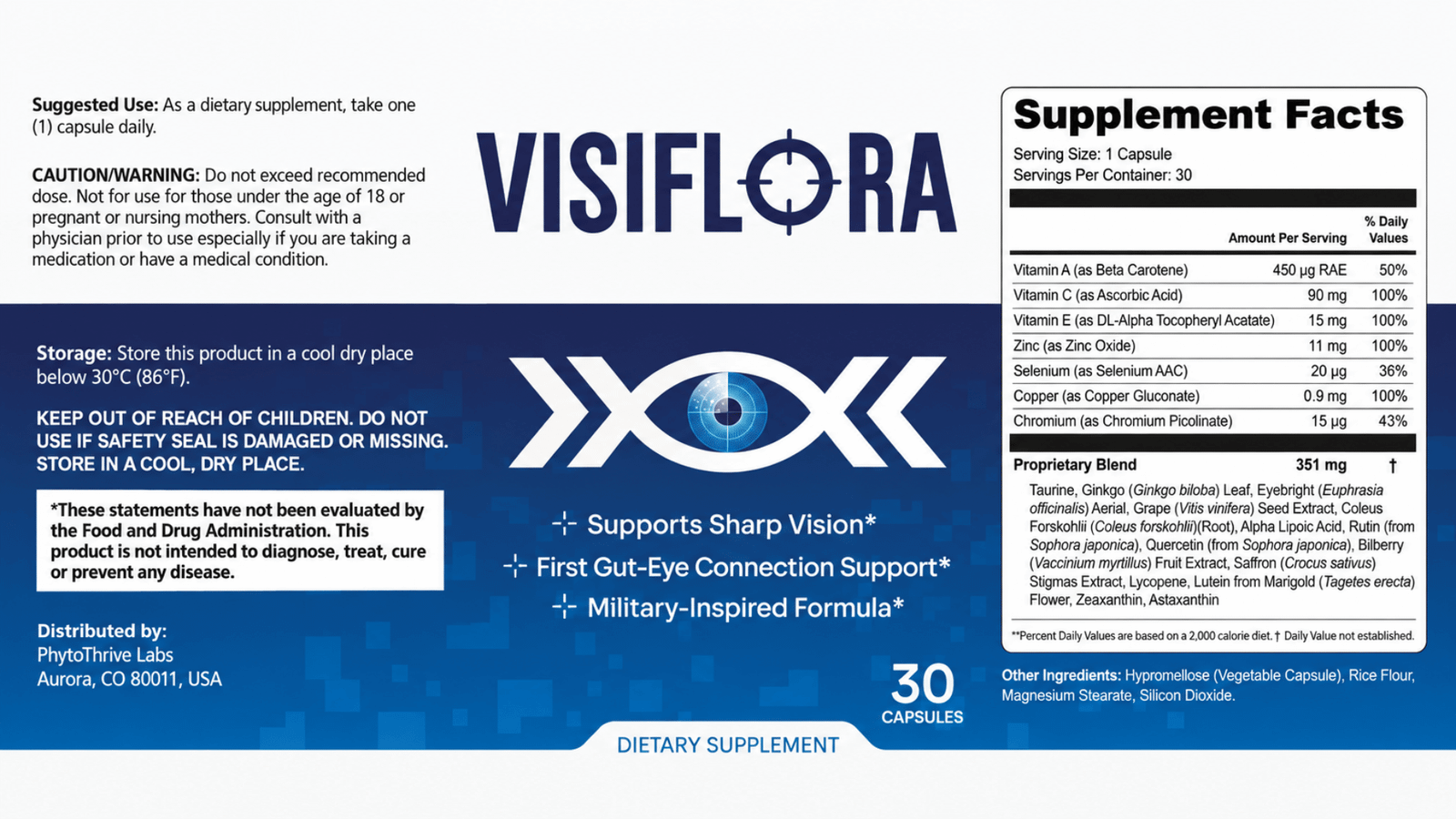
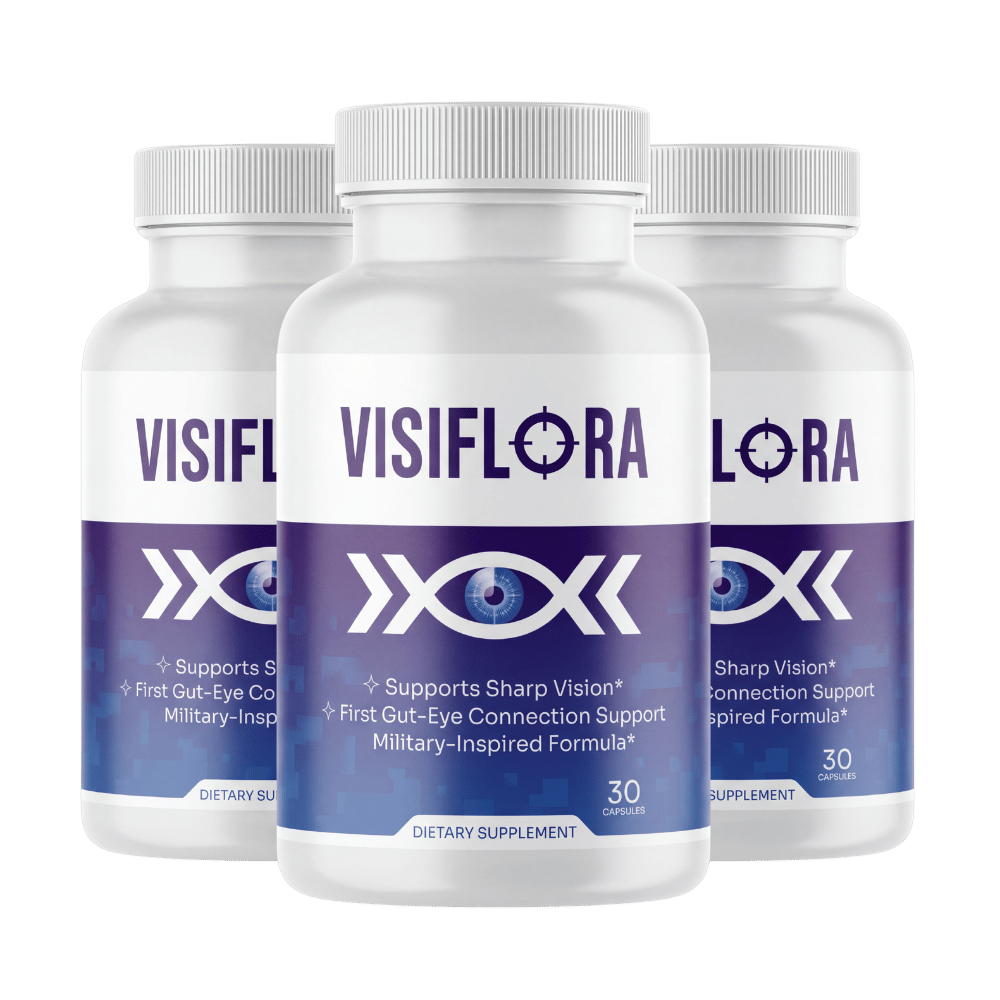
What Does the VisiFlora Label Actually Disclose?
| Label item | Declared detail | What the label supports | Important boundary |
|---|---|---|---|
| Serving Size | 1 capsule; 30 servings per container | The labeled daily serving and approximately 30 labeled daily servings per bottle. | Serving convenience does not establish a vision outcome. |
| Vitamin A | 450 mcg RAE · 50% DV, as beta carotene | Declared vitamin A exposure in one serving. | This amount does not make VisiFlora an AREDS2-equivalent formula. |
| Vitamin C | 90 mg · 100% DV, as ascorbic acid | Declared vitamin C exposure in one serving. | Nutrient presence does not establish a finished-product visual outcome. |
| Vitamin E | 15 mg · 100% DV, as DL-alpha tocopheryl acetate | Declared vitamin E exposure in one serving. | This dose differs materially from the high-dose AREDS2 formulation. |
| Zinc | 11 mg · 100% DV, as zinc oxide | Declared zinc exposure in one serving. | This dose differs materially from the zinc amount used in AREDS2. |
| Selenium | 20 mcg · 36% DV, as selenium AAC | Declared selenium exposure in one serving. | The label does not establish a VisiFlora-specific ocular outcome from this line. |
| Copper | 0.9 mg · 100% DV, as copper gluconate | Declared copper exposure in one serving. | This dose is not the same as the copper amount in AREDS2. |
| Chromium | 15 mcg · 43% DV, as chromium picolinate | Declared chromium exposure in one serving. | The label alone does not establish a vision-support outcome from chromium. |
| Proprietary Blend | 351 mg total | The combined amount for fourteen named active ingredients. | No internal dose split is disclosed, so study-dose matching is not possible. |
| Taurine | Inside 351 mg blend | Presence on the physical label. | Individual dose and contribution to any finished-product outcome are unknown. |
| Ginkgo biloba leaf | Inside 351 mg blend | Presence on the physical label. | Preparation, dose and ocular blood-flow transfer cannot be established from the label. |
| Eyebright aerial parts | Inside 351 mg blend | Presence on the physical label. | Direct human ocular evidence is limited and the dose is undisclosed. |
| Grape seed extract | Inside 351 mg blend | Presence on the physical label. | Individual dose and extract standardization are not disclosed. |
| Coleus forskohlii root | Inside 351 mg blend | Presence on the physical label. | The label does not establish a VisiFlora-specific ocular-circulation effect. |
| Alpha-lipoic acid | Inside 351 mg blend | Presence on the physical label. | Individual dose and finished-product contribution are unknown. |
| Rutin + Quercetin | Inside 351 mg blend | Presence of both compounds on the physical label. | The label does not establish a product-level gut-barrier or vision outcome from these ingredients. |
| Bilberry fruit extract | Inside 351 mg blend | Presence on the physical label. | Dose and extract standardization are not disclosed, limiting comparison with human trials. |
| Saffron stigmas extract | Inside 351 mg blend | Presence on the physical label. | The individual saffron dose cannot be compared with defined-dose AMD trials. |
| Lycopene | Inside 351 mg blend | Presence on the physical label. | Individual dose and direct VisiFlora outcome are unknown. |
| Lutein + Zeaxanthin | Inside 351 mg blend | Presence of both carotenoids in the formula. | Individual amounts are not disclosed, so the formula cannot be dose-matched to AREDS2 or other human studies. |
| Astaxanthin | Inside 351 mg blend | Presence on the physical label. | Individual dose cannot be compared with defined-dose human carotenoid trials. |
| Other ingredients | Hypromellose, rice flour, magnesium stearate, silicon dioxide | The current non-active ingredient list. | PRM did not independently assay identity, purity or batch composition. |
Count discrepancy: the physical panel reviewed by PRM contains seven individually quantified active lines plus fourteen named ingredients in the proprietary blend—21 named active entries in total. The current seller presentation uses “22-in-1” language. PRM could not identify a distinct 22nd active ingredient on the reviewed label and does not invent one to reconcile that difference.
How Transparent Is the VisiFlora Formula?
Vitamin A, C, E, zinc, selenium, copper and chromium have individual label amounts.
The proprietary blend has a clear total amount but no internal dose split.
The label names each ingredient but does not show how much of any one is present.
Lutein, zeaxanthin, saffron, bilberry and astaxanthin cannot be matched reliably to human-study doses.
Does VisiFlora Work? What the Evidence Actually Supports
Short answer: VisiFlora contains several ingredients with legitimate human eye-health research, but that is not the same as proving the current finished formula works for general vision improvement. The strongest ingredient-level evidence concerns lutein and zeaxanthin in defined eye-nutrition formulas, saffron in small AMD trials, and selected carotenoid combinations in screen-use / visual-function research. The current 351 mg proprietary blend prevents exact dose matching, and no randomized trial of the complete current VisiFlora formula was identified in the reviewed source record.
| Seller positioning | Evidence status | PRM interpretation |
|---|---|---|
| Broad vision support / “sharp vision” | Ingredient-level context exists | Several ingredients are relevant to human eye-health research, but the finished-product outcome has not been established. |
| “First Gut-Eye Connection Support” | Emerging mechanism, not product proof | The gut-eye axis is a legitimate research field, but the reviewed literature does not establish that VisiFlora repairs the gut barrier, lowers systemic LPS or restores vision through that mechanism. |
| “22-in-1” formula | Current label count does not reconcile | The reviewed physical label contains 21 named active entries. PRM records the discrepancy rather than assuming a missing 22nd ingredient. |
| Lutein + zeaxanthin eye-health story | Strong ingredient context | The pair has meaningful human evidence, including AREDS2 context, but VisiFlora’s individual doses are undisclosed and the product is not AREDS2-equivalent. |
| Saffron for visual support | Small human RCTs exist | Defined saffron doses have been studied in AMD populations, but VisiFlora’s saffron dose is unknown and the finished formula was not the intervention. |
| Ginkgo + coleus / circulation framing | Transfer is weak | A small ginkgo-only study reported an ocular blood-flow measure, but it did not test coleus, VisiFlora or a visual-acuity outcome. Later ocular evidence is mixed. |
Has the Current VisiFlora Formula Been Clinically Tested?
Direct randomized clinical evidence for the current VisiFlora formula: not identified in the reviewed source record.
Ingredient-level human evidence: yes, especially for lutein / zeaxanthin, saffron, selected carotenoid combinations, bilberry and ginkgo-related ocular research.
Best evidence anchors: defined-dose carotenoid research and small saffron trials.
Major transfer limitation: fourteen ingredients share one 351 mg proprietary blend, so individual research-dose matching is not possible.
What Does Research Say About VisiFlora’s Ingredients?
The evidence record below prioritizes federal eye-health guidance, randomized human studies and recent reviews. Each source is carried only as far as the studied ingredient, preparation, dose, population and endpoint allow.
Lutein + zeaxanthin — the strongest established eye-nutrition bridge
Defined lutein + zeaxanthin exposure in a specific AMD nutrition formula
Finding: NEI guidance documents lutein and zeaxanthin as part of the specific AREDS2 high-dose formulation used for certain people with age-related macular degeneration.
Boundary: VisiFlora does not disclose its lutein or zeaxanthin amounts, and its disclosed vitamin C, vitamin E, zinc and copper exposures differ materially from AREDS2. VisiFlora should not be described as an AREDS2 substitute.
View NEI guidanceLutein + zeaxanthin in adults with high screen exposure
Finding: a defined lutein / zeaxanthin intervention has been evaluated in adults with high screen exposure for visual and ocular outcomes.
Boundary: the study exposure is known; VisiFlora’s individual carotenoid doses are not. A trial of a defined carotenoid intervention is not a trial of VisiFlora.
View PubMed recordSaffron — small randomized human trials provide an eye-health signal
Saffron in adults with age-related macular degeneration
Finding: the trial reported modest changes in selected visual-function measures in adults with mild/moderate AMD.
Boundary: VisiFlora’s saffron amount is hidden inside the 351 mg proprietary blend. The study population had AMD, and the finished VisiFlora formula was not tested.
View PubMed recordSix-month saffron supplementation trial
Finding: the authors reported selected retinal-function signals with a defined saffron intervention.
Boundary: the dose, preparation and AMD population are not equivalent to an undisclosed amount of saffron inside VisiFlora.
View PubMed recordAstaxanthin + carotenoid combinations — relevant, but formulation-specific
Carotenoid combinations in visual-display-terminal eye fatigue
Finding: a defined combination containing anthocyanin, astaxanthin and lutein was evaluated in healthy adults with visual-display-terminal eye fatigue.
Boundary: the intervention was not VisiFlora and used a defined composition. VisiFlora does not disclose its astaxanthin or lutein amount.
View PubMed recordAstaxanthin + lutein + zeaxanthin after screen use
Finding: the study reported selected visual-performance and macular-pigment signals after a defined astaxanthin / lutein / zeaxanthin intervention.
Boundary: VisiFlora does not reveal the individual doses needed to establish formulation equivalence.
View PubMed recordBilberry — some human eye-fatigue and accommodation research
Bilberry extract and visual-display-terminal eye fatigue
Finding: a controlled human study reported improvement in selected eye-fatigue measures with a defined bilberry extract.
Boundary: VisiFlora does not disclose its bilberry dose or standardization. This study does not establish a VisiFlora-specific night-vision or disease-treatment outcome.
View PubMed recordBilberry and visual accommodation
Finding: human research has evaluated defined bilberry preparations for accommodation-related measures.
Boundary: the current VisiFlora label does not reveal a comparable bilberry exposure.
View PubMed recordGinkgo — ocular blood-flow evidence is mixed
Ginkgo extract and ophthalmic-artery blood-flow velocity
Finding: the study reported a 23% increase in ophthalmic-artery end-diastolic velocity after a ginkgo intervention.
Boundary: this was ginkgo only—not VisiFlora, not coleus, not the current 351 mg blend, and not a demonstration of 23% sharper vision. PRM does not transfer that percentage to VisiFlora.
View PubMed recordRandomized / perfusion studies show a mixed signal
Finding: later glaucoma and ocular-perfusion studies have not produced a uniformly positive clinical picture.
Boundary: this makes a simple “ginkgo improves VisiFlora users’ retinal circulation” conclusion too strong.
View PMID 24282229 View PMID 39961352Gut-eye / LPS mechanism — scientifically plausible, but not finished-product proof
Gut-barrier dysfunction, microbial signals and ocular disease biology
Finding: recent literature describes a plausible gut-eye axis involving barrier function, microbial products, immune signaling and metabolites across several ocular-disease contexts.
Boundary: plausibility and disease association do not establish that VisiFlora repairs the gut barrier, lowers systemic LPS or improves human vision through that pathway.
View PubMed recordLPS-related mechanisms remain a research question, not a VisiFlora outcome
Finding: the review discusses endotoxemia and inflammatory pathways as possible contributors to ocular disease biology.
Boundary: the source does not test VisiFlora and does not establish “eye detox,” retinal LPS removal or restoration of eyesight from this supplement.
View PubMed recordWhat Are the Biggest Evidence Gaps?
- No finished-product randomized trial identified. Ingredient research does not establish the efficacy of the complete current VisiFlora formula.
- The proprietary blend prevents dose matching. Fourteen active ingredients share 351 mg and the internal split is unknown.
- The strongest eye-health ingredients are precisely the ones with hidden doses. Lutein, zeaxanthin, saffron, bilberry and astaxanthin cannot be matched directly to published human interventions.
- The seller’s “22-in-1” count remains unresolved. The physical panel reviewed by PRM contains 21 named active entries.
- The gut-eye mechanism is not a finished-product clinical result. PRM did not identify product-specific human evidence that VisiFlora repairs gut-barrier function, lowers LPS or improves eyesight through that pathway.
- Ocular blood-flow evidence is not the same as visual improvement. Small ginkgo studies should not be converted into a VisiFlora visual-acuity percentage.
- Disease-specific evidence does not automatically transfer to a general supplement buyer. AREDS2, AMD and glaucoma studies answer narrower clinical questions.
- PRM did not independently verify manufacturing, raw-material identity, batch purity or a certificate of analysis.
Is VisiFlora the Same as AREDS2?
Short answer: no. VisiFlora overlaps with AREDS2 on several familiar eye-health nutrients, but its disclosed vitamin and mineral amounts are materially different, and its lutein and zeaxanthin doses are hidden inside the proprietary blend. AREDS2 is a specific high-dose formulation studied for defined AMD risk groups, not a generic template that every eye supplement automatically matches.
| Nutrient | VisiFlora label | AREDS2 reference formula | PRM interpretation |
|---|---|---|---|
| Vitamin C | 90 mg | 500 mg | Not dose-equivalent. |
| Vitamin E | 15 mg | 400 IU | Different dose / formulation context. |
| Zinc | 11 mg | 80 mg | Not dose-equivalent. |
| Copper | 0.9 mg | 2 mg | Not dose-equivalent. |
| Lutein | Amount not disclosed | 10 mg | Cannot compare. |
| Zeaxanthin | Amount not disclosed | 2 mg | Cannot compare. |
NEI advises people to discuss AREDS2 use with an eye-care professional because the evidence and intended use are tied to specific stages of age-related macular degeneration. View NEI AREDS2 guidance.
How Much Does VisiFlora Cost?
60-day supply. $9.95 U.S. shipping was shown in the observed checkout path; destination-dependent tax may vary.
90-day supply. Free U.S. shipping was shown in the observed checkout path.
180-day supply. Free U.S. shipping and three seller-advertised digital ebooks were shown.
The reviewed seller / ClickBank path was presented as a one-time purchase rather than recurring autoship.
Where Do the VisiFlora Product and Offer Facts Come From?
VisiFlora physical Supplement Facts panel
Supports: one-capsule serving, 30 servings, seven individually quantified nutrients, 351 mg proprietary blend, fourteen named blend ingredients, other ingredients, suggested use and printed warnings.
Does not prove: finished-product efficacy, batch purity, extract standardization not printed on the panel or the internal dose split of the proprietary blend.
Current VisiFlora seller funnel
Supports: current “gut-eye” positioning, seller claims, package ladder, bonus presentation and seller-described return policy.
Does not prove: that the finished VisiFlora capsule has demonstrated the seller’s biological or visual outcomes in a controlled clinical trial.
View the seller pageCurrent VisiFlora affiliate resource page
Supports: seller-provided promotional angles and current affiliate rules, including SEO permissions, disclosure expectations and restrictions on bypassing the seller funnel.
Boundary: affiliate promotional copy is not independent clinical substantiation.
View the affiliate resource pageCurrent U.S. ClickBank checkout record
Supports: observed totals, U.S. shipping presentation, one-time purchase behavior and the transaction path used for the 2-, 3- and 6-bottle checks.
Does not prove: product effectiveness or that pricing, shipping, tax, bonuses and policy terms will remain unchanged.
Open the current offerHow Strong Is VisiFlora’s Seller Evidence?
Seller materials are useful for documenting what VisiFlora claims and how the offer is presented, but seller language is broader than the independent evidence record. The main gaps are finished-product testing, dose visibility and the step from an emerging gut-eye mechanism to a claimed product outcome.
The current evidence base is ingredient-level and mechanism-level rather than finished-product clinical proof.
The reviewed physical panel does not reveal a distinct 22nd active ingredient.
Emerging biological research should not be converted into a claim that VisiFlora repairs the gut barrier or removes retinal LPS.
Lutein, zeaxanthin, saffron, bilberry, astaxanthin and ginkgo cannot be matched cleanly to published interventions.
Is VisiFlora Safe?
Short answer: VisiFlora should not be described as universally safe. The reviewed label says not to exceed the recommended dose, excludes use under age 18 and during pregnancy or nursing, and advises physician consultation especially for people taking medication or managing a medical condition. Ginkgo adds an additional medication-interaction consideration, while sudden or worsening vision symptoms should be evaluated rather than self-treated with a supplement.
The printed label advises medical consultation for people using medication or managing a medical condition and excludes use under 18 and during pregnancy / nursing.
NCCIH notes that ginkgo may increase bleeding risk with anticoagulants such as warfarin and may interact with other medicines.
Sudden increases in floaters, flashes of light or a curtain / shadow over vision can require urgent evaluation for retinal detachment.
Ingredient safety information does not establish a complete safety profile for the finished multi-ingredient capsule.
NCCIH — Ginkgo
Supports: interaction and bleeding-risk context relevant to a formula that contains ginkgo.
Boundary: this is ingredient-level safety guidance and does not establish the complete VisiFlora safety profile.
View NCCIH guidanceNational Eye Institute — retinal detachment
Supports: sudden new floaters, flashes and a curtain / shadow over vision are warning signs that can require urgent medical evaluation.
Why it matters: seller or affiliate “floater” language should never displace appropriate eye-care triage.
View NEI guidanceHow this dossier was prepared
The Pro Review Metric Editorial Team used the physical VisiFlora Supplement Facts panel as the controlling formula source, then compared it with the current seller funnel, affiliate materials, package presentation and live U.S. ClickBank checkout evidence. Independent evidence was prioritized toward National Eye Institute guidance, NCCIH safety material, randomized human studies and recent PubMed-indexed reviews.
Seller claims remain seller claims. Ingredient research was not presented as proof of the finished formula. Dose, preparation, extract standardization, population, disease context and endpoint differences were treated as evidence-transfer limits.
Pro Review Metric did not conduct a firsthand VisiFlora product-use trial, laboratory assay, manufacturing audit, independent batch test, raw-material authentication or certificate-of-analysis verification.
Last updated: September 17, 2026. This dossier is reviewed when product details, pricing, labeling, seller claims or material evidence changes.