Disclosure: We may earn a commission if you purchase through links on this page, at no additional cost to you. Our editorial conclusions are developed independently.
A closer look inside the liquid formula
What ingredients are in Audifort—and how much do you actually get?
Audifort’s reviewed Supplement Facts label lists chromium at 0.7 mcg (2% Daily Value) plus a 200 mg proprietary blend containing 22 named ingredients. Those include grape seed, Panax ginseng, green tea, guarana, maca, GABA, amino acids and other botanical extracts. The label discloses the combined blend weight—but not the individual dose of any of those 22 components.
Ingredient lists can look impressive at a glance. The more useful question is what kind of formula those names create together—and whether that formula fits the routine you actually want. Audifort gives you a recognizable mix to examine, with one important limit: the label doesn’t tell you how much of each blend ingredient is present.
If you’re tired of comparing separate bottles and long capsule schedules, the appeal is easy to see: Audifort brings botanicals, amino acids and related compounds into one liquid supplement. You can evaluate the whole list in one place, then decide whether that convenience is worth the trade-off in dose detail. It is a practical product choice, not a proven shortcut to better hearing.
Formula facts come from the physical-label record used in PRM’s Audifort Research Dossier. Your current bottle label and seller terms should be checked again before ordering.
Start with the actual Supplement Facts
What does the Audifort ingredient label confirm?
The label confirms one separately quantified micronutrient and one combined botanical-and-compound blend. Chromium has its own amount. The 22 proprietary-blend components do not. That difference is essential when you compare Audifort with a supplement that discloses individual ingredient doses.
| Label detail | Recorded amount or wording | What it means |
|---|---|---|
| Format | Liquid dietary supplement | A dropper-based option rather than capsules. |
| Serving size | 1 mL | The unit used to state the amounts on the panel. |
| Servings per container | 60 labeled servings | Sixty 1 mL units on the reviewed panel; daily bottle life depends on actual measured use. |
| Chromium | 0.7 mcg · 2% DV | Separately listed as chromium picolinate; not evidence of a hearing benefit. |
| Proprietary blend | 200 mg total | Combined weight across 22 named components, without their individual amounts. |
| Suggested use | 1 or 2 droppers full daily | Two permitted use patterns appear in the label directions; seller package durations assume a specific routine. |
| Other ingredients | Glycerin, water, organic lemon extract, stevia extract 97% (Reb A), xylitol, sodium benzoate, potassium sorbate, citric acid, natural flavors | Liquid base, flavoring and preservation components; quantities are not individually stated. |
Some outside product summaries describe different serving counts or ingredient combinations. PRM’s review and dossier prioritize the physical Supplement Facts record they examined, rather than blending incompatible versions. If the bottle you encounter carries a different panel, that difference needs a current seller explanation—not an assumed reconciliation.
The complete inventory, not just the headline herbs
What are all 22 ingredients in Audifort’s 200 mg proprietary blend?
The label names 22 blend components, ranging from plant extracts to amino acids and related compounds. The list below follows the order recorded in PRM’s audited label source; chromium is separate and is not one of these 22.
Blend components · first half
Ingredients 1–11
- Maca (Lepidium meyenii) root extract
- Grape (Vitis vinifera) seed extract
- Guarana (Paullinia cupana) seed extract
- African mango (Irvingia gabonensis) seed extract
- Eleutherococcus senticosus root extract
- Astragalus root extract
- Green tea (Camellia sinensis) leaf extract
- Gymnema leaf extract
- Coleus forskohlii root extract
- Capsicum annuum fruit extract
- Grapefruit (Citrus paradisi) fruit extract
Blend components · second half
Ingredients 12–22
- Panax ginseng aerial extract
- Raspberry ketones
- L-glutamine
- L-tyrosine
- L-arginine base
- Beta-alanine
- Monoammonium glycyrrhizinate
- GABA (gamma-aminobutyric acid)
- L-ornithine HCl
- L-tryptophan
- L-carnitine base
Put the two lists together and a distinctive picture emerges: antioxidant-oriented botanicals, energy-associated plants and amino-acid compounds share one liquid formula. That’s useful for comparing ingredient preferences or spotting something you want to avoid. The 200 mg amount still applies to the entire blend; it cannot be divided into trustworthy individual doses from this label.
Reading the formula by function
Why are these different ingredient groups included?
Breaking the 22 names into groups makes the label easier to use. You can see why Audifort looks different from a single-herb formula, which ingredients might catch your attention, and which ones call for a closer look before they become part of your routine.
Antioxidant-oriented botanicals
Grape seed, green tea and astragalus
These plant ingredients have been studied in antioxidant and broader wellness contexts. Oxidative processes are also relevant to the scientific discussion of ear health, but that connection does not establish a hearing-specific benefit from Audifort. The label does not reveal the amount of any of these extracts.
Green tea may contain caffeine and may matter for medication review; the product does not disclose its caffeine exposure.
Energy and stress-oriented plants
Guarana, maca, eleuthero and Panax ginseng
These ingredients are often found in energy, fatigue or stress-oriented supplements. Guarana can provide caffeine. Panax ginseng has also been studied in humans, but the plant part and dose used in those trials differ from Audifort’s undosed aerial extract.
They help explain the formula’s broad wellness positioning, not a clinically confirmed hearing outcome.
Metabolic and other botanical extracts
African mango, gymnema, coleus, capsicum, grapefruit and raspberry ketones
These ingredients appear frequently in general metabolism or weight-oriented product discussions. Their presence adds breadth, but does not create a proven hearing-specific mechanism or clinical outcome for the finished blend.
Grapefruit deserves special attention for medication users, because grapefruit can interact with certain medicines. The exact relevance of an undisclosed Audifort dose has not been established.
Amino acids and related compounds
Seven amino-acid entries, GABA and a licorice-derived compound
L-glutamine, L-tyrosine, L-arginine, beta-alanine, L-ornithine, L-tryptophan and L-carnitine sit alongside GABA and monoammonium glycyrrhizinate on the label. These differ chemically from the botanical extracts and may matter to a complete ingredient review.
Because the 200 mg blend is shared across all 22 components, independent studies of separately dosed amino acids or GABA do not establish what this product will do.
That is the real appeal—and the real boundary—of this formula: Audifort combines several ingredient categories in a single liquid routine. If a convenient, varied blend is what you’re looking for, that may be worth exploring. If your priority is a precisely dosed, clinically established hearing intervention, the ingredient list alone can’t give you that assurance.
Research is not the same as product proof
Do Audifort’s ingredients have evidence for hearing or tinnitus?
There is some human research involving ginseng preparations and multi-ingredient antioxidant supplementation in tinnitus, but neither intervention was the finished Audifort formula. The study preparations and doses cannot be matched to Audifort’s 200 mg combined blend. A 2026 U.S. tinnitus guideline also recommends against dietary supplements as the primary intervention for persistent, bothersome tinnitus.
| Evidence examined | What researchers studied | What transfers to Audifort? |
|---|---|---|
| Korean red ginseng pilot | A four-week, open-label randomized trial of Korean red ginseng at 1,500 or 3,000 mg/day versus a ginkgo group; selected tinnitus-impact measures changed in the higher-dose group. | Only distant ingredient context. Audifort specifies Panax ginseng aerial extract, with no individual dose, inside a much smaller total blend. |
| Antioxidant combination trial | A 70-person randomized, double-blind trial of a distinct vitamin/mineral/antioxidant intervention that included standardized grape-seed material. | An interesting research direction, but not an Audifort trial or proof that its undisclosed grape-seed amount improves tinnitus. |
| 2026 clinical guideline | A multidisciplinary evidence review for persistent, bothersome tinnitus. | The current medical recommendation is not to use dietary supplements as the primary treatment for that condition. |
Research makes the ingredient story more interesting, but it also helps you ask better questions. The studies above used different preparations and known study doses, so their outcomes should not be assigned to Audifort. Our Research Dossier provides the detailed comparison if scientific support is central to your decision.
Research: Korean red ginseng pilot (2015) · Antioxidant combination trial (2019) · AAO-HNSF 2026 tinnitus guideline.
One small number worth understanding
What does chromium at 0.7 mcg add to Audifort?
Chromium is the only active component on the reviewed panel with an individual dose: 0.7 micrograms, stated as 2% of the Daily Value. Chromium is commonly discussed in relation to nutrient metabolism and insulin action—not as an established treatment for hearing loss or tinnitus.
The NIH Office of Dietary Supplements describes a mixed evidence base for chromium supplementation in metabolic outcomes. Many cited trials use substantially larger amounts than the figure on Audifort’s panel, with different study questions. That research cannot be used to infer a hearing effect from Audifort’s separately declared 0.7 mcg.
In a label dominated by a combined blend, that individually stated chromium amount is a useful point of clarity. It helps you compare what is actually declared without turning a metabolic nutrient into an unsupported hearing claim.
Make the serving make sense
Does one or two droppers a day change the ingredient dose?
Yes, the total amount taken can depend on the actual measured volume, but the label does not establish that every full dropper equals exactly 1 mL. The reviewed Supplement Facts uses a 1 mL serving. Its suggested use says one or two full droppers daily. The seller’s package durations assume a two-dropper routine.
That means a buyer should not automatically equate “one full dropper” with a precisely measured 1 mL or calculate double exposure from an unverified dropper volume. The correct next step is to confirm the marked volume of the supplied dropper and the directions on the current package.
A 60-serving label and a roughly 30-day seller package claim can both be presented under different use assumptions. What you should avoid is confusing an advertised supply duration with a medical recommendation to take more.
The part a label cannot decide for you
A simple routine should come with a clear understanding of what’s inside.
Maybe you started looking into hearing wellness after noticing little moments that are easy to dismiss: turning up the TV, missing part of a conversation, or simply wanting to take better care of yourself. Then you find yourself comparing formulas and wondering what could realistically fit into an ordinary day.
That is where a liquid supplement can feel appealing. One bottle, one familiar routine, no separate handful of capsules to organize. Simplicity is a legitimate reason to prefer one format over another.
Of course, a routine only feels simple when you understand what you’re choosing. The 22 names help you recognize the formula; the shared blend amount tells you where the detail stops. Both facts deserve a place in the decision.
You don’t have to turn that trade-off into an all-or-nothing verdict. You can appreciate a broad, convenient combination while deciding whether its limited dose detail meets your own standard.
The goal isn’t to be persuaded by a long list. It’s to find a routine you can understand, feel comfortable evaluating, and choose for the right reasons.
Six useful checks before purchase
How can you evaluate the Audifort formula before ordering?
Once you know the ingredients, the next step is straightforward: turn that knowledge into a few checks that protect your time, your budget and your peace of mind.
Label identity
Match the 22-component list
Compare the product offered to the exact blend list and separately listed chromium amount. An unfamiliar alternative formula deserves clarification before purchase.
Dose transparency
Know what 200 mg does—and doesn’t—mean
The 200 mg figure belongs to the entire proprietary blend. No individually studied dose is established for grape seed, ginseng or another component.
Daily routine
Check the actual dropper volume
Confirm current directions and whether the supplied dropper is marked in milliliters. Don’t assume one dropper always equals the labeled 1 mL serving.
Medicine compatibility
Review the complete list, not just the featured herbs
Grapefruit, green tea, ginseng and other ingredients make a full-label review useful if you take medication or have a health condition.
Evidence standard
Decide what kind of proof you require
If you require a finished-product human trial with disclosed ingredient doses, the evidence reviewed for this Guide will not meet that standard.
Offer details
Inspect the exact seller route
Check the actual merchant, bottle count, final payment and current return terms on the destination before authorizing an order.
For medication interactions and practical precautions, the relevant question goes beyond ingredients alone. A clinician or pharmacist can help assess the complete list for your circumstances; sudden or unexplained hearing changes warrant medical assessment rather than a supplement experiment.
Safety context: FDA on grapefruit and medicines · NCCIH on Asian ginseng · NCCIH on green tea.
A qualified buying decision
Who should consider Audifort’s ingredients—and who should compare further?
Audifort’s clearest appeal is the format and the combination: a liquid routine with 22 named blend components you can review before buying. If that simplicity matters to you, it makes sense to explore the offer. The deciding question is whether you’re comfortable with the level of dose detail the label provides.
A reasonable fit to explore
Consider the current Audifort offer if…
- You prefer drops to another capsule in your daily routine.
- You are comfortable with a broad formula whose blend ingredients are named but not individually dosed.
- You understand that hearing-support marketing is not a clinically established result for this finished product.
- You can check the current seller, instructions, billing and return terms before paying.
A reason to wait or compare
Look elsewhere first if…
- You want a clinically tested product for restoring hearing or treating persistent tinnitus.
- You require an exact per-ingredient amount to compare with human clinical trials.
- You have unresolved medication, pregnancy, nursing or medical-condition concerns about the complete blend.
- The current bottle, dropper directions or checkout details do not match what you researched.
PRM’s recommendation: If you’d prefer a liquid supplement to assembling a more complicated routine, Audifort earns a closer look for its format and recognizable ingredient mix. Check that the current label matches this record and that the complete offer works for you. If you need individually quantified ingredients or clinical proof of hearing improvement, a different option—or appropriate medical care—will be a better starting point.
Ready to examine the actual product?
Make the formula your starting point—not the promise.
You’ve done the part most sales pages skip: looked past the headline and into the actual formula. You know which ingredients are named, how the liquid serving is presented, and which details matter when comparing Audifort with another option.
If the liquid format and broad blend appeal to you, the next useful step is to examine the current Audifort offer. Match the product to the reviewed label, check the seller and billing terms, and decide whether this is the kind of routine you want to bring home. The link does not preselect a package or promise a health outcome.
The ingredient verdict
Are Audifort’s ingredients worth considering?
Audifort is worth considering for adults who want a convenient liquid format and a broad ingredient mix they can identify by name. Its label makes the composition recognizable, and that matters when you’re comparing products or checking for ingredients that may not suit you.
The trade-off stays important: all 22 components share one 200 mg total, so the label cannot support a dose-for-dose match with clinical research. PRM also has not identified a trial showing hearing improvement from the finished Audifort formula in the evidence reviewed.
That leaves a practical choice. If you value a straightforward wellness routine and can accept those limits, exploring the offer is reasonable. If you’re dealing with tinnitus or hearing loss, don’t put off an appropriate clinical evaluation in favor of a supplement.
Questions buyers ask about the formula
Audifort ingredients: frequently asked questions
What are the ingredients in Audifort?
PRM’s reviewed physical label shows chromium at 0.7 mcg separately plus a 200 mg proprietary blend with 22 listed components. The blend includes maca, grape seed, guarana, African mango, eleuthero, astragalus, green tea, gymnema, coleus, capsicum, grapefruit, Panax ginseng, raspberry ketones, several amino acids, GABA and monoammonium glycyrrhizinate. The complete list appears above.
Does Audifort have 22 ingredients or 23?
It has 22 ingredients inside the proprietary blend and one separate chromium entry on the reviewed Supplement Facts panel. Counting both sets produces 23 declared active entries, but the seller’s “22-ingredient blend” wording refers specifically to the blend components.
How much chromium is in Audifort?
The reviewed label lists 0.7 mcg of chromium (as chromium picolinate) per 1 mL serving, stated as 2% of the Daily Value. That amount is not evidence of a hearing-specific effect.
What is the 200 mg Audifort proprietary blend?
It is the combined total weight printed for 22 named blend ingredients per labeled serving. It is not 200 mg of each ingredient, and the individual amounts are not disclosed.
Are individual doses of grape seed or ginseng published?
No individual dose is stated for either ingredient on the reviewed panel. Both are included among the 22 components sharing a 200 mg blend total.
Is Audifort a liquid supplement?
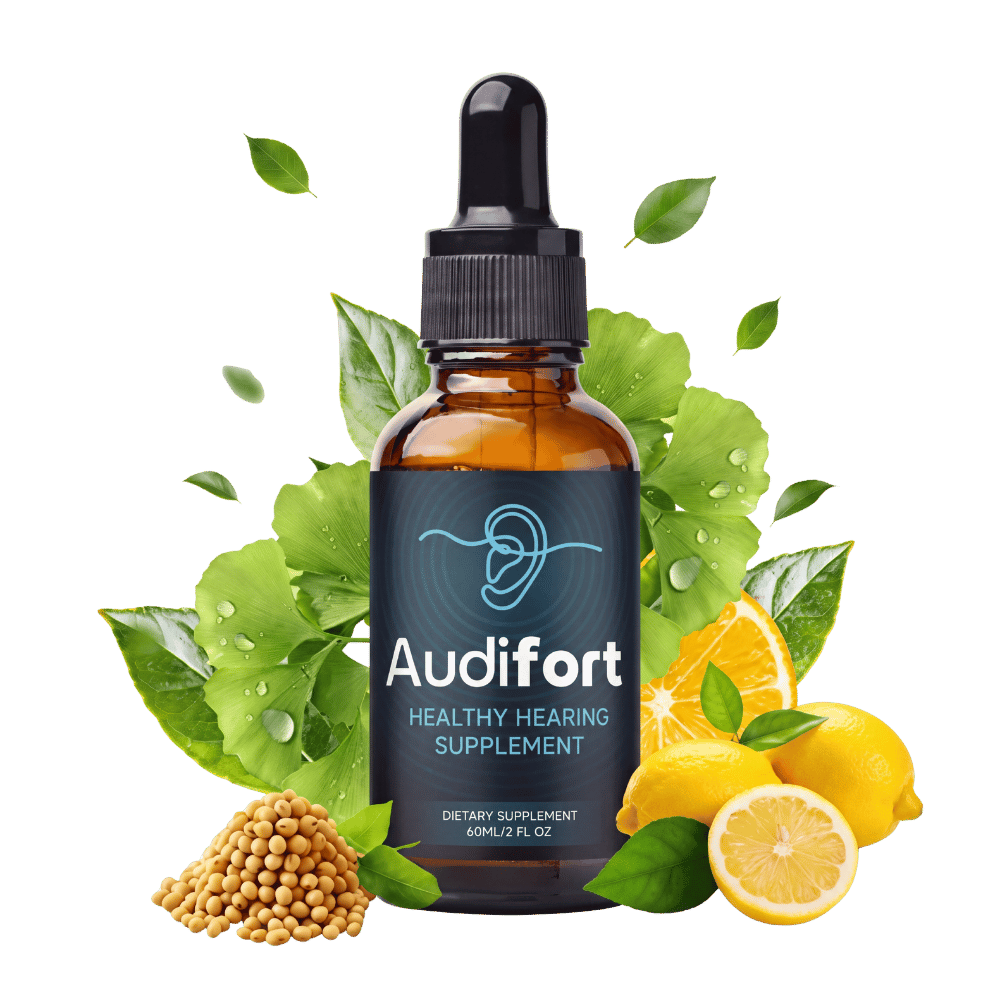
Yes. The reviewed package presents Audifort as a dropper-based liquid dietary supplement with a 1 mL Supplement Facts serving.
How many servings are in an Audifort bottle?
The physical label record used by PRM states 60 servings per container at 1 mL each. Check the bottle currently offered because outside summaries and seller materials may describe different supply durations.
Should Audifort be taken once or twice daily?
The reviewed label says one or two full droppers daily; seller materials describe a two-dropper routine. Because the volume of a full dropper has not been independently verified, confirm the markings and directions on the actual package rather than assuming a fixed milliliter amount per dropper.
Does Audifort contain caffeine?
The listed blend includes guarana and green tea, botanicals that can contain caffeine. The reviewed Audifort label does not state a measured caffeine amount, so PRM cannot calculate exposure from its ingredient list.
Does Audifort contain GABA?
Yes. GABA is listed as one of the 22 ingredients in the proprietary blend. Its individual quantity and finished-product hearing effect are not established by the label.
Does Audifort contain grapefruit?
Yes. Grapefruit fruit extract appears in the blend. Grapefruit can interact with certain medicines, so people taking medications should review the entire formula with a clinician or pharmacist. The specific interaction potential at Audifort’s undisclosed grapefruit dose is not established.
Is Panax ginseng in Audifort the same as the ginseng used in tinnitus studies?
No equivalence has been established. Audifort lists Panax ginseng aerial extract without its individual dose. A published pilot used Korean red ginseng at much higher, specified daily amounts and a different preparation.
Are Audifort’s ingredients clinically proven to improve hearing?
PRM did not identify a human clinical trial of the complete Audifort formula in its reviewed evidence. Research on separate botanicals or another antioxidant combination does not prove hearing improvement from Audifort itself.
Can Audifort treat tinnitus?
It should not be treated as an established tinnitus treatment. The 2026 AAO-HNSF guideline advises against dietary supplements as a primary intervention for persistent, bothersome tinnitus. Seek appropriate medical or audiology care for concerning symptoms.
What are the inactive ingredients in Audifort?
The reviewed label names glycerin, water, organic lemon extract, stevia extract 97% (Reb A), xylitol, sodium benzoate, potassium sorbate, citric acid and natural flavors. Individual amounts are not listed in the reviewed record.
Is the Audifort formula safe with medications?
Suitability cannot be determined from the label alone. Grapefruit, green tea, ginseng and other components may be relevant to medication or health-condition review. Discuss the full formula with an appropriate healthcare professional before use if you take medications or have a medical condition.
Who is Audifort most suitable for?
An adult who prefers liquid supplements, values a named multi-ingredient blend, and accepts that 22 component amounts are undisclosed may find Audifort worth evaluating. Buyers who need an individually quantified or finished-product-tested hearing formula should compare alternatives before purchasing. See our Audifort Review and Research Dossier.
Method and evidence boundaries
How PRM evaluated the Audifort ingredient formula
Pro Review Metric used the physical Supplement Facts record documented in its Audifort Dossier as the controlling source for ingredient names, amounts, other ingredients, serving size and directions. We compared its claims with the published product Review and evaluated independent research on related but different study preparations.
We distinguish label facts from seller marketing and from scientific studies. We did not test a bottle, independently assay the 200 mg blend, verify individual ingredient concentrations or locate a completed-product clinical trial in the source record reviewed. No study result is presented as a measured Audifort outcome.
The producer’s sales and affiliate materials can change, including the landing page, merchant, packages and policies. This ingredient Guide does not represent a live checkout test; all transaction details should be checked at the currently presented offer before payment.
PRM records: Audifort Research Dossier · Audifort Review · PRM editorial methodology.
Independent evidence: Kim et al., Korean red ginseng pilot (2015) · Petridou et al., antioxidant tinnitus trial (2019) · AAO-HNSF tinnitus update (2026) · NIH Chromium Fact Sheet · FDA dietary supplements guidance.
Safety resources: FDA grapefruit interactions · NCCIH green tea · NCCIH ginseng.