Disclosure: We may earn a commission if you purchase through links on this page, at no additional cost to you. Our editorial conclusions are developed independently.
Before the first application
Does Kerassentials have side effects?
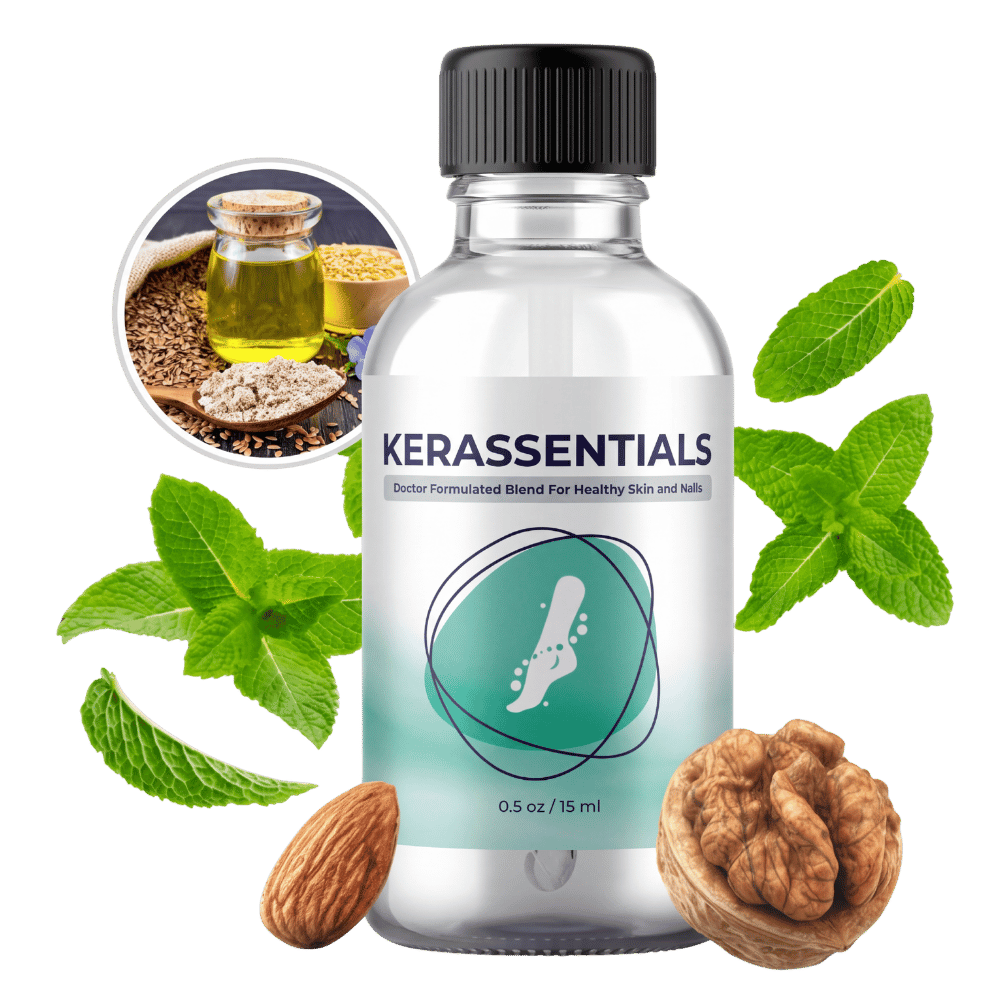
Kerassentials may cause skin irritation or allergic contact reactions in susceptible people. Its documented 17-ingredient topical formula includes tea tree, lavender, lemongrass, clove, camphor and manuka oils, along with menthol, 5% undecylenic acid and almond and walnut oils. The practical signs to watch for are new burning, persistent stinging, itching, redness, scaling, swelling or a rash around the application area. These are plausible ingredient-related concerns—not measured side-effect rates for Kerassentials itself.
The attraction of Kerassentials is easy to understand: a prepared oil applied directly to the nail and cuticle, rather than a set of separate oils to select and mix. But before bringing it into your day, you need to know whether those ingredients are likely to suit the skin that will touch them. The useful question is not “Are natural oils safe for everyone?” but “Are there specific reasons this blend may not be right for me?”
For an adult who wants to make nail care a deliberate habit, Kerassentials offers a defined 17-ingredient formula in one bottle. Its documented four-times-daily directions also give you a realistic test of fit: can you maintain the applications, and do you have any unresolved sensitivity concerns? When those questions have clear answers, comparing an offer becomes a considered decision—not a gamble on the word “natural.”
The formulation and directions above are drawn from the physical Kerassentials label documented by PRM in September 2026. Ingredient-specific risk context comes from dermatology references, including DermNet’s essential-oil allergy review and the tea tree oil contact-allergy literature. Neither reports a Kerassentials finished-product adverse-event rate.
Know the difference
What kinds of reactions should Kerassentials users watch for?
Local irritation and allergic contact dermatitis are different reactions, even though they can look similar. A cooling sensation from an ingredient such as menthol is also not the same thing as proof that a nail treatment is working. What matters is a new, uncomfortable or worsening response, especially on the skin bordering the nail.
Direct skin response
Irritation: burning, stinging or dryness
Irritant contact dermatitis does not require a pre-existing allergy. It can cause dryness, burning, stinging and sometimes redness or peeling near the application site. Repeated exposure or already-damaged skin can make local tolerance more important.
Buyer implication: do not treat persistent discomfort as evidence that an ingredient is “getting to work.” Follow the label’s direction to discontinue if irritation occurs.
Immune-mediated response
Allergy: itching, eczema or swelling
Allergic contact dermatitis is a delayed skin reaction. It may appear a day or more after exposure, even if the first application seemed fine. Itching, a rash, scaling, swelling and occasionally blistering can occur.
Buyer implication: a delayed rash deserves attention rather than another application. A dermatologist may recommend formal patch testing to identify a responsible ingredient.
A different problem entirely
Nail disease: a reason to seek diagnosis
Thickening, discoloration, lifting or pain may arise from fungal disease, injury, psoriasis or other conditions. Those changes are not automatically side effects of the oil or proof that fungus is present.
Buyer implication: if you suspect an infection, have persistent or painful nail changes, or see worsening symptoms, seek clinical evaluation instead of relying on cosmetic improvement claims.
Clinical context: NHS contact dermatitis symptoms · DermNet essential-oil contact allergy · American Academy of Dermatology: nail-fungus diagnosis and treatment.
The formula-specific risk map
Which Kerassentials ingredients deserve the closest safety check?
Not every ingredient carries the same question for every buyer. The essential oils and the named almond and walnut oils are the most useful starting points when checking personal sensitivities. If you have tolerated similar topical products and have no known relevant allergy, that may make the blend easier to consider—but the undisclosed individual concentrations mean no one can predict your response from the label alone.
| Ingredient or group | Relevant safety consideration | What it means before buying |
|---|---|---|
| Tea tree oil | Documented allergic contact dermatitis; oxidized tea tree oil can be more allergenic than fresh oil. | Check any history of reactions to tea tree or fragrance products. Published patch-test findings do not predict your response to Kerassentials. |
| Lemongrass and clove bud oils | Both are recognized essential-oil contact allergens in dermatology references. | A botanical ingredient can be appealing for nail care and still be unsuitable for reactive skin. |
| Lavender, camphor and manuka oils | Part of the aromatic layer; contact-allergy literature includes lavender and other essential oils. Product-specific concentrations are undisclosed. | Consider fragrance and essential-oil sensitivities without assuming every oil has the same risk level. |
| Sweet almond and walnut oils | Nut-derived ingredients warrant special attention for people with relevant allergies. The processing and residual protein content are not documented in the reviewed label. | If you have an almond or walnut allergy, seek guidance from your allergist rather than assuming the topical oil is safe—or that every refined oil has identical risk. |
| Menthol and 5% undecylenic acid | These can contribute to the topical sensory profile; uncomfortable stinging or irritation should not be interpreted as demonstrated benefit. | Judge tolerability by the skin response and the current label cautions, not by the intensity of a sensation. |
| Carrier and conditioning components | Mineral, flaxseed, canola, jojoba and chia oils, aloe vera and tocopheryl acetate help describe the oil-based preparation. Individual sensitivity is still possible. | Review the complete 17-ingredient label, especially if a previous cosmetic product caused a reaction. |
DermNet identifies tea tree, lemongrass and clove among essential oils associated with allergic contact dermatitis. A separate clinical report describes contact allergy involving lavender and tea tree exposure. Food Allergy Research & Education also notes that almond and walnut oils can appear in lotions and other personal-care products. These are useful hazard-identification sources; they do not mean Kerassentials has caused those reactions in a measured proportion of customers.
References: DermNet · Essential-oil allergy patient series · FARE: tree-nut oils in personal-care products. For the exact complete list, see our Kerassentials Ingredients Guide.
Frequency changes the practical question
Does applying Kerassentials four times a day increase the importance of skin tolerance?
Yes. The physical label calls for four daily applications, making skin tolerance and routine fit part of the buying decision. For someone who wants consistent, hands-on nail-and-cuticle care, a defined schedule can be useful. For someone with irritated skin or little time for repeated applications, the same schedule is a reason to pause. Frequency alone does not establish that Kerassentials is unsafe.
First practical question
What is the condition of your skin?
The skin at the nail edge may already be dry, cracked or sensitive. Avoid applying the product to broken or visibly inflamed skin unless a clinician advises otherwise. An existing reaction deserves attention before introducing another topical oil.
Second practical question
Can you follow the actual label?
The documented instructions specify two applications in the morning and two in the afternoon. If you can picture those moments in your normal day, the product may fit your routine better than an improvised collection of oils. Do not increase the frequency to chase faster results, and verify directions on the package you receive.
Third practical question
Will you recognize when to stop?
The label instructs users to discontinue if irritation occurs. Persistent burning, spreading rash or increasing discomfort are not milestones to push through. Stop using the oil and seek advice appropriate to the symptoms.
The documented physical label also instructs external use only, avoidance of eye contact, no swallowing, keeping the bottle away from children and avoiding use if the seal is damaged. Those instructions are part of product suitability, not minor print. A professional allergy assessment, when needed, is different from casually testing a potentially allergenic product yourself.
What the research can and cannot answer
How common are Kerassentials side effects—and has the finished oil been safety-tested?
There is no reliable adverse-event frequency for the complete Kerassentials formula in the reviewed PRM evidence. Studies and clinical reports involving individual essential oils establish that contact reactions are possible. They do not allow us to calculate a “1 in X users” risk for this particular bottle.
A review of tea tree oil contact allergy reports describes how oxidation can increase allergenic potential. A French clinical series involved patients who had already been identified with essential-oil contact allergy, including lavender and tea tree exposure. Neither source is a trial of Kerassentials, and neither provides a population-wide reaction rate for its users.
Unlike an oral supplement, Kerassentials is designed for external application. That changes the principal exposure questions, but it does not justify claiming the formula is medically cleared, free from drug interactions in all circumstances or safe for children, pregnancy and breastfeeding. People in those situations should seek individualized advice when appropriate.
Tea tree oil contact-allergy review, PMID 27173437 · Essential-oil allergy series, PMID 37403438.
When an individual assessment matters
Who should pause before using Kerassentials?
The right screening question is whether a concern applies to you—not whether every possible side effect will happen. A previous reaction to essential oils, relevant nut allergy, broken or inflamed skin, or a nail condition requiring diagnosis should be resolved before purchase. Without those unresolved concerns, you can judge the product on its topical format, ingredient list and practical fit.
Ingredient-specific concerns
Known allergies or previous contact reactions
Prior eczema or itching after tea tree, lavender, clove, lemongrass or fragranced products deserves attention. The same is true of a history of relevant almond or walnut allergy. Seek professional guidance rather than assuming dilution makes the ingredient harmless.
Skin and nail conditions
Broken skin, inflammation or suspected infection
Do not use the oil as a way to ignore a worsening nail, painful skin, discharge or suspected fungal disease. A dermatologist can distinguish fungal infection from other nail problems and advise which treatment—if any—is appropriate.
Additional medical considerations
Pregnancy, breastfeeding or use in a child
The reviewed evidence does not establish safety of this complete essential-oil blend for these situations. Ask a qualified clinician before use. The physical bottle must be kept out of children’s reach and is not for swallowing.
Responding to a problem
What should you do if Kerassentials irritates your skin?
Stop applying it when irritation develops, as the documented label instructs. A symptom appearing after an application does not conclusively identify its cause, but continuing to expose irritated skin is not a sound way to settle that uncertainty.
| What you notice | Why it matters | Appropriate response |
|---|---|---|
| Burning, persistent stinging, dryness or itching | May be local irritation or contact dermatitis. | Discontinue use; consult a pharmacist or clinician if symptoms persist or worry you. |
| New rash, eczema, swelling or blisters | Can reflect allergic or irritant dermatitis, sometimes with delayed onset. | Stop use and seek medical advice; formal allergy testing may be appropriate if reactions recur. |
| Discharge, rapidly worsening pain or feeling unwell | May indicate infection or another condition needing assessment. | Seek prompt medical attention rather than restarting the topical product. |
| Breathing difficulty or sudden lip, tongue or throat swelling | Potential severe allergic reaction. | Seek emergency medical help immediately. |
Clinical guidance: NHS contact dermatitis · NHS severe allergic reactions. Professional patch testing for suspected contact allergy differs from a casual home trial; ask a dermatologist if this is a recurring concern.
Confidence should survive the first application
You shouldn’t have to dismiss discomfort to feel hopeful about your nails.
When a nail keeps catching your attention, there is something appealing about a simple decision: one bottle, a familiar place in your daily routine, and a way to care for the nail and surrounding skin without collecting separate products. You want that small decision to feel manageable, not uncertain.
Then comes the sensible hesitation: what if your skin reacts? Do the essential oils matter for you? Could you recognize a warning sign instead of assuming discomfort is part of the process?
Feeling confident about a product should never require ignoring your skin. Knowing the ingredients, the meaningful allergy signals and the label’s stop-use directions lets you separate a product you might reasonably consider from one that needs a clinician’s advice first.
Once those questions are addressed, the benefit of Kerassentials is easier to judge: one prepared formula, a defined routine and a direct topical application. For someone with an unresolved sensitivity or a nail condition requiring treatment, delaying the purchase remains the better decision.
A decision based on fit
Is Kerassentials a reasonable topical option for you?
If you want a prepared oil for nail-and-cuticle care, Kerassentials has a clear practical appeal: one 17-ingredient topical formula and a defined application routine. The deciding question is whether its botanical oils and other ingredients are suitable for your skin. You do not need to assume the product is irritation-proof to evaluate that fit.
A reasonable reason to explore it
You want a structured topical routine
- You prefer applying one prepared oil instead of blending separate botanical products.
- You have examined the complete label and have no unresolved relevant allergy concern.
- Your skin is suitable for topical application and you know when to discontinue use.
- You can realistically follow the documented four-times-daily routine.
- You understand that cosmetic nail care is not a substitute for diagnosing or treating an infection.
A reason to postpone
Your skin or nails need a different first step
- You have a known allergy to a listed oil or an unresolved history of contact dermatitis.
- The surrounding skin is broken, actively inflamed or reacting to another product.
- You have painful, changing or potentially infected nails without a clear diagnosis.
- You are considering it for a child or during pregnancy or breastfeeding without professional advice.
- You expect a guaranteed fungal cure or want proof of a measured finished-product safety rate.
Let suitability lead the purchase
Should you buy a larger Kerassentials package before checking tolerance?
Once the relevant skin and allergy questions are resolved, the buying decision becomes more straightforward. Compare a quantity you can realistically use with the four-times-daily routine and the checkout total. A package saving only has value if the product is suitable for you; it should not override a known allergy or an unresolved medical concern.
Check the formula
Know what would touch your skin
Review the full label, not only the eight featured ingredients. Consider previous reactions to essential oils, fragrance products and relevant nut-derived ingredients.
Check the routine
Make four daily applications realistic
A larger purchase offers little practical value if the required application schedule does not work for you or your skin cannot tolerate the product.
Check the transaction
Commit to a quantity you understand
Once suitability concerns are addressed, compare current package quantities, the final amount charged, shipping and return terms. Do not assume a bundle has been selected by the link below.
Your next informed step
If the formula suits your skin, compare the Kerassentials offer.
The reason to take a closer look is practical: a prepared nail-and-cuticle oil with 17 documented ingredients, a disclosed 5% undecylenic acid component and a clear application schedule. For someone who wants a structured topical routine instead of sourcing several oils, that combination is worth evaluating.
If you have checked the ingredient list, have no unresolved sensitivity concerns and can follow the schedule, explore the current Kerassentials offer. See which bottle quantity fits your intended use, then confirm the final charge, shipping and return conditions. If a specific allergy or medical question remains, address it before committing.
Our safety conclusion
Is Kerassentials safe enough to consider buying?
Kerassentials may be worth comparing if you want a ready-made topical nail-care routine and have no unresolved concerns about its ingredients. Its appeal is convenient, targeted application with a disclosed formula inventory—not a claim that essential oils are harmless or that the finished product has demonstrated a particular safety rate.
The important advantage for the buyer is clarity: you can read the 17-ingredient list and understand the four-times-daily commitment before placing an order. That makes it possible to evaluate whether the product suits your habits rather than buying only because the ingredients sound appealing.
If the formula and application schedule fit, comparing the current offer is a reasonable next step. Choose a quantity you can use and terms you understand. If your skin is reacting, the nail is painful or a relevant allergy remains unresolved, make the health decision first.
Frequently asked questions
Kerassentials side effects and safety questions, answered
What are the possible side effects of Kerassentials?
Based on its ingredients and the dermatology literature, possible reactions include local irritation, burning, stinging, itching, rash or allergic contact dermatitis. These are plausible ingredient-related reactions; PRM has not established adverse-event rates for the finished product.
Can Kerassentials cause a rash or contact dermatitis?
Yes, a topical blend containing essential oils can trigger irritant or allergic contact dermatitis in susceptible people. Stop use if irritation occurs and seek professional advice for persistent, recurrent or severe symptoms.
Can tea tree oil in Kerassentials irritate skin?
Tea tree oil has documented contact-allergy reports, and oxidation can increase its allergenic potential. The tea tree concentration in Kerassentials is undisclosed, so published rates from other preparations cannot be applied to this finished formula.
Are lavender, lemongrass and clove oils allergy-free?
No. Essential oils including lemongrass and clove are recognized contact allergens, and lavender has appeared in clinical contact-allergy reports. Individual sensitivity varies; their presence does not mean a particular user will react.
Does Kerassentials contain almond or walnut oil?
Yes. Both are on the documented 17-ingredient label. People with relevant nut allergies should obtain individualized guidance because the reviewed label does not establish the oils’ processing or residual allergen content.
Can Kerassentials cause burning or tingling around the nails?
An oil containing aromatic ingredients and menthol can produce sensory effects, but persistent burning or painful stinging should not be treated as proof of benefit. The label instructs users to discontinue if irritation occurs.
How do I tell irritation from an allergic reaction?
The two may look similar. Irritation can occur directly after exposure, while allergic contact dermatitis can develop later and may involve itching, rash or swelling. A dermatologist can evaluate suspected allergy and determine whether patch testing is appropriate.
Is Kerassentials safer because it is applied topically rather than swallowed?
Its intended external-use route differs from taking an oral supplement, but that does not eliminate contact allergy, local irritation or all other risks. The completed Kerassentials formula has not been assigned a reliable safety rate by the reviewed evidence.
Does applying Kerassentials four times daily make it unsafe?
Not necessarily. The documented label directs four daily applications, so repeated exposure makes individual skin tolerance relevant. Do not exceed the directions or continue through irritation.
Can I apply Kerassentials to broken or inflamed skin?
Do not apply it to broken or visibly inflamed skin without medical guidance. If the skin around the nail is damaged, seek advice about the underlying problem and review current packaging warnings.
Is Kerassentials safe during pregnancy or breastfeeding?
PRM’s reviewed evidence does not establish safety of the completed essential-oil blend for pregnancy or breastfeeding. Ask a qualified clinician before use.
Can children use Kerassentials?
Do not assume a topical oil marketed for adults is appropriate for children. The documented label says to keep it out of children’s reach. Seek pediatric clinical advice before considering use.
Can Kerassentials replace antifungal treatment for nail fungus?
No such equivalence has been established. A dermatologist can confirm whether a nail change is fungal and recommend suitable treatments. Kerassentials should not replace indicated medical care.
What should I do if a reaction appears after using Kerassentials?
Stop application. Seek medical guidance for persistent or worsening symptoms, rash, swelling or possible infection. Sudden breathing difficulty or swelling of the mouth, tongue or throat requires emergency medical care.
Should I buy a large Kerassentials bundle before knowing if it suits my skin?
Resolve any relevant ingredient-sensitivity or medical question first. Then compare the current package quantities, charges and policies. A discount does not compensate for a formula you cannot appropriately use.
Where can I review the full Kerassentials formula and buying assessment?
See the Kerassentials Ingredients Guide for all 17 components, the Research Dossier for primary evidence and the full Review for the broader purchasing assessment.
How we assessed the safety questions
Our Kerassentials side effects methodology and independent sources
The formula and application directions come from the physical Kerassentials label documented by Pro Review Metric on September 22, 2026, cross-referenced with the previously completed Kerassentials Review and Research Dossier. The 17 listed ingredients, 5% undecylenic acid, 15 mL bottle and four-times-daily use are historical label observations, not independently verified specifications of every future production batch.
Independent dermatology and public-health sources were reviewed for topical contact dermatitis, essential-oil sensitization, nut-derived ingredients in personal-care products, nail-disease diagnosis and symptoms requiring urgent care. These were evaluated as risk context for listed ingredients, not as finished-product clinical testing.
PRM did not perform a patch test, laboratory composition analysis, clinical trial, user adverse-event survey or batch safety inspection of Kerassentials. The available label does not disclose individual concentrations for the other 16 components, so exact botanical exposure and a numerical adverse-event rate cannot be established. A consumer’s personal tolerance cannot be certified from this article.
For the current purchase, verify the most recent product label and seller terms. The references below support general risk distinctions and are not substitutes for professional assessment of an actual reaction.
PRM documentation: Kerassentials documented physical label · Ingredients Guide · Research Dossier · Full Review.
Independent contact-safety evidence: DermNet — Essential Oil Contact Allergy · Tea Tree Oil Contact Allergy (2016) · Essential Oil Allergy Series (2023) · FARE — Tree Nut Allergens.
Clinical safety and diagnosis: NHS — Contact Dermatitis Symptoms · NHS — Severe Allergic Reactions · AAD — Nail Fungus Diagnosis and Treatment.