Disclosure: We may earn a commission if you purchase through links on this page, at no additional cost to you. Our editorial conclusions are developed independently.
Four blends. One daily decision.
What ingredients are in Nagano Tonic?
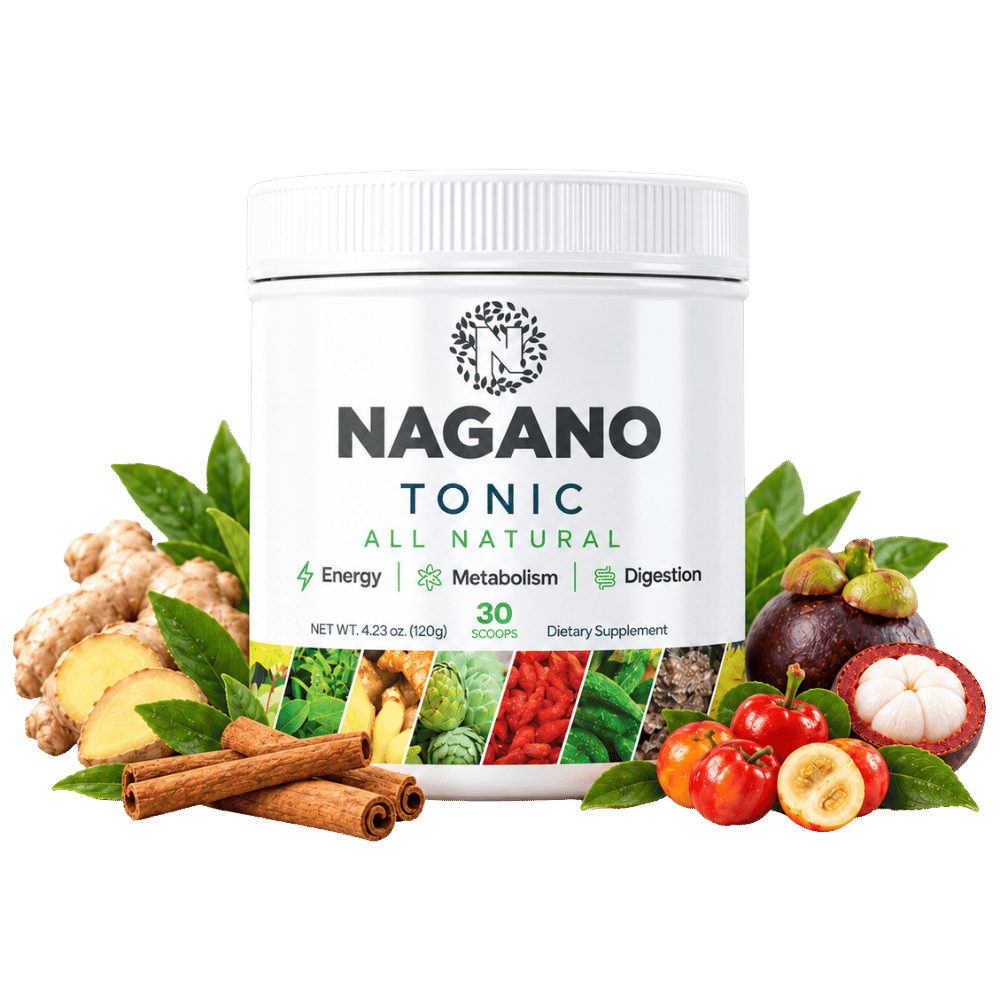
Nagano Tonic brings four groups into one scoop: a 2 g greens-and-antioxidant blend, 800 mg of herbs and extracts, a 406 mg digestive complex, and a 22.5 mg probiotic blend listing five strains and 2.5 billion CFU at manufacture. The label also declares 75 mg of vitamin C and 25 mcg of vitamin B12. Each jar contains 30 labeled servings.
That is the appeal of Nagano Tonic in a sentence: rather than choosing a greens powder, a botanical blend, a digestive formula and a probiotic separately, you can evaluate one ready-made combination.
But convenience is only valuable when it matches what you actually want. A buyer looking for a broad daily powder may appreciate the mix. Someone looking for a precise, clinically studied dose of a single herb may not. The ingredient list tells us which purchase makes sense for which person.
*Probiotic CFU is stated at manufacture. Formula figures come from the documented Supplement Facts reviewed in our Nagano Tonic Research Dossier.
Start with the actual formula
What does one scoop of Nagano Tonic actually deliver?
One scoop supplies four measured blends, two separately quantified vitamins and smaller amounts of other nutrients. The useful distinction is between a blend’s total weight and the amount of any ingredient inside it. Here is what the label allows us to compare.
| Declared component | Amount per scoop | What that means for you |
|---|---|---|
| Greens & Antioxidant Blend | 2 g total | Twelve listed plant powders create the greens-and-fruits foundation. |
| Natural Herbs & Extracts | 800 mg total | Nine botanicals broaden the formula beyond an ordinary greens powder. |
| Digestive Complex | 406 mg total | Apple fiber, chicory inulin, bromelain and papain add a digestive-oriented component. |
| Probiotic Blend | 22.5 mg total | Five identified strains; 2.5 billion CFU declared at manufacture. |
| Vitamin C | 75 mg · 83% DV | A separate, measurable vitamin amount. |
| Vitamin B12 | 25 mcg · 1,042% DV | A separate, measurable amount as cyanocobalamin. |
| Other label values | 10 calories; 2 g carbohydrate; selenium 1 mcg; sodium 15 mg; potassium 10 mg | Nutritional context—not a meal replacement or complete multivitamin. |
A 2 g blend shared by twelve plants does not provide 2 g of each plant. The same is true of the nine ingredients sharing 800 mg. That is the main transparency trade-off of this label, and it is worth understanding once before interpreting the individual components.
Blend 01 · Greens and fruits
Which 12 greens and antioxidants make up the 2 g blend?
The 2 g blend lists twelve plant-derived ingredients. Its value is breadth: leafy greens, vegetables, berries and fruits appear together rather than as separate powders a buyer must choose one by one.
Greens
Alfalfa, barley grass, spinach and spirulina
These familiar greens-powder ingredients give Nagano Tonic its recognizable green foundation.
Why a buyer might care: a plant-forward daily drink without selecting four individual green ingredients.
Vegetables
Asparagus stem and broccoli leaf
Two vegetable-derived components expand the profile beyond grasses and leafy plants.
Why a buyer might care: greater ingredient variety within the same serving.
Berries
Blueberry, cranberry, raspberry and strawberry juice powder
Four recognizable berry sources help explain the blend’s fruit-and-antioxidant positioning.
Why a buyer might care: greens and berries are combined rather than sold as separate categories.
Distinctive fruits
Camu camu and pomegranate
These complete the twelve-ingredient lineup and contribute to the plant variety on the label.
Why a buyer might care: the formula offers more than a single headline green ingredient.
These are ingredients in a powdered supplement, not twelve servings of fruit and vegetables. The sensible reason to value this blend is its convenient range of plant sources, while continuing to get nutrition from food.
Blend 02 · Roots, herbs and extracts
What are the nine herbs in Nagano Tonic’s 800 mg blend?
Its second blend contains acerola berry extract, cassia cinnamon bark, eleuthero root, ginger root, mangosteen pericarp extract, ashwagandha root, bitter melon fruit, standardized green tea leaf extract and Panax ginseng root.
This is the portion that makes Nagano Tonic feel different from a basic greens mix. Instead of one botanical dominating the identity of the product, several familiar herbal categories sit together in a single formula.
Familiar roots and spice
Ginger, cassia cinnamon and acerola
Ginger root and cassia bark are familiar culinary botanicals. Organic acerola berry extract also appears in the formula’s vitamin C context.
What this adds: recognizable ingredients that make the herbal blend easier to evaluate without relying on exotic marketing names.
Traditional botanical roots
Ashwagandha, eleuthero and Panax ginseng
These are distinct root ingredients often discussed in traditional botanical and stress-related research. The label identifies them, but does not give an individual dose for any of the three.
What this adds: a broader botanical profile for shoppers already interested in herbal blends—not a proven stress or energy treatment.
Fruit and plant extracts
Bitter melon, mangosteen and green tea
Bitter melon fruit powder and mangosteen pericarp extract are included alongside standardized green tea leaf extract.
What this adds: additional plant ingredients commonly encountered in metabolism-oriented supplement research.
A useful label detail: standardized green tea
The documented specification lists 98% polyphenols, 80% catechins and 50% EGCG, with less than 1% caffeine in the extract. Those percentages describe the extract—not the percentage of the whole scoop.
Because the individual green tea extract weight is not stated, they do not tell you how many milligrams of EGCG or caffeine the complete serving contains. This is an informative formulation detail, not proof of a particular metabolic result or a caffeine-free claim.
Why this blend may be worth your attention: it adds a recognizable botanical layer to a greens drink. If you already wanted a multi-ingredient herbal powder, that integration may matter more to you than any one ingredient’s reputation.
Blend 03 · Beyond a greens drink
What does the 406 mg digestive complex add?
Apple fiber, chicory-root inulin, bromelain and papain share a 406 mg Digestive Complex. This gives the formula both fiber-oriented and enzyme-oriented ingredients in the same serving.
Fiber and prebiotic component
Apple fiber + chicory inulin
Inulin is a recognized prebiotic fiber. For someone comparing greens powders with products containing gut-oriented ingredients, its inclusion makes Nagano Tonic a broader formulation.
The individual fiber quantities are not provided, so this is not interchangeable with a separately dosed fiber supplement.
Plant-derived enzymes
Bromelain + papain
Bromelain comes from pineapple stem and papain from papaya fruit. The label specifies bromelain powder at 2,400 GDU/g, an enzyme-activity measure.
The activity specification does not establish an individual serving dose or demonstrate a specific digestive outcome from the finished powder.
The meaningful difference: Nagano Tonic is not positioned solely around greens and botanicals; it incorporates a digestive-ingredient category without requiring a separate purchase. Whether that category is important enough to you is a better buying question than whether the ingredient list is unusually long.
Blend 04 · Named cultures
Which probiotic strains are in Nagano Tonic?
The 22.5 mg probiotic blend lists five identified strains and declares 2.5 billion CFU at manufacture. That gives the product a probiotic component as well as a greens, herbal and digestive profile.
| Species named on the label | Strain code |
|---|---|
| Lactobacillus acidophilus | LA85 |
| Bifidobacterium longum | BL21 |
| Bifidobacterium bifidum | BBi32 |
| Lactobacillus casei | LC89 |
| Lactobacillus rhamnosus | LRa05 |
Strain codes are useful identifiers. They do not by themselves demonstrate an outcome, and the label does not assign a separate CFU count to each strain. CFU measures viable organisms; 22.5 mg is the blend’s physical weight. Those figures are not interchangeable.
Amounts you can compare directly
What do vitamin C and B12 contribute to the formula?
The label separately quantifies 75 mg of vitamin C (83% DV), from acerola extract and ascorbic acid, and 25 mcg of vitamin B12 (1,042% DV), as cyanocobalamin.
Vitamin C
A clearly stated 75 mg
Vitamin C plays established roles in normal body functions. Unlike most blend components, its amount is explicit, making it straightforward to compare with other supplements you take.
Vitamin B12
A clearly stated 25 mcg
Vitamin B12 supports normal neurological and blood-related functions. A high percentage of Daily Value does not mean the product will create extra energy in someone who already has adequate B12 status.
Other listed ingredients include natural flavors, citric acid, stevia leaf extract and silicon dioxide. If sweetness, flavoring or any specific ingredient matters to you, these belong in your label comparison too.
Research without exaggerated expectations
Do Nagano Tonic’s ingredients have scientific evidence behind them?
Several ingredient categories have independent human research, but the evidence cited here does not establish predictable results from the finished Nagano Tonic formula. Three references explain what a buyer can—and cannot—take from the research.
Green tea preparations
Studied does not mean substantial weight loss
A Cochrane review found that weight changes observed with green tea preparations were very small and unlikely to be clinically important.
Decision value: green tea is a studied ingredient category, but its presence is not a credible reason to expect dramatic weight loss from this powder.
Chicory inulin
Research requires the studied preparation
A randomized study examined an inulin intervention in adults with prediabetes. It provides context for inulin, but does not make a mixed powder with an undisclosed inulin amount equivalent to that intervention.
Decision value: the digestive category is real; a specific research outcome cannot be assumed for this scoop.
Finished-product evidence
A combination is not automatically a clinical result
NIH guidance explains why ingredient form, quantity and finished-product evidence matter when assessing supplements marketed for weight management.
Decision value: evaluate Nagano Tonic’s documented composition and practical fit without treating its formula as a proven weight-loss treatment.
For the shopper interested in a convenient daily mix, this distinction is liberating rather than discouraging: you can judge the product by what its label actually gives you, without needing to believe an outsized promise to justify considering it.
The decision behind the ingredient list
You can keep comparing powders. Or decide what you actually want to use.
Picture the decision that often comes before a first supplement order: one product has a long greens list, another highlights probiotics, and a third is built around herbs. Each looks interesting for a different reason. But buying all three means three products to compare, pay for and remember to use.
Nagano Tonic offers a different proposition. Its four ingredient categories are already combined into one scoop. You still need to like mixing a powder, and the formula still needs to be appropriate for you. But the product removes the step of assembling that particular combination yourself.
That is where its practical value lives—not in promising to transform your body overnight, but in making one part of your supplement routine easier to choose and repeat.
If that simplicity sounds genuinely useful, the formula deserves consideration. If you would rather control every ingredient and dose, convenience alone should not persuade you to compromise.
A fair comparison
Is a four-blend supplement better than buying separate products?
Not universally. It is a different buying choice. A ready-made powder can reduce the number of products you manage. Separately dosed products can offer more control when you are targeting a particular ingredient.
What Nagano Tonic offers
One combined formula
Greens, nine botanicals, digestive ingredients, five probiotic strains and separately declared vitamins are packaged into one daily serving.
This is a strong fit for buyers who prioritize variety and a simple format.
What standalone products may offer
Greater dose control
If you need a known amount of a specific prebiotic, herb or probiotic strain, an individually dosed product may make research comparison and monitoring easier.
This is a stronger fit for buyers who prioritize precision over consolidation.
The purchase question is therefore specific: does having these four categories together solve a real convenience problem for you? If yes, the formula has a reason to be on your shortlist. If not, its long ingredient list is not a sufficient reason to spend money.
Make the choice appropriate for you
Which ingredients deserve a safety check before buying?
Nagano Tonic includes active botanicals such as ashwagandha, green tea extract, Panax ginseng and bitter melon. Suitability can depend on medications, pregnancy or breastfeeding, health conditions and individual sensitivity. Concentrated extracts can have considerations different from ordinary foods or beverages.
If any of those factors applies, review the complete current label with a qualified healthcare professional before purchasing. For a deeper safety discussion, consult independent references such as NCCIH’s ashwagandha guidance and the NIH supplement overview.
The formula is more appealing when you can buy it with confidence about its suitability, rather than having to overlook a concern to justify the purchase.
Your practical fit test
Who is the Nagano Tonic formula best suited for?
The clearest fit is an adult who wants several supplement categories in a powder and is comfortable judging the formula by its documented composition rather than expecting a clinical outcome.
Worth comparing further if…
You want variety without a complicated routine
- You like a scoop mixed into a drink more than several separate capsules.
- You were already interested in greens, botanicals, digestive ingredients and probiotics.
- A predictable 30-serving jar fits the way you plan supplements.
- You accept that the blend totals are disclosed but individual component doses mostly are not.
- You have checked that the complete ingredient profile suits your circumstances.
A reason to pause if…
Your decision depends on exact doses or medical outcomes
- You need the milligrams of one specific herb, fiber or extract.
- You require guaranteed probiotic potency through expiration or individual strain counts.
- You are looking for a proven treatment or a guaranteed weight-loss result.
- A health condition or medication raises an unresolved ingredient concern.
- You dislike powdered drinks or would not realistically use them.
A good purchase does not mean ignoring the second column. It means recognizing when the first column describes your needs—and choosing only after the material concerns are resolved.
Ready to turn ingredients into a decision?
If four blends in one scoop is what you wanted, compare the current Nagano Tonic offer.
You have seen the ingredient categories, the measured blend totals, the named strains and the main research limitation. The reason to consider Nagano Tonic should now be concrete: one multi-category powdered formula instead of building that combination from several purchases.
At one scoop a day, a jar provides 30 labeled servings. The seller has previously presented one-, three- and six-jar options; the offer currently available may differ. A smaller order reduces the initial quantity commitment, while larger quantities may suit an established routine. Compare the actual total—including applicable shipping—rather than choosing by a headline price.
If the formula suits you and the convenience is worth the cost, checking the current seller presentation is the appropriate next step.
The offer link opens a seller presentation; it does not preselect a jar count. Confirm the current formula, merchant, package, delivered total and terms before ordering.
Three final checks
What should you confirm before ordering Nagano Tonic?
Once the ingredients make sense, the purchase should be just as clear.
01 · Match the formula
Read the product label at the seller
Check that the current packaging still lists the four blends and the amounts discussed here. Do not assume a differently branded or reformulated product has identical ingredients.
02 · Match the commitment
Count servings, then compare total cost
One documented jar supplies 30 scoops. Decide how many you realistically want, then examine the actual checkout amount, shipping and applicable taxes. Do not equate the lowest unit price with the best choice for everyone.
03 · Know the return process
Review the published terms
The seller’s published policy describes a 180-day period from shipment, contacting support and returning all jars—including empty ones—at the buyer’s shipping expense. Confirm the terms applicable to your order.
PRM’s ingredient conclusion
Are Nagano Tonic’s ingredients worth considering?
Yes, if your goal is a convenient four-category powdered supplement rather than an exact-dose treatment. Nagano Tonic has a clear product proposition: greens and fruits, herbs and extracts, digestive ingredients, probiotics, and separately quantified vitamins in one daily scoop.
What makes it interesting is not the promise that every ingredient will deliver a dramatic result. It is the possibility of having a broader supplement routine in one product you are actually willing to prepare.
If you value that combination, the ingredient profile gives you a legitimate reason to compare the offer. If you require precisely dosed botanicals or product-specific clinical weight-loss evidence, the label does not answer that need.
Specific answers before you buy
Nagano Tonic ingredients: frequently asked questions
What are the main ingredients in Nagano Tonic?
The label lists four blends: twelve greens-and-antioxidant ingredients; nine herbs and extracts; apple fiber, chicory inulin, bromelain and papain; and five probiotic strains. Vitamins C and B12 are separately quantified.
How many blends are in Nagano Tonic?
Four. They are listed as 2 g greens and antioxidants, 800 mg herbs and extracts, 406 mg digestive complex, and 22.5 mg probiotics per scoop.
How much Nagano Tonic is one serving?
The documented directions use one scoop mixed into a beverage, and a jar lists 30 servings. Check the directions on the current package before use.
Does Nagano Tonic contain green tea extract?
Yes. The herbal blend lists green tea leaf extract standardized to polyphenols, catechins and EGCG. Its individual milligram amount per scoop is not disclosed.
Is Nagano Tonic caffeine-free?
The green tea extract specification says less than 1% caffeine, but the amount of extract per scoop is unknown. The available label does not establish that the complete product is caffeine-free.
Does Nagano Tonic contain ashwagandha and ginseng?
Yes. Ashwagandha root and Panax ginseng root are listed, along with eleuthero root. The amounts of these individual herbs are not supplied.
What fruits and greens are in the 2 g blend?
Alfalfa, barley grass, spinach, spirulina, asparagus, broccoli, blueberry, cranberry, raspberry, strawberry juice powder, camu camu and pomegranate.
Does Nagano Tonic contain prebiotic fiber?
Yes. Chicory-root inulin appears alongside apple fiber in the digestive complex. The amount of inulin alone is not stated.
Which digestive enzymes does it contain?
Bromelain from pineapple stem and papain from papaya fruit are listed. Both share the digestive complex’s 406 mg total with two fiber ingredients.
Which probiotic strains are in the formula?
The label names L. acidophilus LA85, B. longum BL21, B. bifidum BBi32, L. casei LC89 and L. rhamnosus LRa05.
What does 2.5 billion CFU mean?
CFU counts viable colony-forming units. Nagano Tonic declares 2.5 billion CFU at manufacture; it does not specify separate counts per strain or guarantee the same count through expiration.
What is the difference between 22.5 mg and 2.5 billion CFU?
22.5 mg is the mass of the probiotic blend. CFU measures viable organisms. They are different measurements and cannot be converted directly.
How much vitamin C and B12 does it contain?
Per documented serving: 75 mg vitamin C (83% DV) and 25 mcg vitamin B12 (1,042% DV).
Does the label show the exact dose of every ingredient?
No. It identifies ingredient names and complete blend weights, but most individual botanicals, fibers, enzymes and probiotic strains do not have separately disclosed doses.
Is Nagano Tonic clinically proven to cause weight loss?
The cited studies examine selected ingredients or other preparations. They do not establish predictable weight-loss results for Nagano Tonic as a finished product.
What other ingredients are listed?
The documented label includes natural flavors, citric acid, stevia leaf extract and silicon dioxide. Check current packaging for changes.
Where can I read the full review and research?
See the complete PRM Review for the broader buying verdict and the Research Dossier for the documented label and evidence.
Sources and editorial method
How did PRM evaluate Nagano Tonic’s ingredients?
We compared the documented Supplement Facts with seller-published information and independent research on selected ingredient categories. Our analysis separates label statements from research findings and from our interpretation of the product’s practical value to a buyer. PRM did not personally consume or laboratory-test the powder.
Product documents
- PRM Nagano Tonic Research Dossier — documented formula and evidence.
- Nagano Tonic seller / affiliate information — producer positioning and affiliate guidance.
- Seller refund policy — published order-return conditions.
Independent research
- Cochrane — Green tea and weight management.
- Randomized inulin study — PubMed.
- NIH Office of Dietary Supplements — Weight-Loss Supplements.
- NCCIH — Ashwagandha: Usefulness and Safety.
A documented ingredient is not proof of a finished-product result. Source scope, preparation, dose and individual suitability matter. Read our methodology for the PRM review approach, and verify current packaging, merchant and terms before purchasing.