Disclosure: We may earn a commission if you purchase through links on this page, at no additional cost to you. Our editorial conclusions are developed independently.
Five named components. One important distinction.
What ingredients are in ProDentim?
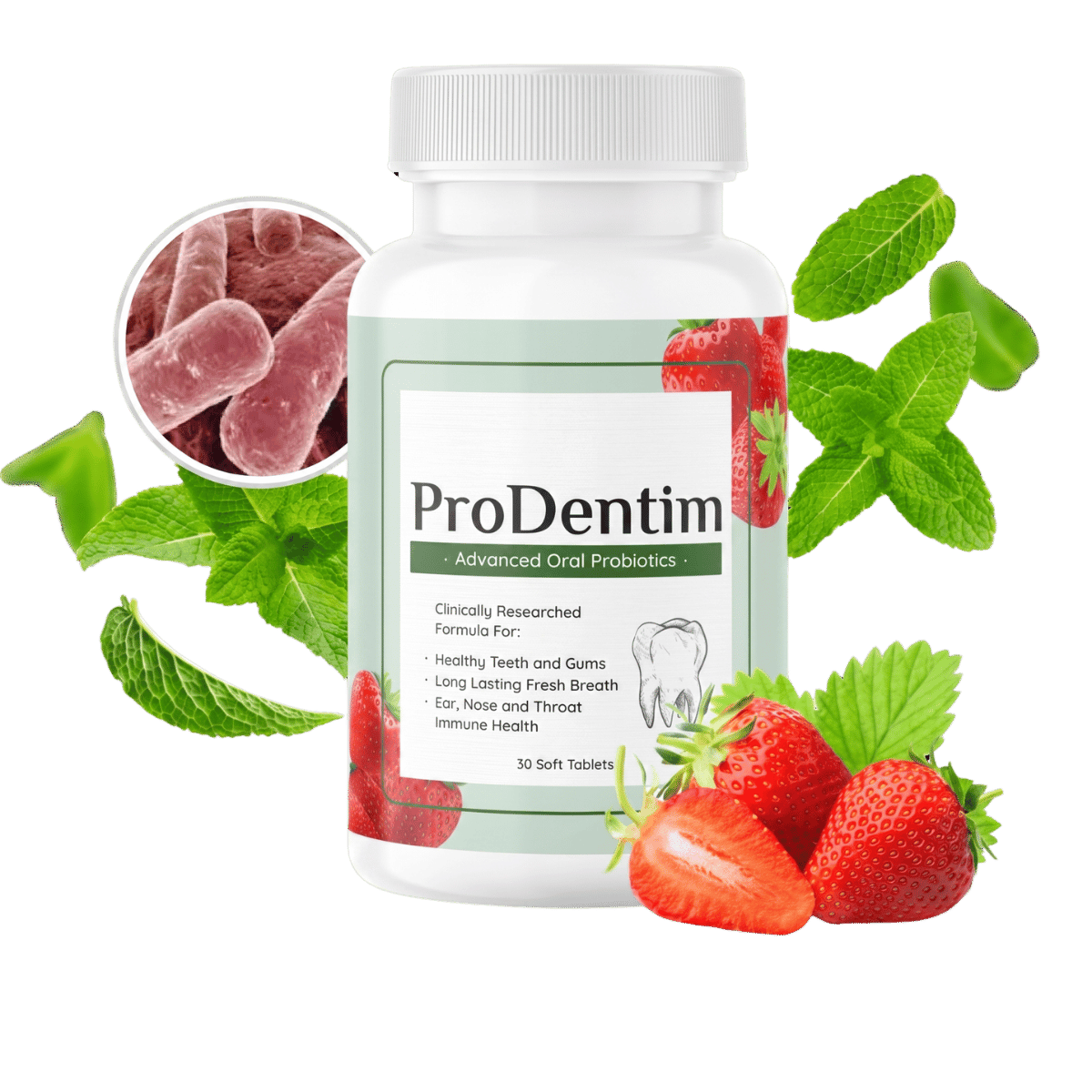
The ProDentim Supplement Facts panel reviewed by PRM lists chicory-root inulin (100 mg), a proprietary probiotic blend (20 mg) containing Lactobacillus paracasei, Lactobacillus reuteri and Bifidobacterium lactis Bl-04®, plus Streptococcus salivarius (20 mg) separately. The main blend declares 3.5 billion colony-forming units (CFU) at the time of manufacture—not per strain and not as a guaranteed count at expiry. One serving is one strawberry-flavored soft tablet designed to dissolve in the mouth.
What makes ProDentim different from another toothpaste or rinse is the role it aims to play: a strawberry-flavored, mouth-dissolving probiotic tablet added to an oral-care routine you already have. You do not have to replace your toothbrush or reorganize your day to understand the appeal of one additional step.
Behind that simple routine is a formula with recognizable probiotic species, a specifically named Bl-04® strain and a measured prebiotic. The ingredient list gives you something tangible to assess—not just a general promise about a healthier smile.
The decision comes down to two things: whether you like the format enough to use it consistently, and whether the label offers enough detail for the kind of evidence you expect. The 3.5-billion-CFU figure belongs to the shared blend at manufacture, while the separate S. salivarius entry is measured in milligrams without a K12/M18 strain designation. We unpack those distinctions below so you can make that decision confidently.
Label baseline: PRM’s photographed Supplement Facts panel, checked August 6, 2026, reproduced and interpreted in the ProDentim Research Dossier. Facts here describe that reviewed panel, not laboratory testing or a newly authenticated batch. Scientific interpretations were cross-checked November 5, 2026.
Start with the actual Supplement Facts—not a promotional list
What does the ProDentim Supplement Facts label disclose?
The reviewed label gives three separately measured formula lines: 100 mg of inulin, a 20 mg three-organism probiotic blend and 20 mg of Streptococcus salivarius. Its 3.5-billion-CFU statement belongs to the shared blend. It does not assign 3.5 billion CFU to each organism or to the separately listed S. salivarius.
| Supplement Facts component | Disclosed per tablet | What we can conclude | What remains unknown |
|---|---|---|---|
| Inulin powder Chicory root (Cichorium intybus) | 100 mg | Identified prebiotic fiber with an individual labeled mass. | Whether this exact amount creates a meaningful oral-health benefit in this tablet. |
| Proprietary probiotic blend L. paracasei, L. reuteri, B. lactis Bl-04® | 20 mg total; 3.5 billion CFU at manufacture | Three named members share one stated mass and manufacturing-time viable-cell count. | Individual species’ mass, CFU contribution and viable count at expiry. |
| Streptococcus salivarius Listed outside the main blend | 20 mg | A separately listed probiotic species with a measured mass. | Its CFU count and strain identity, including whether it is K12 or M18. |
| Other ingredients | No individual amounts listed | Tricalcium phosphate, microcrystalline cellulose, natural strawberry flavor and peppermint essential oil appear on the reviewed panel. | Their individual quantities and any independent clinical contribution to oral-health outcomes. |
Those amounts should be read as label quantities, not as a complete disclosure of each live organism’s dose. A milligram measures mass; a CFU count estimates viable microorganisms under specified conditions. The two units cannot be substituted for each other.
These amounts describe a formula designed for a specific, easy-to-picture routine: let one tablet dissolve after oral care. The reviewed directions allow one tablet once or up to twice daily; a 30-tablet bottle consequently lasts 30 days at once daily or 15 at twice daily. That frequency makes a practical difference when you compare package quantities. Follow the directions on the bottle you receive.
The number looks impressive—but read the footnote
Does ProDentim contain 3.5 billion CFU per tablet?
The reviewed label declares 3.5 billion CFU at the time of manufacture for the main probiotic blend in one serving. That does not mean 3.5 billion CFU for each of its three species, and it does not provide a separately stated live-cell guarantee at the time you consume the tablet.
What the label establishes
One shared manufacturing-time count
Three organisms appear together in a 20 mg blend. The 3.5-billion-CFU statement refers to that blend, and the separate S. salivarius entry has no stated CFU figure.
Meaning: this is a specific starting count, not an empty marketing number—but its scope matters.
What it does not establish
Individual counts or expiry potency
PRM cannot calculate how many CFU are contributed by L. reuteri, L. paracasei or Bl-04®, or what the count will be through the expiration date, from the reviewed panel alone.
Meaning: do not compare the headline number directly with a dose used in a specific strain trial.
The NIH Office of Dietary Supplements explains why strain identification and the duration of a CFU guarantee matter in probiotic labeling. A strain with a strong research record cannot substitute for missing identity or dose information about the organism inside a different product.
The formula’s active core
Which three probiotic organisms are in the ProDentim blend?
The core blend contains Lactobacillus paracasei, Lactobacillus reuteri and Bifidobacterium lactis Bl-04®. These are recognizable probiotic names, but they do not all carry the same level of identification on the label. That distinction controls how confidently clinical research can be applied.
Core blend / Species identified
Lactobacillus paracasei
Part of the shared 20 mg / 3.5-billion-CFU-at-manufacture blend. Researchers have studied specific L. paracasei strains for salivary bacteria, including SD1, but ProDentim’s reviewed panel does not identify its ingredient as SD1.
Buyer implication: the species offers a scientific starting point; the trial-to-product connection remains incomplete.
Core blend / Species identified
Lactobacillus reuteri
A second member of the blend. Human oral-health trials have evaluated named L. reuteri strains, including DSM 17938 and ATCC PTA 5289. Those strain codes do not appear on the ProDentim panel reviewed by PRM.
Buyer implication: a familiar species name cannot establish matching study conditions or clinical benefit.
Core blend / Strain identified
Bifidobacterium lactis Bl-04®
Bl-04® is an identifiable branded strain, unlike the other two species entries. That improves traceability, but the label does not specify Bl-04®’s share of the CFU count or prove the oral-health outcomes of the finished tablet.
Buyer implication: stronger identity information is not the same as a confirmed effective dose.
Together, these three entries explain the product’s everyday proposition: one dissolving tablet brings several probiotic organisms into a single oral-care step. For a buyer who values simplicity over managing separate supplements, that breadth is a genuine feature. It should be judged as a formulation choice, while dose-specific claims remain tied to the exact strains and amounts actually studied.
A named strain is useful evidence—not a clinical shortcut
What is special about B. lactis Bl-04® in ProDentim?
Bl-04® is the only probiotic strain explicitly identified by strain designation in the reviewed core blend. It is associated with HOWARU® strain documentation from IFF, which discusses stability and immune/respiratory research applications. That establishes an identifiable ingredient reference, not a tested dental benefit from ProDentim.
One published randomized gingivitis trial tested B. lactis HN019 as an adjunct to professional dental therapy. That is not Bl-04®, and it would be incorrect to place the HN019 result next to ProDentim’s logo as though the product had been tested. Read the HN019 trial.
For a buyer comparing probiotic labels, Bl-04® is a useful point of differentiation: it is a strain you can identify and research by name. That improves transparency, even though a study of HN019 cannot tell you what Bl-04® will do in this formula. The value is traceability; the clinical question remains open.
The separate probiotic line is easy to misread
Is Streptococcus salivarius K12 or M18 in ProDentim?
The reviewed ProDentim label says Streptococcus salivarius, 20 mg, without identifying K12, M18 or any other strain. It also gives no separate CFU count for this line. PRM cannot call the ingredient K12 or M18 based on the species name alone.
That matters because some of the most discussed oral-probiotic trials involve a particular S. salivarius strain. A small randomized K12 study examined plaque, saliva flow and immune markers; a separate M18 trial investigated gingival indices. Their findings can help explain why researchers are interested in the species, but they do not document the same organism, dose or complete formula sold as ProDentim.
What you can say
The formula includes S. salivarius
The species appears separately with a stated 20 mg mass. Research on identifiable S. salivarius strains provides relevant context for the oral-probiotic category.
What you cannot say
That its strain is K12—or M18
Neither designation appears on the reviewed label. The study CFU amounts and outcomes cannot be assigned to an unidentified S. salivarius ingredient.
For the source studies, see the K12 randomized pilot and M18 randomized trial. These are studies of identified strains, not finished-product trials of ProDentim.
The most visible prebiotic amount
What does the 100 mg of chicory-root inulin add?
Inulin is a prebiotic fiber, and the reviewed ProDentim label lists 100 mg per tablet. Its role in the formula is conceptually distinct from the live microorganisms: prebiotics are substrates that can be used by certain microbes, while probiotics are live organisms themselves.
That is a coherent pairing on paper. It does not establish that 100 mg of inulin changes the oral microbiome, prevents cavities or improves gums when delivered in this exact tablet. Research on inulin in another amount, food matrix or digestive-health setting cannot prove an effect in ProDentim’s oral routine.
That separately disclosed 100 mg amount is useful when comparing ingredient panels: you know exactly what the prebiotic portion contributes by mass, instead of finding it hidden within the probiotic blend. It adds clarity to the formula, even without proving a particular oral-health outcome at that dose.
Four entries that should not be mistaken for clinical actives
Are peppermint, strawberry flavor and tricalcium phosphate active ProDentim ingredients?
The reviewed panel lists tricalcium phosphate, microcrystalline cellulose, natural strawberry flavor and peppermint essential oil as other ingredients. Their presence helps describe the tablet’s composition and sensory presentation. They are not additional clinical outcomes or an independently dosed four-herb treatment blend on that panel.
Other ingredient
Natural strawberry flavor
Contributes to the intended flavor experience. The name does not establish that whole strawberries, a particular malic-acid dose or a whitening effect are present.
Other ingredient
Peppermint essential oil
Part of the tablet’s flavor profile. A fresh sensation should not be equated with a proven long-term breath, gum or antimicrobial outcome.
Other ingredient
Tricalcium phosphate
Appears among other ingredients; the reviewed panel does not give it a separate active dose or establish an enamel-remineralization effect from the finished tablet.
Other ingredient
Microcrystalline cellulose
A commonly used tablet-formulation material. Its inclusion does not convert the supplement into a clinically proven dental product.
If another online ProDentim list describes malic acid, a “four plants and minerals” complex or a different excipient panel, treat it as a different source or possible label version until the actual Supplement Facts are compared. PRM’s physical-label record controls this Guide, not a stitched-together list of promotional claims.
Scientific context requires a fair comparison
What do human studies say about ProDentim-related probiotic strains?
Human studies make the oral-probiotic category worth investigating, but none of the studies below tested the exact ProDentim blend documented in PRM’s product record. Species, strain, formulation, study population and outcome all matter. Some trials show encouraging signals for their specific interventions; others are small, mixed or not statistically conclusive.
| Study and organism | What was examined | Relevant finding | Why it cannot prove ProDentim |
|---|---|---|---|
| L. paracasei SD1 PMID 23892501 | Randomized study of 40 healthy young adults receiving SD1 in milk powder. | Lower salivary mutans-streptococci counts were reported with the studied strain. | ProDentim does not identify SD1; delivery, dose and full formulation differ. |
| L. reuteri DSM 17938 / ATCC PTA 5289 PMID 34325540 | Small randomized adolescent trial of these named strains in tablets. | Some oral indices moved in a favorable direction, but key group differences did not reach statistical significance. | Neither strain code appears on the reviewed label and the small trial does not test this blend. |
| S. salivarius K12 PMID 35268099 | Pilot randomized trial with 31 recruited participants measuring plaque, salivation and salivary IgA. | Plaque measures improved in the study; saliva flow and secretory IgA did not show the same benefit. | The separate S. salivarius entry has no K12 identifier or stated CFU. |
| S. salivarius M18 PMID 37764667 | Randomized trial of young adults with gingivitis using M18. | Some measured plaque and gingival indices improved during the intervention. | M18 is not established as the strain in the current reviewed panel. |
| B. lactis HN019 PMID 36305963 | Randomized gingivitis trial as an adjunct to professional cleaning, with HN019 lozenges. | Certain gingival bleeding measures improved with HN019 versus placebo. | HN019 is a different strain from the listed Bl-04®. |
The fairest conclusion: it is reasonable to see why scientists investigate specific oral probiotics. It is not reasonable to combine their results and announce that a mixed, differently dosed tablet is clinically proven to rebuild gums, prevent tooth decay or eliminate bad breath. This distinction protects the buyer without discarding legitimate scientific context.
Format and practicality—not a shortcut to a clinical claim
Why does ProDentim use a tablet that dissolves in the mouth?
The mouth-dissolving format is the feature you can appreciate before knowing whether the product will deliver an individual benefit. The reviewed directions place ProDentim after ordinary oral care, as a strawberry-flavored soft tablet that dissolves in the mouth rather than a capsule to swallow or another surface-cleaning product.
For someone who already brushes and flosses, that is a practical proposition: one extra step at a familiar moment of the day, without assembling several separate probiotic products. The appeal is not complicated. You can picture how it would fit into your bathroom routine before deciding whether to buy it.
What the format cannot tell us on its own is whether the organisms establish lasting changes in the mouth or achieve a specific dental outcome. Think of the format as a reason to consider ProDentim—and the label and research as the tools for deciding whether it earns a place in your routine.
The serving directions change the real supply
How should ProDentim be taken—and how long does a bottle last?
The reviewed directions allow one soft tablet once daily or up to twice daily, preferably after brushing or mouthwash, and say to let it dissolve completely. There are 30 tablets per bottle, so a bottle offers approximately 30 days at one tablet a day or 15 days at two. Neither the label nor PRM establishes that doubling intake produces a stronger result.
The seller’s general presentation may simplify the instructions to one daily tablet or describe chewing. The reviewed label is more specific about dissolving and the permitted frequency. When your bottle arrives, confirm its exact directions before establishing your routine, especially if it differs from a website’s shorthand.
Choose the frequency before the quantity. Two bottles cover about 60 days at one tablet per day but only 30 days at two. Knowing which routine you would realistically follow turns the package comparison into a better-informed purchase, rather than a guess based on the bottle count alone.
There is more behind the ingredient question
You want a smile that feels like yours—not a label you have to take on faith.
Maybe you have a regular brushing routine, keep floss on the bathroom counter and still catch yourself holding back in a close conversation. Buying another oral-care product is easy. Feeling confident about why you bought it is harder.
A dissolving tablet makes the idea of an extra step simple. Three named organisms and a prebiotic make it sound purposeful. But when the label gives a shared CFU total without each organism’s contribution, you may wonder whether you are choosing something researched—or merely something well presented.
You do not need perfect certainty to explore a product. You do need a clear distinction between what its label tells you and what a study of another strain cannot promise you.
The better purchase is the one that still makes sense after the details are clear. That is the kind of confidence ProDentim’s formula should earn, rather than demand.
A qualified buyer decision
Who is ProDentim’s ingredient formula best suited for?
ProDentim makes the most sense for an adult who likes the idea of a simple oral-probiotic addition to an existing brushing and flossing routine. Its appeal is the combination of a dissolving format, a named three-species blend and a separately measured prebiotic—not a requirement to buy several individual ingredients. Someone seeking a specific, clinically studied strain at a disclosed CFU dose, or a treatment for a dental condition, needs a different standard of evidence and care.
An informed reason to compare
Consider ProDentim if…
- You like a dissolving oral-care format and would use it consistently alongside normal hygiene.
- You value the named probiotic structure and the disclosed inulin amount without treating them as a clinical guarantee.
- You understand that 3.5 billion CFU refers to the shared blend at manufacture, not each species at expiry.
- You have reviewed suitability, allergies and health concerns with an appropriate professional when relevant.
- Its current bottle count, shipping, price and return terms fit your budget and intended daily frequency.
A good reason to wait
Choose more clarity first if…
- You specifically need S. salivarius K12 or M18, L. reuteri DSM 17938 or another clinically studied strain.
- You need separately disclosed CFU per blend member or a verified live count through expiry.
- You are treating persistent bleeding gums, tooth pain, infection or another condition requiring dental care.
- You assume a favorable study of another strain proves that ProDentim works the same way.
- You have not yet checked the actual label or a medical condition that may affect probiotic suitability.
Our recommendation: if an oral-probiotic tablet is the kind of addition you would actually use, ProDentim deserves a look at the current offer. The formula gives you a clear starting point: three blend organisms, one identified Bl-04® strain, separately listed S. salivarius and 100 mg of inulin. Start by matching the current label to your expectations, then choose a supply that suits your intended frequency and budget. There is no reason to buy a larger bundle before you are comfortable with those basics.
One routine. A clearer decision.
Know the strains and their limits. Then choose whether ProDentim fits.
One dissolving tablet combines a three-species probiotic blend, separately listed S. salivarius and 100 mg of inulin. For a buyer who values a straightforward addition to an established oral-care routine, that is a concrete reason to explore ProDentim—not a claim that it replaces dental treatment.
See which current package fits the routine you would actually follow. Compare the label, final amount and return terms on the seller’s presentation before making a decision. The offer link does not preselect a package or guarantee a clinical result.
What to confirm before adding the formula to your day
What should you check on the ProDentim bottle and offer?
01 / Exact Supplement Facts
Match the bottle to the reviewed formula
Look for the 100 mg inulin line, three-species 20 mg blend, 3.5-billion-CFU manufacturing footnote and 20 mg S. salivarius. If the current package differs, use the new panel instead of assuming an older article still applies.
02 / Strain and viability
Look beyond the species names
Check whether any new label names the strains that are currently unidentified or states CFU through expiration. Do not infer either from a general probiotic marketing claim.
03 / How you will use it
Plan for the actual frequency
One daily tablet makes a 30-tablet bottle last 30 days; two daily tablets make it last 15. Follow your package’s directions and seek advice if a health condition or medication warrants it.
04 / Purchase fit
Confirm terms before a larger supply
Check the full checkout amount, merchant, shipping and return requirements on the current offer. A lower unit cost is not better value when the formula is not right for you.
The ingredient verdict, without an inflated promise
Are ProDentim ingredients worth considering?
Yes. ProDentim’s ingredients are worth considering if you want an oral-probiotic step that feels simple enough to keep using. The reviewed label combines a three-species probiotic blend, identifiable Bl-04®, separately listed S. salivarius and a measured inulin component in a strawberry-flavored dissolving tablet. The product’s clearest practical advantage is that you can add this format to a routine you already recognize.
The scientific distinction remains important: the 3.5-billion-CFU count is shared across the core blend at manufacture, individual blend amounts and the S. salivarius strain are not identified, and the available human studies do not establish a clinical benefit from the completed ProDentim tablet. That evidence boundary should shape your expectations, not erase the product’s practical features.
Make the buying decision in the right order: first decide whether a dissolving oral probiotic is an addition you want; next confirm that the current label and use directions meet your expectations; then compare the package total and supply length. If those three checks align, examining the current ProDentim offer is a reasonable next step.
Direct answers to the questions behind the label
ProDentim ingredients and probiotic questions, answered
What are the main ingredients in ProDentim?
The PRM-reviewed Supplement Facts list chicory-root inulin (100 mg), a 20 mg blend of L. paracasei, L. reuteri and B. lactis Bl-04® with 3.5 billion CFU at manufacture, and Streptococcus salivarius (20 mg) outside that blend. Other ingredients include tricalcium phosphate, microcrystalline cellulose, natural strawberry flavor and peppermint essential oil.
How many probiotic strains are in ProDentim?
The core blend lists three probiotic organisms; a separate Streptococcus salivarius entry brings the number of named probiotic species entries to four. Among the core three, only B. lactis Bl-04® carries an explicit strain designation on the reviewed label. The standalone S. salivarius has no strain code.
Does each ProDentim probiotic contain 3.5 billion CFU?
No. The reviewed panel assigns 3.5 billion CFU at the time of manufacture to the three-species blend as a whole, not to each member. It does not specify the CFU contribution of each organism or a count for the separately listed S. salivarius.
Are the 3.5 billion CFU guaranteed until expiration?
The panel reviewed by PRM says “at the time of manufacture.” It does not separately guarantee that same live-cell count through the expiration date. Check the current bottle for any updated potency guarantee or storage instructions.
How much Lactobacillus reuteri is in ProDentim?
Its individual mass and CFU contribution are not disclosed. L. reuteri appears inside a 20 mg blend shared with L. paracasei and B. lactis Bl-04®, with 3.5 billion CFU at manufacture across all three.
Does ProDentim contain Lactobacillus paracasei SD1?
The reviewed label identifies L. paracasei at species level but does not name SD1. A trial of the SD1 strain in milk powder is relevant scientific context, not proof that the same strain or effect is present in ProDentim.
What is Bifidobacterium lactis Bl-04®?
It is the one explicitly strain-identified organism in ProDentim’s three-species core blend. Bl-04® has manufacturer documentation, but the product label does not state its individual CFU, and research on other B. lactis strains such as HN019 is not proof of Bl-04® or ProDentim oral-health effects.
Does ProDentim contain Streptococcus salivarius K12 or M18?
The reviewed label states Streptococcus salivarius, 20 mg, but identifies neither K12 nor M18. Results from clinical studies of those named strains cannot be assigned to the product without evidence that its ingredient matches.
What does the 20 mg Streptococcus salivarius amount mean?
It is the mass listed for a separate product component. Milligrams do not tell us how many live colony-forming units are present, and the reviewed label does not state that organism’s strain designation or CFU.
What does 100 mg of inulin do in ProDentim?
Inulin is a prebiotic fiber, and the 100 mg quantity is shown on the reviewed panel. Its presence makes the probiotic-plus-prebiotic formula concept clear, but does not prove that this amount in ProDentim improves oral health.
Does ProDentim contain peppermint and strawberry?
The reviewed other-ingredients list names peppermint essential oil and natural strawberry flavor. That supports a flavor description, not an independently proven whitening, antibacterial or long-lasting-breath outcome.
Is ProDentim a probiotic or a prebiotic?
It combines both: live-organism probiotic entries and the prebiotic fiber inulin. The product is sold as an oral probiotic tablet; that category does not mean every clinical claim about it has been established.
Has the complete ProDentim formula been clinically tested?
PRM did not identify a randomized clinical trial of the exact finished tablet in the evidence set reviewed. Human studies exist for particular oral-probiotic strains, but some differ from the identities, doses or format disclosed for ProDentim.
Is ProDentim safe for people taking medications or managing dental conditions?
The label and seller advise consulting a healthcare professional when taking medication, pregnant or nursing, or managing a medical condition. Probiotic suitability can vary; the present Guide addresses the formula rather than an individual safety assessment. Do not postpone dental care for persistent pain, bleeding or infection.
Should I chew ProDentim or let it dissolve?
The physical label reviewed by PRM instructs users to allow the soft tablet to dissolve completely in the mouth, ideally after brushing or mouthwash. Some marketing copy is less precise. Follow the current directions on the bottle supplied to you.
How long will one bottle of ProDentim last?
A bottle contains 30 soft tablets and the reviewed serving size is one. At one tablet per day the bottle lasts 30 days; at two tablets per day it lasts 15. Follow your current bottle’s directions and do not assume a larger dose is more effective.
Will ProDentim replace brushing, flossing or dental treatment?
No. A probiotic supplement is an optional addition to—not a replacement for—appropriate oral hygiene, fluoride toothpaste, cleaning between teeth and professional dental evaluation when needed. The finished product has not been established in PRM’s evidence set as a treatment for dental disease.
Are ProDentim’s ingredients worth the price?
The ingredient mix and dissolving format may be appealing if you accept the dose and strain-evidence limitations. Compare the actual current checkout and expected supply against your budget before ordering; do not assume a larger bottle bundle is better solely because its advertised unit price is lower.
Sources, dates and the line between product and study
How PRM checked the ProDentim ingredient list
PRM used the physical Supplement Facts panel documented during its original ProDentim investigation on August 6, 2026 to establish the one-tablet serving, 30-tablet package, disclosed components, probiotic count footnote, label directions and other ingredients. This Guide was written with a November 5, 2026 check of its independent scientific and published seller-policy references. We did not receive or test a newly manufactured product batch in this review.
When seller advertisements simplify or expand an ingredient list, the archived physical-label record controls what we report for the version studied. A current customer’s bottle may differ, and any different panel should be checked instead of harmonized with older marketing claims. The photos and original record are in the PRM ProDentim Research Dossier; the independent Review explains overall suitability and the historical offer record.
We treated manufacturer descriptions of Bl-04® as identification evidence, not independent proof of dental benefit. The human trials linked below were assessed for exact strain, studied population, intervention format and outcome. They do not demonstrate efficacy of this combination at undisclosed per-strain CFU or through-expiry potency. PRM did not perform a laboratory viability assay, conduct a clinical trial, test a purchase or independently validate current affiliate attribution.
PRM product record: ProDentim label and Research Dossier · ProDentim Review. Probiotic labeling guidance: NIH Office of Dietary Supplements · IFF HOWARU® Bl-04® strain information (manufacturer source).
Human study references: L. paracasei SD1 (PMID 23892501) · L. reuteri DSM 17938 / ATCC PTA 5289 (PMID 34325540) · S. salivarius K12 (PMID 35268099) · S. salivarius M18 (PMID 37764667) · B. lactis HN019 (PMID 36305963).
Seller terms for buyer verification: Published ProDentim affiliate and promotion rules · Published seller refund policy. These are seller-controlled, not clinical sources; confirm the applicable current terms with the checkout merchant.