Disclosure: We may earn a commission if you purchase through links on this page, at no additional cost to you. Our editorial conclusions are developed independently.
Nine named ingredients. One practical question.
What ingredients are in Prostadine?
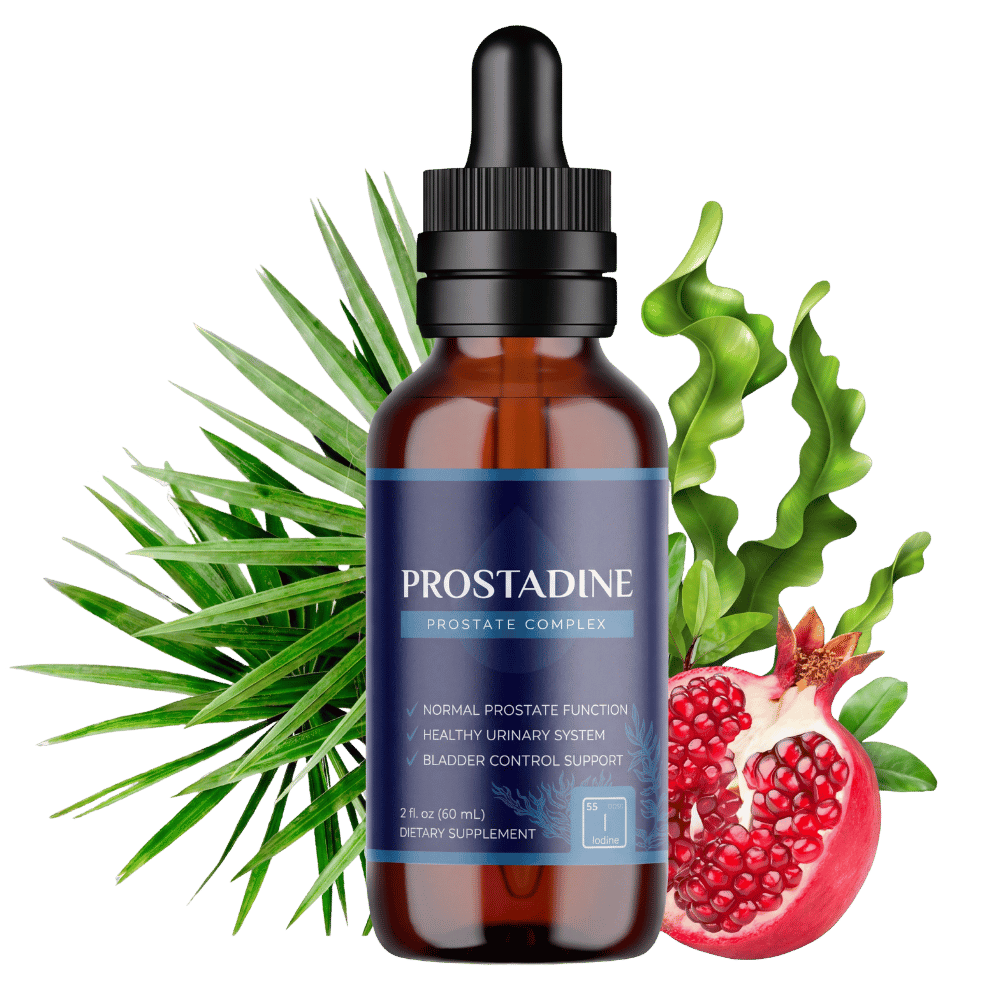
Prostadine contains nine named active components in a liquid prostate-support supplement: iodine; nori yaki, wakame, kelp and bladderwrack; neem oil and saw palmetto essential oil; pomegranate extract; and shilajit extract. The reviewed physical label declares 275 mcg of iodine, a combined 500 mg neem/saw-palmetto oil blend, four 10 mg seaweed lines and two 5 mg extracts per 2 mL serving. The individual amounts of the two oils are not disclosed.
Those details make Prostadine different from a generic prostate capsule. The formula has a recognizable marine identity, and the routine is deliberately small: shake the bottle and take two full droppers once daily, preferably in the morning. For someone tired of adding yet another complicated step to the day, that simplicity is an understandable part of the appeal.
But ingredient names alone don’t answer the buying question. You need to know which amounts are printed, where the iodine comes from, what the 500 mg blend actually tells you, and whether ingredient research can reasonably apply to this specific liquid.
Here, the label is more informative than a sales headline. It makes the mineral and six separate botanical or seaweed amounts visible, while leaving the two oil proportions undisclosed. That mix of clarity and uncertainty shapes how we would evaluate the product—and whether we’d consider the current offer.
Formula amounts are from the physical Supplement Facts panel recorded in PRM’s Prostadine Research Dossier (September 8, 2026). They describe the reviewed label, not an independent laboratory assay of today’s bottle.
Read the actual serving, not the promotional ingredient list
What does the Prostadine Supplement Facts label disclose?
One serving is two full droppers (2 mL), and one 60 mL bottle provides 30 labeled servings. The table below separates ingredients with individual amounts from oils listed only inside a combined proprietary blend. This matters when comparing Prostadine with standalone supplements or trying to match research doses.
| Label item | Amount per 2 mL | What this lets you assess |
|---|---|---|
| Iodine | 275 mcg · 183% Daily Value; from potassium iodide, nori yaki, wakame and kelp | Total declared iodine exposure in the serving; the individual source contributions are not stated. |
| Proprietary oil blend | 500 mg total · neem oil + saw palmetto essential oil (Serenoa repens) | Combined blend amount only. Neither oil’s individual dose or proportion is disclosed. |
| Nori Yaki Extract Powder (leaf) | 10 mg | A quantified seaweed line; also named as one iodine source. |
| Wakame Extract (leaf) | 10 mg | A second quantified marine extract; also named in the iodine declaration. |
| Kelp Powder (leaf) | 10 mg | Quantified seaweed ingredient with iodine relevance. |
| Bladderwrack Powder | 10 mg | A fourth separately listed marine ingredient, with no matched human urinary-outcome trial established. |
| Pomegranate Extract (fruit) | 5 mg | A named fruit extract; the label does not provide its standardization. |
| Shilajit Extract (gum & resin) | 5 mg | A named resin extract; available human trials examine different doses and endpoints. |
| Other ingredient | MCT oil; quantity not stated | The carrier listed outside the named active components. |
There are nine named active components: iodine, the two oils, four seaweed ingredients, pomegranate and shilajit. Do not mistake nine names for nine separate dose disclosures. The label has one iodine amount, six botanical or seaweed amounts, and one total covering both oils.
Transcription follows the reviewed physical label shown in PRM’s Review and discussed in the Research Dossier. The seller’s shorter marketing list is not a substitute for the Supplement Facts panel.
The formula’s identity, explained
Why are iodine and four kinds of seaweed central to Prostadine?
Because the formula doesn’t merely mention a generic “marine complex.” It names nori yaki, wakame, kelp and bladderwrack as four separate 10 mg lines, and discloses 275 mcg of total iodine supplied from potassium iodide and several seaweed sources. That specificity distinguishes Prostadine’s ingredient identity from a one-botanical pill.
It is useful to separate formula identity from clinical advantage. Iodine is an essential mineral for making thyroid hormones. Seaweeds can contain iodine and other compounds. Neither fact establishes that this mixture reduces prostate enlargement, improves urine flow or addresses the seller’s hard-water narrative.
10 mg · seaweed
Nori Yaki Extract
One of the individually measured marine ingredients and an identified iodine source. Its appearance on the label tells you what is present; it does not establish a 10 mg clinical dose for urinary symptoms.
10 mg · seaweed
Wakame Extract
Another quantified seaweed inclusion. Studies of marine compounds may be scientifically interesting, but they do not demonstrate the outcome of this precise extract amount in Prostadine.
10 mg · seaweed
Kelp Powder
A separately listed powdered seaweed also named among the iodine sources. It makes total iodine exposure worth understanding, especially if your diet or other supplements also supply iodine.
10 mg · seaweed
Bladderwrack Powder
The fourth 10 mg marine line. Its inclusion broadens the formula’s botanical profile, without establishing an independently tested prostate-support effect at this dose.
The buyer benefit here is clarity of composition: you can see which seaweeds are present and at what declared amounts. It is not a license to infer that four seaweeds are four proven treatments. That distinction makes the comparison more useful, not less.
A number worth understanding before checkout
Is Prostadine’s 275 mcg of iodine a meaningful dose?
Yes. The label reports 275 mcg per serving, or 183% of the U.S. Daily Value. For context, the NIH Office of Dietary Supplements lists 150 mcg as the recommended daily amount for most adults and 1,100 mcg as the adult tolerable upper limit from food and supplements combined. Prostadine’s labeled serving is below that upper limit on its own, but that is not a personal safety guarantee.
Do not add the listed seaweed weights as if they were extra measured iodine. The 275 mcg declaration already identifies potassium iodide, nori, wakame and kelp as sources, without allocating the iodine amount between them. Bladderwrack is separately listed; the record does not break down every possible contribution to total exposure from the finished preparation. The relevant personal question includes iodine from food, multivitamins, other seaweed products and individual thyroid considerations.
For someone already managing a thyroid condition or using thyroid-related medication, the iodine figure should be reviewed before purchase. That is a more practical way to assess whether this marine-centered formula suits you than treating 183% DV as inherently better or worse.
NIH Office of Dietary Supplements — Iodine · PRM label and iodine-source record.
A recognizable botanical pair—with an important limit
What is inside Prostadine’s 500 mg proprietary blend?
The label names neem oil and saw palmetto essential oil (Serenoa repens) together in a 500 mg proprietary blend. The combined weight is declared, but neither individual oil quantity is given. A 500 mg label is therefore not evidence that Prostadine contains 500 mg of saw palmetto, 500 mg of neem, or any particular dose of either.
Neem oil
A disclosed oil, not a disclosed individual dose
Neem gives the blend a different identity from an ordinary saw-palmetto-only formula. But the preparation, individual amount and direct human urinary-outcome evidence remain uncertain. We would not use neem’s traditional reputation as a clinical promise.
Saw palmetto essential oil
A familiar prostate-support name in a different form
Saw palmetto is recognizable to many buyers researching prostate supplements. Prostadine specifically lists an essential oil inside a shared blend; that is not interchangeable with standardized berry extracts tested in clinical trials, especially without a separate dose.
This is the most consequential transparency gap for a research-minded buyer. The label lets you know that both botanical oils are part of the formula, but not how much of either you would actually take. It is a reason to compare the finished product on routine and composition, not to purchase based on a borrowed study dose.
A well-known ingredient deserves accurate context
Does research on saw palmetto support Prostadine’s formula?
Not directly. Saw palmetto has been widely studied for urinary symptoms associated with benign prostatic hyperplasia (BPH), but the NCCIH’s current evidence summary says saw palmetto taken alone probably provides little or no benefit for those symptoms. The literature also varies by preparation, and it does not establish the effect of an undisclosed quantity of saw palmetto essential oil inside Prostadine.
Some individual studies and reviews examine lipid-based or otherwise standardized saw-palmetto preparations. The fact that an ingredient name appears in both a trial and a supplement label does not make the two exposures equivalent. To make that comparison, you would need the same preparation, amount, treatment period and clinical endpoints.
NCCIH — Saw Palmetto: Usefulness and Safety · Randomized saw-palmetto BPH trial (2006) · PRM evidence comparison.
Two smaller ingredients, honestly explained
What do pomegranate and shilajit add to Prostadine?
Both are explicitly quantified at 5 mg per serving. Pomegranate extract adds a fruit-derived botanical component; shilajit adds a resin-derived extract. They make the ingredient mix broader than seaweed plus saw palmetto alone, but neither amount can be presented as clinically validated for urinary symptoms.
5 mg · fruit extract
Pomegranate
Some pomegranate trials have examined men after treatment for prostate cancer, using different preparations and measuring PSA-related outcomes. These are not trials showing that a 5 mg Prostadine extract improves BPH symptoms. The label also does not state a standardized active-compound amount.
5 mg · gum and resin
Shilajit
Purified shilajit has been investigated in human studies, including hormone endpoints in healthy men, at much larger studied amounts. That research cannot substantiate a urinary benefit from Prostadine’s 5 mg line or prove comparable extract quality.
What those two lines offer a buyer is a fuller picture of the composition. They should not become the decisive reason to purchase on the strength of health claims that neither the label nor matched clinical evidence can establish.
Pomegranate placebo-controlled study, different prostate context · Purified shilajit human study, different dose/endpoints.
Quantity is useful when the research matches
Which Prostadine ingredients have transparent doses—and which do not?
Most of the printed ingredient lines have an amount, while the two oils do not. The label provides an iodine total, four separate 10 mg seaweed lines and two 5 mg extracts. It gives one 500 mg total for neem and saw palmetto essential oils together. That distinction is central to evaluating this product fairly.
| Question | What is disclosed | Why the distinction matters |
|---|---|---|
| Can I identify the daily serving? | Yes · 2 full droppers (2 mL) and 30 servings per 60 mL bottle | You can estimate how long a labeled bottle lasts without inventing a dosage schedule. |
| Can I quantify iodine? | Yes · 275 mcg total, 183% DV | The amount matters for dietary and thyroid-related suitability; sources are not separately apportioned. |
| Can I quantify the four seaweeds? | Yes · 10 mg each | The measured presence is clear, but no dose-matched urinary benefit is established. |
| Can I quantify pomegranate and shilajit? | Yes · 5 mg each | Their labeled amounts can be contrasted with different exposures used in research. |
| Can I quantify each botanical oil? | No · only 500 mg for the two-oil blend | Neither saw palmetto nor neem can be matched to an independent ingredient dose. |
| Can I confirm batch purity or exact standardization? | Not from the reviewed label and PRM source record | A Supplement Facts panel is not an independent assay or certificate of analysis. |
Having these distinctions on one page is valuable because it saves you from piecing together disconnected seller claims. Prostadine’s composition is not entirely hidden; it is also not fully characterized. The best decision reflects both facts.
A small ritual rather than another stack of pills
What is the practical advantage of Prostadine’s liquid dropper format?
The clearest practical advantage is routine simplicity. The reviewed label directs adults to shake the bottle and take two full droppers (2 mL) once each day, preferably in the morning. That can appeal to someone who dislikes capsules or wants to keep a supplement habit in one place on the morning calendar.
A 60 mL bottle contains 30 labeled servings. At the printed daily use, it is approximately a one-month supply, so the number of bottles matters if you are comparing purchasing options. The liquid form itself does not prove better absorption, faster results or stronger prostate support than capsules.
Think about the real habit, not an imagined breakthrough: one measured step in the morning that is easy to remember, alongside ordinary care and any treatment recommended by your clinician. If that format fits your preferences, it is a legitimate product attribute to value. If you prefer exact component doses or need a clinically established therapy, convenience alone is not enough.
Source claims and science should never be conflated
Do Prostadine ingredients remove hard-water minerals or treat enlarged prostate?
Those outcomes are not established by the evidence reviewed. The seller presents hard-water mineral buildup as a central explanation for prostate symptoms, and promotes the seaweed-based formula as a response. That is seller positioning—not a mechanism validated for the finished Prostadine product.
The NIDDK describes BPH in the context of prostate growth, aging and other factors; urinary symptoms also have causes besides BPH. Its guidance does not identify ordinary hard-water exposure as a proven root cause that a seaweed supplement reverses. Ingredient-level studies, including test-tube or animal research, cannot supply that missing product-level clinical evidence.
That does not erase the ingredients or the appeal of an easier format. It sets a fair boundary: buy Prostadine, if at all, as a formula whose composition and routine suit you—not as a clinically proven way to dissolve minerals, shrink a prostate or replace appropriate care.
NIDDK — Enlarged Prostate (BPH) · Seller’s formula and mechanism presentation · PRM evidence review.
Evidence is most useful when it shapes expectations
Has the complete Prostadine formula been clinically tested?
PRM did not identify a randomized clinical trial of the complete current Prostadine liquid formula in its approved research record. The seller’s scientific reference page lists material about individual botanicals, iodine, prostate conditions and other related topics. Some entries are human trials; others are mechanistic studies or consumer articles. They are not a single finished-product trial.
That is important because a number on a label doesn’t create a clinical outcome by itself. Even if one ingredient has been studied, the research must match its preparation, individual amount, population and endpoint before any result can reasonably be compared. Here the key oil amounts are undisclosed, and the independently quantified seaweed/extract lines have no direct dose-matched Prostadine urinary trials in the PRM evidence record.
Prostadine — seller scientific references · NCCIH saw-palmetto evidence · PRM Research Dossier.
The right question before a health-related purchase
Who should be especially careful with the Prostadine ingredient list?
People with thyroid concerns, relevant medical conditions or medication use should review this specific formula with a qualified healthcare professional before taking it. The 275 mcg iodine serving and additional iodine exposure from diet and supplements are part of that discussion. The label also contains the warning, “The safety of this product has not been determined.” That printed language is a reason to make an informed choice, not to dramatize or ignore the formula.
Persistent, worsening or unusual urinary symptoms need medical attention rather than a supplement-only plan. Seek prompt care for inability to urinate, blood in urine, or painful urinary symptoms with fever and chills. If your situation requires medical evaluation, the right next step is clinical guidance before comparing packages.
For detailed interaction and symptom considerations, the dedicated PRM Side Effects Guide will address them when published. For now, the NIDDK clinical guidance and NIH iodine guidance supply a useful starting point.
A formula you can choose for the right reasons
The goal isn’t the longest ingredient list. It’s a routine that makes sense to you.
You may have started looking at prostate supplements because small interruptions are taking more room in your life than you’d like—planning a drive around stops, thinking about the next bathroom before a movie begins, or resenting another broken night.
That can make any promise of a quick fix sound attractive. But the moment to decide whether Prostadine belongs in your morning isn’t when a headline gets your attention. It’s when you can look at the label and say: I understand the 2 mL serving, the iodine amount, the four marine ingredients and the part of the blend that is still not disclosed.
There is something genuinely appealing about a two-dropper morning routine. You do not need to pretend the oils are clinically proven or that all urinary concerns have the same cause to appreciate the simplicity. The value is in a manageable format and a distinctive formula that you’ve evaluated with open eyes.
An honest two-sided buying decision
Who is Prostadine’s ingredient profile best suited for?
It makes the most sense to consider the formula when convenience and a marine-centered composition are actually priorities for you—and the specific iodine and oil-blend questions are acceptable. It makes less sense when you need a transparent individual dose for every botanical or are seeking a proven treatment.
A qualified reason to consider it
You value a simple liquid with a distinct composition
The reviewed 2 mL label, 30-serving bottle, four measured seaweed lines and known iodine total make Prostadine easy to understand as a daily routine. If you’ve checked the formula against your health needs and accept that two botanical oil doses are undisclosed, the current offer is worth examining as a convenient, differentiated supplement.
A reason to wait or choose differently
You need dose-level proof or have unresolved medical questions
Wait if thyroid status, medications or urinary symptoms require assessment; if the individual neem/saw-palmetto amounts are essential to your decision; or if you expect clinically proven results from the complete Prostadine formula. The same caution applies when the purchase would strain your budget.
These aren’t conflicting verdicts. They identify two different buyers. The right purchase is the one whose formula, routine, limitations and cost fit the person making it.
Turn the label facts into a practical purchase choice
Are Prostadine’s ingredients worth considering before you buy?
Yes—for a qualified buyer looking for a convenient seaweed-and-botanical liquid, Prostadine is worth comparing on its current seller offer. It delivers a specific profile rather than an anonymous list: 275 mcg of iodine, four 10 mg seaweed ingredients, pomegranate and shilajit at 5 mg each, and a 500 mg shared oil blend. The distinction matters because you can evaluate what you are buying instead of taking the marketing at face value.
Its strongest appeal is practical, not miraculous: two full droppers once in the morning instead of a separate routine for several named components. Its most meaningful limitation is also practical: the saw-palmetto essential-oil and neem-oil amounts cannot be individually compared with research doses. If you value precise, independently validated dosages above all else, that limitation should carry real weight.
For the broader buying verdict, including the previously documented package structure and sales terms, consult our full Review. And when you do examine the live offer, check the exact package, merchant, shipping and refund rules rather than assuming terms from an older checkout observation remain unchanged.
If the formula fits your priorities
Know the ingredients. Then see whether Prostadine fits your routine.
Prostadine’s appeal is a recognizable marine-and-botanical formula in one measured 2 mL daily serving. If you’ve checked the iodine and health considerations and you’re comfortable with the undisclosed oil split, compare the seller’s current packages and terms. The offer button does not preselect a package or guarantee a health outcome.
Four label checks that matter at checkout
What should you verify on a current Prostadine bottle or seller page?
Formula documentation is useful only when it matches the product offered to you. The physical label in PRM’s approved record is dated September 2026; package artwork, batches and offers may change. Before ordering, verify these points:
01 — Serving
Two droppers, not an assumed single dropper
Confirm that the current Supplement Facts and directions show two full droppers (2 mL) once daily, with 30 servings per bottle. Follow the label on the product actually shipped.
02 — Mineral exposure
Read the complete iodine line
Look for the declared total iodine, its source wording and any relevant warnings. Compare that information with your other supplements and any professional advice.
03 — Blend disclosure
Separate the 500 mg total from each oil
Do not interpret the proprietary-blend weight as a standalone neem or saw-palmetto dose. Check whether a later label has changed the disclosure.
04 — Transaction
Inspect the real purchase terms
Confirm bottle count, merchant, total, shipping and refund conditions on the actual checkout. A documented formula is not a substitute for an understandable purchase.
Ingredient questions, answered directly
Prostadine ingredient questions: frequently asked answers
What are the nine Prostadine ingredients?
The nine named active components are iodine; nori yaki, wakame, kelp and bladderwrack; neem oil and saw palmetto essential oil; pomegranate extract; and shilajit extract. The other listed ingredient is MCT oil.
How much iodine does Prostadine contain?
The physical label documented by PRM declares 275 mcg of iodine per 2 mL serving, equal to 183% Daily Value, from potassium iodide and named seaweed sources. It does not allocate the amount to each source.
How much seaweed is in Prostadine?
The reviewed label separately lists 10 mg each of nori yaki, wakame, kelp and bladderwrack per daily serving. Four 10 mg lines do not prove a clinically effective urinary-support dose.
Is the 500 mg blend all saw palmetto?
No. The 500 mg total covers neem oil and saw palmetto essential oil together. Their individual amounts and proportions are not disclosed.
Is saw palmetto essential oil the same as a studied saw palmetto extract?
Not necessarily. Saw palmetto research often uses specific berry extracts, preparations and doses. Prostadine lists an essential oil without its individual amount, so clinical findings cannot be transferred automatically.
Does Prostadine contain pomegranate?
Yes. The reviewed label lists 5 mg of pomegranate fruit extract per serving. This inclusion does not establish a benefit for BPH or urinary symptoms from the finished product.
How much shilajit does Prostadine contain?
The label lists 5 mg of shilajit extract (gum and resin). Human studies of different purified preparations and much larger doses do not prove the effect of this Prostadine component.
Does Prostadine contain neem oil?
Yes. Neem oil is one member of the 500 mg combined proprietary oil blend. Its separate amount is not disclosed, and no dose-matched clinical urinary outcome for the finished formula has been established.
Does Prostadine contain MCT oil?
Yes. MCT oil is listed as the other ingredient on the reviewed physical label, outside the nine named active components.
How many droppers of Prostadine should adults take?
The reviewed directions say to shake well and take two full droppers (2 mL) daily, preferably in the morning. Follow the instructions on your current package and obtain medical advice when appropriate.
How many servings are in one Prostadine bottle?
The documented 60 mL bottle contains 30 labeled servings at 2 mL each. That is approximately a month’s supply if used according to those directions.
Are Prostadine ingredients clinically proven to improve prostate symptoms?
PRM did not identify a randomized clinical trial of the complete current Prostadine formula in its approved source record. Research on isolated ingredients differs in dose, preparation and endpoints and is not product-level proof.
Does Prostadine remove mineral buildup from the prostate?
The seller promotes a hard-water/mineral-buildup mechanism, but the reviewed clinical references do not establish that mechanism or demonstrate mineral removal by the finished product.
Should someone with a thyroid condition consider Prostadine?
They should review the 275 mcg iodine amount, other iodine sources and current medication with a qualified clinician before use. The adult iodine upper limit is not a blanket individual safety guarantee.
Is the liquid formula necessarily better than prostate capsules?
No. A measured 2 mL liquid can be convenient for someone who prefers droppers, but format alone does not establish superior absorption, symptom improvement or clinically proven effectiveness.
Where can I check the current Prostadine offer after reading the ingredients?
Use the managed PRM offer link to inspect available package choices and current payment terms, or consult the full Prostadine Review for the broader buying assessment. The link does not preselect a package.
What we verified and what remains unknown
Our Prostadine ingredient methodology and independent sources
Pro Review Metric used the physical Supplement Facts panel documented September 8, 2026 as its primary source for the 2 mL serving, 30 servings per container, ingredient identities and amounts, proprietary-blend composition, other ingredient and package warning. We cross-checked those facts with the approved PRM Review and Research Dossier.
We also reviewed the seller’s formula presentation and scientific reference list as seller-controlled materials. Where a marketing claim extends beyond the verified label or independent research, it is described as seller positioning rather than a demonstrated fact about the finished supplement.
Independent sources included the NIH Office of Dietary Supplements iodine fact sheet, NCCIH saw palmetto summary, NIDDK BPH guidance and human studies in preparations not assumed equivalent to the Prostadine formula.
For relevant ingredient-level comparisons we referenced the saw palmetto BPH trial, pomegranate study and purified shilajit study. Their distinct dose, preparation, population and endpoint limits were preserved.
PRM did not perform a laboratory assay, authenticate today’s batch, verify the individual neem/saw-palmetto oil quantities, inspect the manufacturer, conduct a finished-product clinical trial or retest the current affiliate redirect and checkout for this Guide. The approved product evidence record did not identify a randomized clinical trial of the complete Prostadine liquid formula. A dated label record is not proof that every future package is identical.
This Guide evaluates the ingredient and routine decision. The Dossier contains the deeper reference analysis; the Review addresses the broader value proposition and buying terms. Neither page is an alternative to individualized clinical guidance for persistent urinary symptoms.