Disclosure: We may earn a commission if you purchase through links on this page, at no additional cost to you. Our editorial conclusions are developed independently.
The measured formula behind the one-scoop routine
What are the ingredients in ProstaVive?
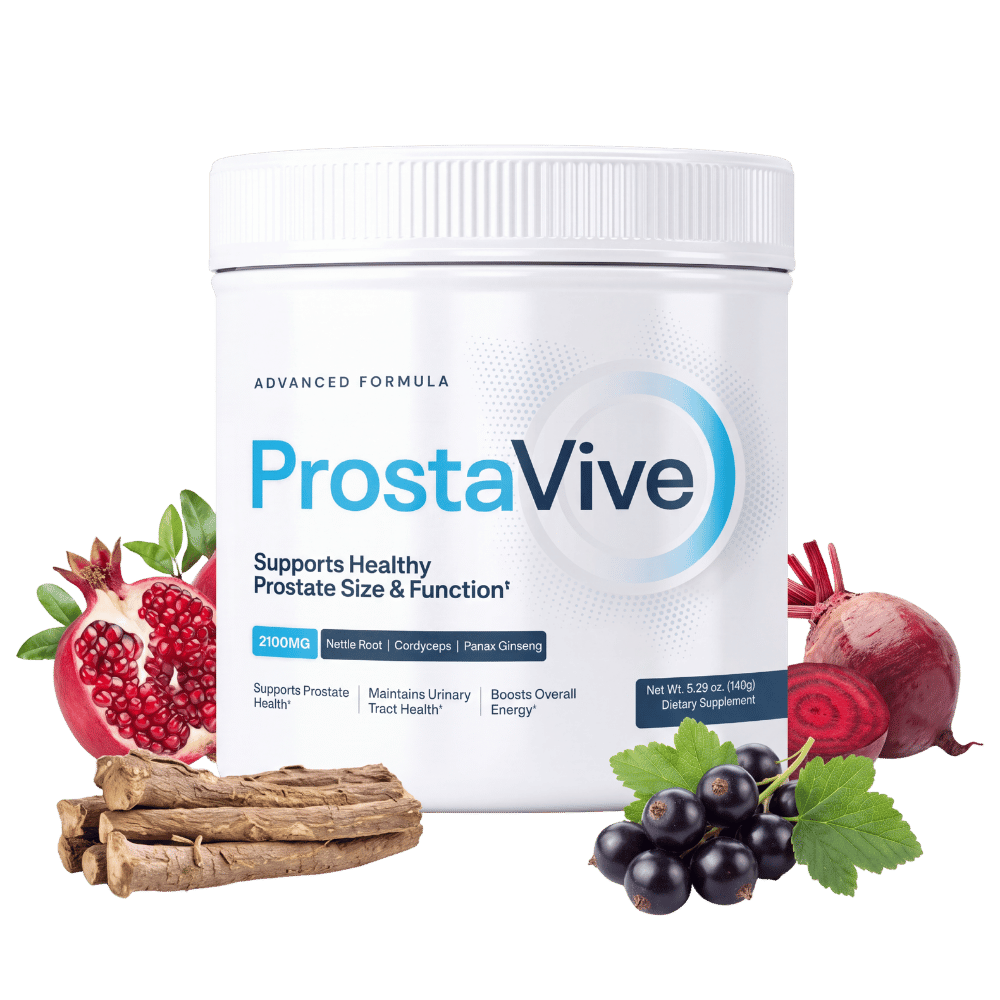
ProstaVive combines vitamins, minerals and botanicals in one powdered serving. Its reviewed Supplement Facts panel lists 13 individually quantified nutrient or botanical lines, plus 70 mg sodium and a separate 200 mg proprietary blend. Notable amounts include fenugreek seed powder (500 mg), artichoke extract (300 mg), ashwagandha extract (250 mg), cordyceps powder (250 mg), maca root extract (250 mg), stinging nettle root extract (200 mg), tongkat ali extract (100 mg), Panax ginseng extract (50 mg) and boron (5 mg). The six ingredients inside the 200 mg blend do not have individual doses disclosed.
That combination gives ProstaVive a distinctive appeal: instead of asking you to assemble separate prostate and vitality supplements, it puts a broad ingredient list into a single daily scoop. The convenience is tangible. The scientific result of taking the complete combination is a different question.
For someone comparing men’s-health products, the meaningful advantage is the number of quantities you can actually inspect. You can compare most label lines with independently researched ingredients. You cannot assume that every amount matches a clinical study, or that the undisclosed blend has a proven circulation effect.
Formula source: PRM ProstaVive Research Dossier and its photographed physical Supplement Facts panel, reviewed September 10–11, 2026. The current seller page was also checked November 10, 2026. The label is a documented snapshot, not a new laboratory assay or proof that batches cannot change.
Read the label, not just the ingredient headlines
What does the full ProstaVive Supplement Facts panel disclose?
One labeled scoop weighs approximately 4.93 g, and the container lists 30 servings. The amounts below are per scoop, taken from the physical panel documented by PRM in September 2026. They are not amounts per bottle or the doses used in cited human studies.
| Nutrient or botanical | Declared amount / scoop | Label interpretation |
|---|---|---|
| Fenugreek seed powder | 500 mg | Largest individually declared botanical by weight; powder, not a study-matched standardized extract. |
| Artichoke extract | 300 mg | Listed as standardized to 5% cynarin; no direct prostate-treatment proof follows from that figure. |
| Ashwagandha root extract | 250 mg | Listed at 1.5% withanolides; preparation and dose matter when comparing studies. |
| Cordyceps powder | 250 mg | A mushroom powder; species, active-compound standardization and urinary outcomes are not established here. |
| Maca root extract | 250 mg | Vitality-oriented plant extract; not a demonstrated BPH treatment at this dose. |
| Stinging nettle root extract | 200 mg | The ingredient with the clearest specific human urinary-symptom research connection. |
| Proprietary fruit and vegetable blend | 200 mg total | Six named components share this amount; individual allocations and nitrate content are unknown. |
| Tongkat ali extract (100:1) | 100 mg | A specified extract ratio, not proof of equivalence to a studied standardized preparation. |
| Panax ginseng extract | 50 mg | Included in the broader vitality positioning; studied ginseng products differ. |
| Boron (as boron citrate) | 5 mg | A quantified trace-element ingredient; prostate benefits are not established from its presence. |
The physical label also specifies the following vitamins, minerals and sodium. These are separate nutrient lines, not extra amounts allocated from the 200 mg proprietary blend.
| Additional line | Declared amount / scoop | Practical significance |
|---|---|---|
| Vitamin D3 | 50 mcg | Declared exposure to vitamin D; not evidence of reduced prostate size. |
| Vitamin B6 | 10 mg | A substantive B6 amount to consider alongside other supplements. |
| Magnesium (as citrate) | 50 mg | Declared magnesium; general nutrient function is not a urinary-outcome claim. |
| Zinc (as citrate) | 12 mg | Declared zinc; men’s-health relevance does not by itself establish BPH benefit. |
| Sodium (from sea salt) | 70 mg | Sodium exposure, separate from the botanical and vitamin/mineral discussion. |
Other listed ingredients: natural flavors, citric acid, sea salt and stevia leaf extract. The approximately 4.93 g scoop weight describes the complete powder serving; it is not the sum of only the highlighted active ingredients. The published label should be rechecked against the actual package before purchase if formula precision is important to you.
Where the prostate-specific case is strongest
Why does ProstaVive include 200 mg of stinging nettle root?
Stinging nettle root is the most directly prostate-relevant declared botanical in the reviewed formula. Preparations of Urtica dioica have been studied in men with benign prostatic hyperplasia (BPH) and lower urinary tract symptoms such as frequent urination or weak flow. That is more specific than simply calling an ingredient an antioxidant or a “male vitality booster.”
A randomized trial involving 620 participants reported improvements in urinary symptom scores and flow measures with a nettle preparation. A separate 60-person randomized study used 450 mg/day of nettle-root extract over 12 weeks and reported improvement in its symptom-score measures. Other nettle studies have produced more modest or inconsistent outcomes. The U.S. National Center for Complementary and Integrative Health describes the overall evidence as limited. None of these trials tested ProstaVive. 620-person trial · 450 mg nettle-root trial · NCCIH BPH evidence guidance.
Why this matters before you buy: The visible 200 mg nettle line gives buyers a concrete ingredient to investigate, rather than requiring trust in a vague proprietary “prostate complex.” For buyers who prioritize exact study-matched dosages, the lack of preparation equivalence remains an important reason to compare alternatives.
A formula broader than a prostate-only supplement
What do fenugreek, ashwagandha, maca and tongkat ali contribute?
These ingredients help explain ProstaVive’s broader positioning around male vitality, stress, energy and sexual wellness. They are not interchangeable with the nettle-root evidence for urinary symptoms. Their research contexts are different, and the form listed on ProstaVive’s panel is not necessarily the formulation used in trials.
500 mg / seed powder
Fenugreek: the largest visible botanical line
Fenugreek makes a substantial contribution to the ingredient list by labeled weight. Some research has investigated standardized fenugreek products for sexual-wellness outcomes, but ProstaVive lists seed powder, not the same standardized preparation used in those studies. NCCIH notes that evidence for many promoted uses is limited and that fenugreek may affect blood sugar or cause digestive effects.
Buyer consequence: a visible high-weight ingredient, but not a reliable promise of increased libido or easier urination.
250 mg / 1.5% withanolides
Ashwagandha: stress-related research, not a prostate trial
Some ashwagandha preparations have human evidence involving stress and sleep. The physical ProstaVive label specifies 250 mg of root extract standardized to 1.5% withanolides, but research uses different extracts and amounts. NCCIH also documents safety concerns, including thyroid and drug-interaction considerations.
Buyer consequence: a recognizable research-oriented component of the overall wellness positioning, not a tested urinary-tract outcome from ProstaVive.
250 mg / root extract
Maca: a vitality ingredient with a dose caveat
Maca appears in studies of sexual function, but a small randomized trial in a specific clinical population studied 1.5 to 3 grams per day, not the 250 mg maca extract listed here. Extracts and powders should not be assumed chemically or clinically interchangeable simply by comparing numbers.
Buyer consequence: relevant to why the seller markets ProstaVive beyond the prostate, without establishing a sexual-performance result.
100 mg / extract 100:1
Tongkat ali: a concentrated extract claim to interpret carefully
Tongkat ali has been investigated in human hormone-related studies. The “100:1” on this label describes an extract ratio; it is not proof that 100 mg produces the effects of 10 g of any particular root preparation. Study extracts, standardization and populations differ.
Buyer consequence: an identifiable vitality-oriented botanical that deserves separate evidence and safety scrutiny, not an established increase in testosterone from this powder.
The important distinction is relevance versus proof. These herbs explain why ProstaVive looks broader than a single-purpose prostate formula. Their presence does not establish the seller’s advertised combination of urinary, circulation, sexual and energy benefits.
The supporting ingredients without exaggerated claims
What about artichoke, cordyceps, Panax ginseng and boron?
They add breadth to the formula, but none is independently established here as a clinically validated ProstaVive prostate treatment. Their main editorial value is helping you understand the type of preparation you are considering rather than treating every label name as a separate proven benefit.
Botanical extracts
Artichoke, 300 mg
The label specifies artichoke extract standardized to 5% cynarin. This is useful formulation detail, but the scientific literature on artichoke and general metabolic or antioxidant endpoints cannot establish improvement in prostate size or urinary frequency from ProstaVive.
Mushroom ingredient
Cordyceps, 250 mg
Cordyceps gives the powder an additional mushroom-derived component. The label does not establish a specific species or measured active compound, so claims based on particular standardized cordyceps products should not automatically transfer to this serving.
Traditional vitality botanical
Panax ginseng, 50 mg
Panax ginseng has been studied for several outcomes, including sexual function, but a Cochrane review found generally low-certainty evidence and limited overall effects on erectile-function scores. The labeled 50 mg extract should not be treated as an equivalent tested treatment.
Trace element
Boron, 5 mg
Boron is a quantified trace ingredient, not an undisclosed blend filler. Its inclusion does not mean that animal or laboratory studies of prostate tissue can be translated into claims that this human supplement changes prostate size, treats BPH or prevents cancer.
The six-ingredient line most buyers miss
What is inside ProstaVive’s 200 mg proprietary blend?
Beet root, alfalfa, black currant, broccoli, pomegranate extract and raspberry powder share one total 200 mg blend. The label names the components but does not disclose how much of the 200 mg belongs to any one of them.
What you can confirm
Six recognizable plant components
The label identifies the fruit and vegetable ingredients and their combined weight. That is more informative than an unnamed blend but less transparent than individual dosing.
What you cannot determine
Beet-root dose or nitrate content
The 200 mg is not a 200 mg beet-root dose. No component-specific quantities or nitrate standardization are given, so the amount cannot be matched to beetroot cardiovascular studies.
This difference matters because the seller promotes a nitric-oxide and circulation explanation for prostate benefits. Research on nitrate-rich beetroot preparations and blood pressure cannot demonstrate that this six-part blend changes prostate blood flow, shrinks tissue or relieves urinary symptoms. The seller’s cited 2023 discussion of mechanisms involved in BPH likewise does not test ProstaVive. Beetroot/nitrate cardiovascular evidence · 2023 BPH-mechanism review.
An important comparison with conventional prostate blends
Does ProstaVive contain saw palmetto, pygeum or beta-sitosterol?
Those ingredients are not named on the physical ProstaVive Supplement Facts panel reviewed by PRM. This is not the same formulation as a classic saw-palmetto or beta-sitosterol prostate supplement. The product instead combines stinging nettle root with a range of vitality-oriented botanicals and support nutrients.
That positioning can be a positive if you specifically prefer a wider men’s-health ingredient profile. It can be a reason to compare other products if you are looking for a particular ingredient that a clinician recommended or that you want at a defined study-matched dose. It does not mean saw palmetto or other prostate supplements are automatically more effective; NCCIH describes inconsistent or limited evidence across these approaches.
NCCIH — Complementary Approaches for BPH.
Evidence that can—and cannot—follow you to checkout
Are the ProstaVive ingredients clinically proven to improve urinary flow?
No clinical trial of the complete currently documented ProstaVive formula was identified in PRM’s research dossier. There is ingredient-level human research, especially for nettle root, but its preparations, doses and outcomes do not establish clinical performance for this exact scoop of powder.
| Research area | What evidence can support | What it cannot prove |
|---|---|---|
| Stinging nettle in BPH | Some randomized nettle-root trials reported urinary-symptom improvements; the overall evidence remains limited. | That 200 mg ProstaVive nettle extract has equivalent effects, or that the whole product treats BPH. |
| Ashwagandha, maca, tongkat ali | Selected stress, hormone or sexual-wellness research involving particular preparations. | A guaranteed change in testosterone, energy, libido or urinary symptoms from ProstaVive. |
| Beetroot / nitric oxide | Specific nitrate-rich beetroot interventions have cardiovascular research context. | Any prostate benefit from an undisclosed fraction of a 200 mg multi-plant blend. |
| Vitamins and minerals | Known physiological and nutritional functions at declared amounts. | A demonstrated prostate-size or urinary-flow improvement in an otherwise untested formula. |
The distinction is useful rather than discouraging. It lets you appreciate what is real about the label—one clearly defined serving and multiple disclosed amounts—without paying for a clinical promise that has not been established for the finished product.
For individual studies, preparation differences and the citation audit, use the PRM ProstaVive Research Dossier. It is deliberately separate from this ingredients-focused buying guide.
Fit the ingredients into an actual day
What is the practical advantage of ProstaVive’s one-scoop format?
It packages an extensive ingredient list into one powder serving mixed with water or another beverage. The reviewed container lists 30 servings, so one labeled daily scoop corresponds to approximately a month of use. The seller recommends mixing a scoop into a drink, and the actual package instructions should control preparation.
For someone who dislikes keeping several supplement bottles organized, that is a meaningful convenience. One daily step is easier to picture than evaluating and timing several individual botanicals. It is also a trade-off: with a premixed powder you cannot independently adjust the nettle, maca or ashwagandha dose without changing the entire serving.
A realistic advantage
One habit rather than a separate stack
Several botanical categories and nutrients are already combined. That simplifies preparation and purchasing decisions, although it does not prove more reliable health outcomes.
A realistic limitation
Fixed ingredient proportions
You can see most doses on the label, but cannot fine-tune individual botanical amounts. Buyers needing highly specific doses may prefer a different product design.
A realistic commitment
Thirty labeled servings per container
Supply length is straightforward at the stated one-scoop serving. A larger order means more prepayment and more time using the same formulation, not a stronger daily dose.
That is the right basis for comparing this kind of product: simplicity, ingredient visibility and suitability—not an unsupported idea that powder is inherently absorbed better than capsules.
For the buyer looking beyond the front label
Which ProstaVive label details deserve an extra check?
The vitamin B6 amount, the ashwagandha extract, the fenugreek component and the lack of dose information for the proprietary blend all deserve consideration. That does not mean the supplement is unsafe for every adult. It means the finished combination is not a substitute for an individualized health review.
For example, 10 mg vitamin B6 and 50 mcg vitamin D3 are meaningful recorded exposures if you already use multivitamins or other supplements. Ashwagandha may interact with certain medications and requires particular caution with thyroid, autoimmune or hormone-sensitive conditions. Fenugreek can affect blood sugar in some circumstances. NCCIH specifically recommends that people with hormone-sensitive prostate cancer avoid ashwagandha. NCCIH — Ashwagandha safety · NCCIH — Fenugreek safety.
Seek medical evaluation for new or persistent urinary symptoms. Frequent nighttime urination, weak flow and urgency have multiple possible causes; they are not a diagnosis of BPH by themselves. Inability to urinate, blood in urine, fever with painful urinary symptoms or severe lower-abdominal pain warrant prompt medical care. NIDDK — Enlarged Prostate.
This Guide explains the label and buyer decision. It does not replace your clinician’s guidance or the full medical-evidence discussion in our dossier.
A small detail that changes the purchase decision
You shouldn’t need to guess what a scoop contains.
The front of a supplement offer can make every ingredient sound essential. You read about circulation, energy, prostate comfort and feeling more like yourself. By the time you reach the packages, it can be difficult to remember which of those promises belongs to an actual measured ingredient and which is simply part of the sales story.
ProstaVive gives you a useful way to separate them. There is a real 500 mg fenugreek line. There is a real 200 mg nettle-root line. There is a real 250 mg ashwagandha line. And there is also a six-ingredient blend that provides no individual amounts.
That clarity matters when you’re considering a product for a personal concern. You want the routine to feel manageable. You want a sensible reason to compare the offer. And you want to know what you’re committing to before purchasing several containers.
The strongest purchasing confidence isn’t created by a longer list of promises. It’s created by knowing exactly which parts of the formula are clear, which remain uncertain, and why the product might still fit your preferences.
Turn formula knowledge into a buying decision
Who should consider ProstaVive’s ingredient combination?
The formula makes the most sense to adults who value a convenient one-scoop, multi-ingredient powder and appreciate having most quantities disclosed. It is a less suitable match when a buyer expects an exact trial-matched prostate dose, a proven finished-product outcome or complete visibility into every plant component.
A reason to compare the offer
You value a simple, transparent-enough daily formula
- A single daily powder fits your routine better than managing several products.
- Individually listed amounts for nettle, fenugreek, ashwagandha and other components help you evaluate the formula.
- You understand that the 200 mg blend is only partly transparent.
- You are comparing convenience and ingredients, not assuming the supplement treats a diagnosed prostate condition.
- The formulation is appropriate for your medical and medication circumstances.
- You are comfortable comparing the current seller’s package and return terms before paying.
A reason to resolve questions first
You require study-matched doses or medical certainty
- You need the exact amount of each fruit or vegetable inside the proprietary blend.
- You want evidence that this finished ProstaVive formula improves BPH or urinary symptoms.
- You are searching for saw palmetto, pygeum or beta-sitosterol specifically.
- You take medications or have conditions that warrant an ingredient interaction review.
- You have new or worsening urinary symptoms requiring diagnosis.
- You would need a refund to make the purchase financially acceptable.
PRM’s qualified recommendation: Keep ProstaVive on your shortlist if the convenience, declared quantities and ingredient profile align with your priorities, and you are not expecting it to replace medical treatment. If precision dosing or product-level clinical proof is nonnegotiable, other options deserve comparison before you spend.
Compare the product for what it actually offers
A one-scoop formula with real dose visibility. Does it fit your routine?
You can now distinguish the individually quantified ingredients, the 200 mg blend and the research that does—or does not—apply to the finished product. That is a stronger reason to evaluate ProstaVive than simply trusting a dramatic sales claim.
If the ingredient profile is suitable for you, review the current ProstaVive offer and choose only the supply that fits your intended routine and budget. The seller publishes a 180-day return window from the order date, with conditions including contact, return of bottles and buyer-paid return postage. Verify the terms and total at the actual retailer checkout; prices and shipping observed in September 2026 are historical, not a live quote.
Clear answers to ingredient questions
ProstaVive ingredients: frequently asked questions
What are the main ingredients in ProstaVive?
The reviewed physical label includes fenugreek, artichoke extract, ashwagandha, cordyceps, maca, stinging nettle, tongkat ali, Panax ginseng, boron, vitamins D3 and B6, magnesium, zinc and sodium, plus a six-component proprietary plant blend. The full per-scoop doses are shown in the tables above.
How many ingredients does ProstaVive disclose individually?
PRM’s September 2026 Research Dossier describes thirteen individually quantified nutrient or botanical lines, plus a separate 70 mg sodium line and a 200 mg proprietary blend. The blend names six components but does not provide their individual quantities.
What is the serving size for ProstaVive?
The photographed Supplement Facts panel lists one scoop, approximately 4.93 g, with 30 servings per container. Confirm the serving on the container you actually receive.
How much stinging nettle root is in ProstaVive?
The reviewed label lists 200 mg of stinging nettle root extract per scoop. Human BPH studies have examined other nettle preparations, including a 450 mg/day extract; the studies do not establish that this product produces the same effects.
How much fenugreek is in ProstaVive?
The label lists 500 mg of fenugreek seed powder per scoop. That is a different preparation from standardized extracts used in some clinical research, so a study on a branded extract should not be treated as proof of this dose’s effects.
Does ProstaVive contain ashwagandha?
Yes. The reviewed panel lists 250 mg ashwagandha root extract standardized to 1.5% withanolides. The ingredient has specific medication, thyroid and hormone-sensitive-condition precautions; see NCCIH guidance before considering it with relevant conditions or medicines.
What does 100:1 tongkat ali mean on the label?
It is a stated extract ratio for the 100 mg tongkat-ali line. It does not establish a clinically effective dose, measured active-compound content or equivalence to a particular standardized extract used in trials.
Is there saw palmetto in ProstaVive?
No saw palmetto is listed on the physical Supplement Facts panel reviewed by PRM. The formula instead includes stinging nettle root and a broader range of vitality-oriented herbs. A changed label would require a new check.
What is the 200 mg proprietary blend made of?
The label names beet root, alfalfa, black currant, broccoli, pomegranate extract and raspberry powder. The 200 mg is the total for all six; the portion contributed by each ingredient is not disclosed.
Does the 200 mg blend contain 200 mg of beetroot?
No. Beet root is one of six shared ingredients. Neither its individual mass nor its nitrate content is provided, so a direct comparison with nitrate-rich beetroot research is not possible.
Are ProstaVive ingredients proven to shrink the prostate?
There is no identified randomized clinical trial of the complete current formula demonstrating a reduction in prostate size. Ingredient studies, including stinging nettle research, are not interchangeable with a controlled ProstaVive product trial.
Is ProstaVive a substitute for prescribed BPH treatment?
No. New, persistent or worsening urinary symptoms should be assessed by a qualified healthcare professional, and supplements should not replace a diagnosis or prescribed treatment. Seek prompt care for inability to urinate, blood in urine or severe urinary pain.
Why are vitamin D3 and vitamin B6 listed?
They are declared nutrient components: vitamin D3 at 50 mcg and vitamin B6 at 10 mg per scoop. Their known nutritional roles do not establish specific BPH benefits from this product, and amounts should be considered alongside any other supplements being used.
Does ProstaVive contain caffeine?
Caffeine is not listed on the photographed Supplement Facts/other-ingredients panel reviewed by PRM. Because the company could change its formulation, check the current complete package label if avoiding caffeine is important to you.
Does a powder work better than capsules for prostate health?
The one-scoop powder is a convenience feature; the reviewed evidence does not establish that ProstaVive absorbs better or improves prostate outcomes more than capsule products merely because of its format.
Can I compare the formula before purchasing multiple jars?
Yes. Start with the disclosed doses and the 200 mg blend limitation, then review the seller’s current package, shipping and return conditions. Larger packs offer more labeled servings, not a higher amount per daily scoop. See the PRM Review for broader offer context.
Where is the full scientific analysis of ProstaVive?
The PRM Research Dossier provides the label source trail, independent urinary-symptom trials, mechanism limitations, safety context and citation checks. This Guide focuses on the practical ingredient decision.
How this guide was researched
Our ProstaVive ingredients methodology and sources
PRM’s primary formula reference was the physical Supplement Facts panel documented September 10–11, 2026 in the ProstaVive Research Dossier. Its serving size, individually quantified nutrients and botanicals, 200 mg proprietary blend and other-ingredient list were compared with the existing PRM Review. The seller’s product page, affiliate rules and refund instructions were checked again November 10, 2026. The seller’s positioning and offer terms are business claims, not independent evidence of clinical efficacy.
The independent evidence was examined by ingredient, preparation, dose, population and measured outcome. Nettle-root trials concern urinary symptoms in selected men with BPH, not the completed ProstaVive powder. Fenugreek, maca, tongkat ali, ginseng and ashwagandha studies assess other interventions and endpoints. Beetroot/nitric-oxide research is cardiovascular context and cannot be mapped to the undisclosed beet-root portion of a 200 mg blend. No controlled human trial of the full current ProstaVive formulation was identified in the PRM evidence record.
PRM did not use ProstaVive personally, place a new checkout order for this Guide, test a laboratory sample, verify batch-to-batch purity or conduct a customer refund. The September 2026 checkout observations in the Review/Dossier should not be treated as current prices.
Product and policy: PRM ProstaVive Research Dossier / physical label record · PRM ProstaVive Review · ProstaVive seller page · Seller refund policy.
Independent research: NCCIH: Supplements and BPH · Stinging nettle randomized study · Nettle-root randomized study · NCCIH: Ashwagandha · NCCIH: Fenugreek · NIDDK: BPH guidance.