Disclosure: We may earn a commission if you purchase through links on this page, at no additional cost to you. Our editorial conclusions are developed independently.
Inside the one-capsule eye formula
What ingredients are in VisiFlora—and what does the label actually reveal?
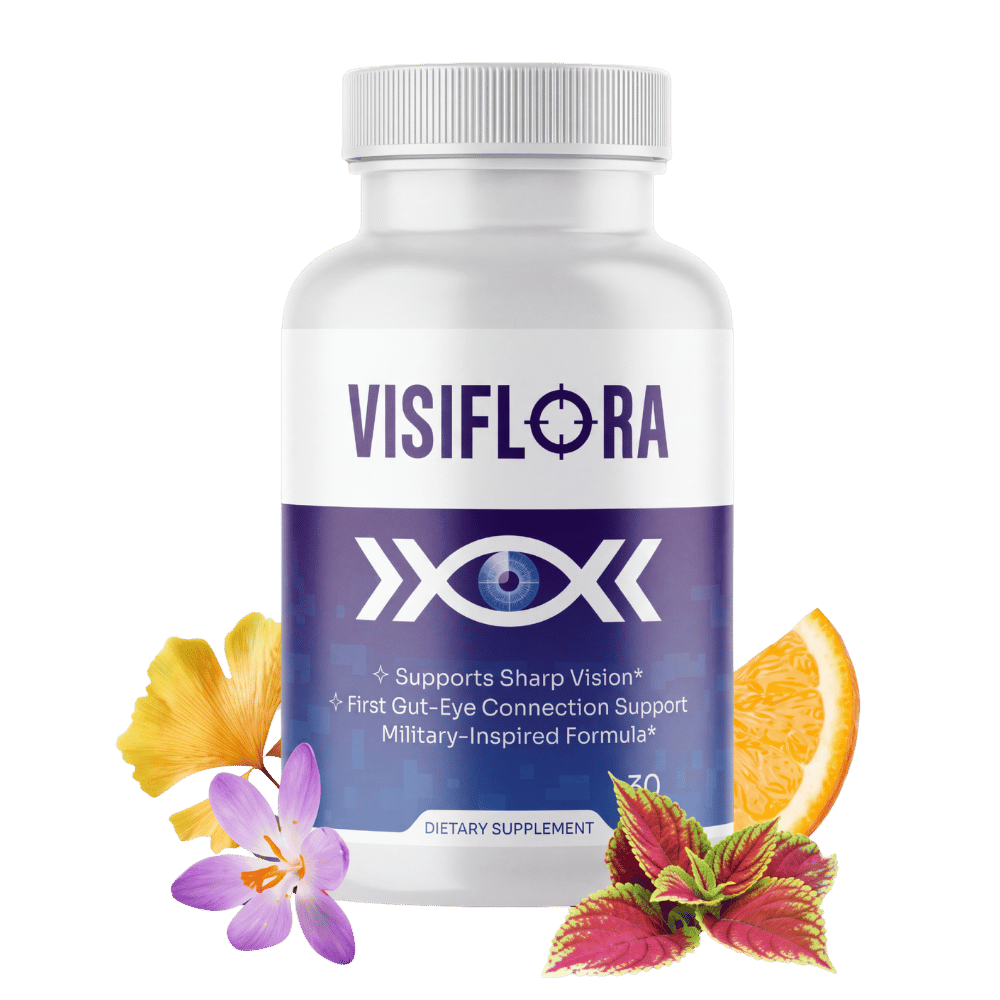
VisiFlora combines seven individually quantified nutrients—vitamins A, C and E, zinc, selenium, copper and chromium—with a 351 mg proprietary blend naming fourteen additional ingredients, including lutein, zeaxanthin, saffron, bilberry, astaxanthin and ginkgo. The reviewed label provides thirty servings at one capsule per day, offering a broad eye-nutrition formula in one simple routine.
If you have been comparing eye-support supplements, you may have opened several ingredient lists looking for a combination that feels complete without turning your routine into a collection of bottles. VisiFlora offers that convenience: familiar nutrients and eye-oriented botanicals together, rather than a separate purchase for every ingredient that catches your attention.
The value is in the completed, easy-to-use combination. The label gives you exact amounts for seven vitamins and minerals, alongside macular carotenoids and botanicals in the same capsule. That makes VisiFlora appealing to adults who prioritize ingredient variety and a manageable daily habit.
There is one meaningful trade-off: while the seven nutrient quantities are printed individually, the fourteen blend components share a combined 351 mg figure. We explain below how that affects precise dose comparisons, so you can judge the complete formula on what the label actually shows.
Formula data comes from the physical label recorded in PRM’s VisiFlora Research Dossier; seller wording was checked against its public presentation on November 3, 2026.
Begin with what you can measure
What does the VisiFlora Supplement Facts label disclose per capsule?
The physical panel specifies one capsule per serving and thirty servings per bottle. Its seven separately measured nutrients provide a clear nutritional base. Everything below is an amount per labeled serving, not a claim that the product has been shown to improve sight.
| Declared nutrient and form | Per capsule | % Daily Value | Why a buyer might care |
|---|---|---|---|
| Vitamin A (beta carotene) | 450 mcg RAE | 50% | An essential nutrient for normal visual function; not an eye-treatment dose. |
| Vitamin C (ascorbic acid) | 90 mg | 100% | A familiar antioxidant vitamin with an exact listed amount. |
| Vitamin E (DL-alpha tocopheryl acetate) | 15 mg | 100% | Another measured antioxidant nutrient, different from AREDS2 dosing. |
| Zinc (zinc oxide) | 11 mg | 100% | A clearly quantified mineral also familiar in eye-nutrition research. |
| Selenium (selenium AAC) | 20 mcg | 36% | A measured trace mineral contributing to the broader nutritional profile. |
| Copper (copper gluconate) | 0.9 mg | 100% | A declared trace mineral; the form and quantity are visible. |
| Chromium (chromium picolinate) | 15 mcg | 43% | A quantified mineral with a metabolic-nutrition role, not established VisiFlora-specific eye benefits. |
| Proprietary blend (14 named actives) | 351 mg combined | Not established | Its total is known; its component-by-component amounts are not. |
These exact amounts are useful when comparing products: you can see the nutritional foundation rather than relying on a vague “premium nutrients” claim. The fourteen botanical and carotenoid additions form a single blend, which we examine separately below.
The capsule’s other ingredients are hypromellose (vegetable capsule), rice flour, magnesium stearate and silicon dioxide. These are supporting formulation materials, not additional active nutrients.
The part of the formula shoppers recognize
Which VisiFlora ingredients are most relevant to eye nutrition?
The most recognizable eye-health components are lutein and zeaxanthin, followed by carotenoids such as astaxanthin, selected antioxidants, and botanicals including saffron and bilberry. The appeal is the combination. What distinguishes stronger from weaker claims is the level of human evidence—and whether this particular label reveals enough to compare doses.
Macular carotenoids
Lutein + zeaxanthin: the strongest research connection
These carotenoids are constituents of macular pigment, which has a role in filtering light and retinal function. Defined-dose supplements containing them have been studied in eye-health research, including AREDS2.
What VisiFlora offers: both are named in the formula. What’s unknown: their individual doses, making study-dose equivalence impossible to verify.
Additional carotenoid
Astaxanthin: another studied pigment
Astaxanthin adds a different carotenoid to the blend. An eight-week human study examined 6 mg astaxanthin with 10 mg lutein and 2 mg zeaxanthin and reported some visual-performance findings.
Buyer meaning: there is defined-dose research for this combination, but the amounts in VisiFlora are undisclosed. The study did not test VisiFlora.
Botanical research
Saffron: promising, but preparation and dose matter
Trials of specified saffron preparations—including one using 20 mg per day in people with age-related macular degeneration—have reported modest, selected visual-function outcomes.
Buyer meaning: saffron is a research-relevant inclusion, but neither its quantity nor an equivalent studied preparation is established for VisiFlora.
Berry extract
Bilberry: useful context for screen-related fatigue
A trial of 480 mg/day bilberry extract evaluated eye-fatigue measures in screen users and reported improvements in certain outcomes. It was a trial of that extract, not this finished capsule.
Buyer meaning: VisiFlora includes bilberry, but its entire fourteen-ingredient blend totals only 351 mg. It cannot be assumed to deliver the trial’s 480 mg bilberry exposure.
There is a reason these names attract attention: they belong to real areas of vision-nutrition research. The benefit of seeing them together is a simple way to approach a broad nutritional profile. The reason not to promise sharper eyesight from the ingredient list is equally clear: a study of one known-dose intervention is not proof of another, undisclosed-dose product.
Research: National Eye Institute — AREDS2 · lutein + zeaxanthin RCT (2025) · three-carotenoid RCT (2023) · saffron RCT (2019) · bilberry RCT (2015).
The complete proprietary-blend inventory
What are the fourteen ingredients inside VisiFlora’s 351 mg blend?
The reviewed Supplement Facts panel names fourteen blend ingredients, in label order. The compact inventory below shows each one and its role in the formula. Their combined weight is 351 mg; individual amounts and extract standardizations are not disclosed.
| Named blend ingredient | Role in the formula |
|---|---|
| Taurine | A compound discussed in retinal biology and broader cellular research. |
| Ginkgo biloba leaf | A botanical studied in vascular and ocular contexts; medication interactions matter. |
| Eyebright aerial parts | A traditional herb associated with eye-care practices, without strong finished-product trial evidence. |
| Grape seed extract | A plant-extract source of polyphenol compounds. |
| Coleus forskohlii root | A botanical explored in physiological and circulation-related research. |
| Alpha-lipoic acid | An antioxidant-related compound also studied in metabolic contexts. |
| Rutin (from Sophora japonica) | A plant flavonoid included in the broader antioxidant layer. |
| Quercetin (from Sophora japonica) | Another flavonoid contributing ingredient diversity. |
| Bilberry fruit extract | A berry extract studied in selected visual-fatigue settings. |
| Saffron stigma extract | A botanical with small defined-dose human eye studies. |
| Lycopene | A carotenoid contributing antioxidant-related diversity. |
| Lutein (from marigold) | A macular carotenoid with established nutritional research context. |
| Zeaxanthin | A second macular carotenoid often researched with lutein. |
| Astaxanthin | A carotenoid investigated alongside lutein and zeaxanthin. |
VisiFlora is more than “lutein plus a few vitamins”: the formula combines carotenoids, botanicals and additional plant compounds in one capsule. That breadth is an appealing design choice for shoppers who want a ready-made combination rather than a growing list of separate supplements.
The other ingredients have a purpose too
What do ginkgo, grape seed, taurine, coleus and the flavonoids add?
They widen the formula beyond classic macular carotenoids, but their presence should not be translated into guaranteed better ocular circulation or visual performance. The group combines distinct scientific and traditional-use backgrounds.
Botanical pair
Ginkgo + coleus: circulation-oriented ingredients
Both are associated with vascular mechanisms in research discussions. Evidence about a ginkgo extract in a small ocular blood-flow study does not establish that this blend improves visual acuity.
Practical check: ginkgo can interact with medicines, including anticoagulants. A broad combination is not automatically suitable for everybody.
Plant polyphenols
Grape seed + rutin + quercetin
These add plant-derived compounds commonly studied in antioxidant and cellular contexts. Their grouping gives VisiFlora variety beyond a basic multivitamin.
What matters: the label does not reveal standardized concentrations, so this is an ingredient-design benefit—not a proven ocular outcome.
Complementary compounds
Taurine + alpha-lipoic acid
These appear in research involving different biological pathways. Taurine has retinal biology context; alpha-lipoic acid is also studied in antioxidant and metabolic settings.
What matters: their presence can help explain the broad formulation concept, not establish that the capsule protects or restores vision.
Traditional and carotenoid extras
Eyebright + lycopene
Eyebright contributes a traditional eye-care botanical; lycopene adds another carotenoid. They make the composition distinct from a plain zinc-and-vitamin formula.
What matters: established research on other nutrients cannot be used to fill the evidence gaps for these exact inclusions.
What 351 mg really means
How much lutein, zeaxanthin, saffron and bilberry is in VisiFlora?
The label does not state those individual amounts. All fourteen blend ingredients share a total of 351 mg per capsule. That is enough to identify the formula’s composition, but not enough to compare any one of its highlighted ingredients against a clinical study.
What you can verify
One stated total across fourteen ingredients
Each capsule contains a proprietary blend labeled at 351 mg. The list names lutein, zeaxanthin, saffron, bilberry, astaxanthin and nine other components. You know what the manufacturer chose to include.
What the label cannot answer
Individual strength, proportions and study matching
You cannot determine whether the lutein is 10 mg, the zeaxanthin is 2 mg, the saffron is 20 mg, or whether any specific extract matches a published trial. Nor can you assume equal amounts for all fourteen.
This distinction also prevents a misleading reading of the label: 351 mg is not the daily dose of each ingredient. A blend is a combined weight. Even a favorable clinical study of an isolated plant extract cannot tell us how that ingredient performs at an undisclosed amount in this combination.
For a buyer, the decision is not simply “hidden dose, therefore bad.” It is whether the convenience of this completed formula matters more to you than the ability to select exact standalone ingredient doses. Both are legitimate preferences.
A claim worth translating carefully
Does VisiFlora really contain 22 ingredients?
The seller advertises 22 targeted nutrients, while PRM’s reviewed physical Supplement Facts panel identifies seven separately quantified actives plus fourteen named blend actives: 21 identifiable entries. PRM did not find a distinct twenty-second active in that record.
The safest conclusion is narrow. The label establishes those 21 named entries and the other nonactive capsule ingredients; the promotional count is not reconciled by the physical panel we reviewed. This is a documentation difference, not proof that an ingredient is missing from a specific bottle or that a product claim is deliberately misleading.
Put published ingredient science in perspective
What do human studies actually tell us about VisiFlora’s ingredients?
Research supports scientific interest in several ingredients, particularly defined-dose lutein and zeaxanthin, carotenoid combinations, saffron and bilberry. It does not establish that the current VisiFlora formula itself has been clinically proven to improve vision.
| Research example | What was actually studied | What you can conclude |
|---|---|---|
| Lutein + zeaxanthin, 2025 | Seventy high-screen-use adults; 10 mg lutein + 2 mg zeaxanthin isomers daily for six months. | Some objective eye measures improved; self-reported outcomes were not clearly different. VisiFlora’s doses are unknown. |
| Three carotenoids, 2023 | 6 mg astaxanthin + 10 mg lutein + 2 mg zeaxanthin daily for eight weeks. | Reported selected eye-hand and macular-pigment findings; not a study of VisiFlora or proof of universal visual improvement. |
| Saffron, 2019 | 20 mg/day saffron in adults with mild-to-moderate age-related macular degeneration. | Modest selected changes were reported in that clinical population. The VisiFlora saffron dose is not stated. |
| Bilberry, 2015 | 480 mg/day defined bilberry extract in a study of eye fatigue with screen use. | Certain measures improved; the intervention was not comparable to an unspecified share of a 351 mg multi-ingredient blend. |
The research is useful because it shows why these ingredient categories belong in an informed conversation about eye nutrition. It is not useful when it is stretched into a promise that every buyer will see sharper images, need fewer glasses or treat an eye condition.
For study-by-study details and the reasoning behind these boundaries, our VisiFlora Research Dossier contains the extended evidence record.
Primary studies: lutein/zeaxanthin (2025) · astaxanthin/lutein/zeaxanthin (2023) · saffron (2019) · bilberry (2015).
A familiar comparison with a different purpose
Is VisiFlora equivalent to an AREDS2 eye supplement?
No. VisiFlora includes some familiar eye-health nutrients, but its amounts do not match the AREDS2 formulation, and its lutein and zeaxanthin quantities are not disclosed. AREDS2 was studied in defined age-related macular degeneration risk groups; it is not interchangeable with a general wellness formula merely because some ingredient names overlap.
| Ingredient | VisiFlora label | AREDS2 reference |
|---|---|---|
| Vitamin C | 90 mg | 500 mg |
| Vitamin E | 15 mg | 400 IU |
| Zinc | 11 mg | 80 mg in the standard reference formula |
| Copper | 0.9 mg | 2 mg |
| Lutein | Not disclosed individually | 10 mg |
| Zeaxanthin | Not disclosed individually | 2 mg |
Vitamin E is printed in different units, and the AREDS2 evidence has formulation and clinical-population specifics. The useful conclusion is not a simplistic ratio across rows: VisiFlora is a different supplement, with a broader wellness positioning and lower listed amounts of several measured nutrients.
For someone whose eye-care professional recommended a specific AREDS2 formula, VisiFlora should not be substituted for that recommendation. For someone seeking a general one-capsule eye-nutrition product, the fact that it is not AREDS2 does not, by itself, remove its convenience appeal.
Source: National Eye Institute — AREDS/AREDS2 frequently asked questions.
One brand story, two different standards of evidence
Does VisiFlora’s “gut-eye” positioning mean it contains probiotics?
No probiotic organisms, strain names, colony-forming units (CFUs) or quantified prebiotic fibers appear on the reviewed Supplement Facts panel. The seller frames the supplement around gut-eye research, but its listed composition is vitamins, minerals, carotenoids, botanicals and other compounds—not a labeled probiotic formula.
What the seller describes
A nutritional concept involving the gut-eye axis
The presentation connects digestive function, nutrient absorption and ocular wellness. Biological research into connections between the gut and eye exists, but that alone cannot establish that this product repairs a gut barrier or changes visual symptoms.
What the capsule declares
A multi-ingredient eye-nutrition supplement
The physical label documents individually measured nutrients and one proprietary blend. It does not establish a probiotic dose, an LPS-reduction endpoint or a clinical result from the complete formula.
If the gut-eye story brought you to VisiFlora, the label gives you a more useful basis for comparison: its composition and simple routine, rather than a mechanism presented as if it were an observed outcome.
The moment the label becomes a decision
You shouldn’t need a chemistry degree to choose one daily capsule.
Picture an ordinary shopping moment: you’ve opened two eye-supplement pages and keep switching between their ingredient lists. Both mention familiar nutrients. One seems broader; the other makes its individual doses easier to compare. You want a routine that fits your life, but you also want to know what you’re paying for.
VisiFlora’s appeal is easy to understand in that moment. One capsule a day. A recognizable core of vitamins and minerals. Lutein, zeaxanthin and botanicals included without asking you to assemble a separate supplement routine.
And then the reasonable question arrives: How much of the ingredients I care most about is actually in that capsule?
The label answers part of the question clearly and leaves another part unanswered. That does not need to turn your decision into a confrontation. It simply tells you what kind of purchase you are considering.
You can value an easy, broad nutritional formula and still expect precision about what is—and isn’t—documented. A decision made with both in view is easier to feel comfortable with after the order.
Everyday practicality matters
What does taking one VisiFlora capsule daily actually simplify?
The reviewed label instructs one capsule per day and provides thirty labeled servings in each bottle. For adults who prefer capsules and do not want multiple separate supplements, that is a concrete usability feature.
One daily step
A routine easy to remember
One labeled serving per day makes the schedule straightforward, without requiring separate morning and evening supplement doses. The seller recommends taking it with a meal.
One combined formula
Fewer separate labels to manage
The formula incorporates a measured nutrient foundation and several eye-oriented botanicals in one product. That can reduce the need to assemble an elaborate supplement stack simply to pursue ingredient variety.
One buying decision
Compare the complete capsule, not just the hero names
Seeing lutein and saffron on the front of a sales page is only a start. Compare the full label and its 351 mg blend before deciding whether the completed product meets your priorities.
One clear limitation
Convenience does not replace precise dosage
If a clinician recommends specific nutrient amounts for an eye condition, a proprietary blend that hides those amounts may not be the right vehicle. VisiFlora’s advantage is simplicity, not individualized dosing.
A small, relevant safety check
Who should review the VisiFlora ingredient list before using it?
Anyone taking medication, managing a medical condition, or relying on a prescribed eye-care plan should examine the label with a qualified healthcare professional before starting. The reviewed packaging excludes use by people under eighteen and during pregnancy or nursing, and advises physician consultation for medicines or medical conditions.
Ginkgo is particularly relevant because the U.S. National Center for Complementary and Integrative Health notes possible interactions, including increased bleeding risk with anticoagulants. Beta-carotene research has distinct considerations for current and former smokers in high-dose AREDS contexts; that evidence should not be casually assigned to VisiFlora’s lower label amount, but it is a reasonable reason to review the full formulation.
Sudden flashes, a surge of new floaters, a curtain across vision or sudden vision loss call for urgent eye evaluation, not a supplement trial. For the broader interaction discussion, the next cluster Guide will address VisiFlora Side Effects after publication; for now the Research Dossier records the source-level safety context.
Who benefits most from this kind of formula?
Is VisiFlora a good ingredient fit for your priorities?
The buying case is strongest for someone who wants a simple, broad nutrition-oriented capsule and is comfortable with a blend that discloses its ingredient names but not every amount. It is less persuasive for someone who needs clinical-dose precision or expects a product to correct a diagnosed eye problem.
A practical fit
Consider VisiFlora further if…
- You prefer one daily capsule to managing several separate eye-nutrition products.
- You value the stated amounts of seven vitamins and minerals alongside additional named carotenoids and botanicals.
- You understand the blend total is 351 mg and accept that individual blend doses are not available.
- Your expectations center on a nutritional routine rather than reversing an eye condition.
- The current offer, ingredient suitability and purchase terms make sense for your budget.
A reason to choose differently
Pause or compare alternatives if…
- You need a supplement that exactly matches an AREDS2 recommendation or another medically specified formula.
- Knowing the precise lutein, zeaxanthin, saffron or bilberry amounts is essential to your decision.
- You are evaluating treatment for visual symptoms rather than optional nutrition support.
- Medication interactions or your medical circumstances have not been reviewed.
- Buying a multi-bottle supply would depend on an unverified promise of sharper vision.
PRM’s recommendation: Keep VisiFlora on the shortlist if ingredient breadth and a simple capsule routine are what you want. If the individual clinical amounts are the deciding factor, choose a formula that publishes them. A thoughtful purchase begins with knowing which advantage you are actually paying for.
From label clarity to the next decision
Seven measured nutrients. Fourteen named blend ingredients. One easy daily step.
With a measured nutritional foundation and a broad set of named botanicals and carotenoids, VisiFlora gives buyers a convenient one-capsule option to compare. The question now is whether that complete formula and its simple routine suit what you want from a daily supplement.
If that balance fits your priorities, examine the current VisiFlora offer and compare the package sizes before buying. On the seller’s November 3, 2026 public presentation, the three-bottle subtotal was $177, just $19 above the $158 two-bottle product subtotal, with free U.S. shipping advertised for three. Six bottles carried the lowest listed unit price at $49 each, but a larger upfront commitment. Those figures are seller listings, not a newly completed PRM checkout.
Four quick checks before committing
What should you verify on the current VisiFlora bottle and offer?
The current label
Confirm the same seven disclosed amounts
Look for one capsule, thirty servings, the seven measured nutrients and the exact ingredient forms. If the packaging changed since the PRM source check, the current physical label takes priority.
The blended ingredients
Check what is and is not quantified
Verify the 351 mg combined weight and the named blend components. Do not assume a clinical amount of lutein or any botanical simply because it is mentioned in the product’s marketing.
Your intended use
Match the formula to your actual goal
Decide whether you want convenient general nutritional support or a product meeting specific professionally recommended doses. These are not interchangeable purchase goals.
The order you authorize
Confirm bottles, retailer and delivered total
Check the current package selection, delivery charge, billing terms and return instructions. A general offer page does not prove the amount or retailer that your particular checkout will show.
The ingredient verdict in one place
Are VisiFlora’s ingredients worth considering?
Yes, as a broad, convenient eye-nutrition formula for a buyer whose expectations match its label. Seven quantified nutrients are a meaningful transparency advantage, and the remaining named ingredients bring recognizable macular carotenoids and additional botanical variety into one daily capsule. The formula does not require multiple separate purchases to assemble that range of ingredient categories.
The deciding trade-off is convenience versus precision: the seven measured nutrient amounts make comparison easier, while the 351 mg blend is better suited to shoppers comfortable evaluating the full combination rather than selecting exact doses of its individual botanicals.
If you value simple daily use and general nutritional breadth, the current offer may deserve a look. If clinical equivalence or exact active-component dosing is your priority, another supplement with disclosed doses may be the better fit.
Frequently asked questions
VisiFlora ingredients and Supplement Facts: FAQs
What are the main ingredients in VisiFlora?
The reviewed label lists vitamin A, vitamin C, vitamin E, zinc, selenium, copper and chromium with separate doses, plus a 351 mg proprietary blend naming taurine, ginkgo, eyebright, grape seed extract, coleus, alpha-lipoic acid, rutin, quercetin, bilberry, saffron, lycopene, lutein, zeaxanthin and astaxanthin.
Does VisiFlora have 21 or 22 active ingredients?
The seller advertises 22 targeted nutrients. The physical Supplement Facts panel reviewed by PRM identifies seven separately quantified actives plus fourteen named ingredients in the proprietary blend, for 21 identifiable active entries. No distinct twenty-second active could be verified from that panel.
How much lutein does VisiFlora contain?
The reviewed label names lutein from marigold within a 351 mg proprietary blend but does not specify lutein’s individual dose. It cannot be assumed to match the 10 mg used in the standard AREDS2 reference formulation.
Does VisiFlora contain zeaxanthin?
Yes. Zeaxanthin is named among the fourteen blend actives. Its individual amount is not disclosed, so a comparison with the 2 mg AREDS2 reference dose is not possible.
How much saffron is in VisiFlora?
Saffron stigma extract is present in the named blend, but the label does not state its individual amount or standardization. Research on defined-dose saffron cannot be transferred directly to this product.
What does the 351 mg VisiFlora blend mean?
It is the total combined weight of fourteen named ingredients per capsule. It does not mean every component provides 351 mg, and it does not disclose how much of the total each ingredient contributes.
Is bilberry included, and is its dose known?
Bilberry fruit extract is included, but its individual dose and anthocyanin concentration are not listed. A human study using 480 mg/day bilberry extract does not establish an equivalent dose or effect from VisiFlora’s entire 351 mg blend.
Does VisiFlora include astaxanthin?
Yes. Astaxanthin is in the proprietary blend with lutein and zeaxanthin. A trial of those three carotenoids used individually specified amounts, unlike the undisclosed amounts on the reviewed VisiFlora label.
What vitamins and minerals are individually measured?
Vitamin A 450 mcg RAE, vitamin C 90 mg, vitamin E 15 mg, zinc 11 mg, selenium 20 mcg, copper 0.9 mg and chromium 15 mcg are each disclosed per capsule.
Does VisiFlora contain ginkgo biloba?
Yes. Ginkgo leaf is named in the proprietary blend. The dose is not disclosed, and ginkgo may interact with medications, including anticoagulants. Discuss suitability with a healthcare professional if you take medicines.
Is VisiFlora a probiotic?
No probiotic strains or CFU counts appear on the reviewed Supplement Facts panel. Despite the seller’s gut-eye positioning, the documented product is a vitamin, mineral, carotenoid and botanical supplement rather than a labeled probiotic.
Is VisiFlora the same as AREDS2?
No. Its listed vitamin C, vitamin E, zinc and copper amounts differ from standard AREDS2, and it does not disclose the lutein or zeaxanthin amounts needed to establish equivalence. Ask an eye-care professional about an AREDS2 formula if you need disease-specific nutrition guidance.
How many capsules are in a VisiFlora bottle?
The physical panel reviewed by PRM lists one capsule per serving and thirty servings per container. The seller describes taking one capsule daily, generally with a meal.
What are VisiFlora’s other, nonactive ingredients?
The label lists hypromellose (vegetable capsule), rice flour, magnesium stearate and silicon dioxide separately from the twenty-one named active entries.
Has the complete VisiFlora ingredient formula been clinically tested?
PRM’s reviewed evidence record did not identify an independent randomized trial of the current finished VisiFlora formula. Studies of lutein, zeaxanthin, saffron, bilberry and other preparations do not prove the same effects from this proprietary combination.
Can VisiFlora ingredients restore eyesight or remove floaters?
Those outcomes have not been established for the finished product. A supplement should not replace professional assessment of visual symptoms. Sudden new floaters, flashes or a curtain across vision require urgent medical evaluation.
Who should check ingredient safety before buying?
Adults taking medication or managing medical conditions should consult their clinician. The reviewed label excludes use during pregnancy or nursing and for people under eighteen. Ginkgo warrants additional attention for medication interactions.
Where can I compare the current VisiFlora offer?
PRM provides a managed link to the configured seller offer. Confirm the current quantity, shipping, merchant and return terms before buying. Read our VisiFlora Review for the wider buyer verdict and the Research Dossier for detailed sources.
How this formula was evaluated
Our VisiFlora ingredient methodology and primary sources
Pro Review Metric used the physical Supplement Facts panel documented in its VisiFlora investigation on September 17, 2026 to identify the one-capsule serving, thirty servings per bottle, the seven quantified nutrients and their listed forms, the fourteen named ingredients sharing a 351 mg proprietary blend, and the nonactive capsule materials. The published Research Dossier preserves that source record; the Review supplies broader buyer context.
The seller’s public presentation was checked on November 3, 2026 to distinguish current marketing statements—such as the 22-ingredient framing, package prices and one-time-purchase presentation—from what the physical panel establishes. A discrepancy in the count was not filled with invented ingredients, and old checkout observations were not treated as new purchases.
Research references were evaluated by intervention, amount, population and measured outcome. Defined-dose lutein/zeaxanthin, carotenoid, saffron and bilberry trials provide ingredient context, not direct proof for the complete current VisiFlora capsule. The AREDS2 reference comes from the National Eye Institute and applies to particular clinical risk groups. The dose visibility and formulation differences prevent treating VisiFlora as an AREDS2 equivalent.
PRM did not perform independent laboratory measurements, verify batch purity or potency, test the complete product in humans, confirm an additional twenty-second active, place a new order or validate an affiliate-redirect purchase during this Guide’s editorial preparation. Buyers should check current labels and transaction terms; the final product decision depends on individual suitability.
Product record: PRM VisiFlora Research Dossier · PRM VisiFlora Review · VisiFlora public seller presentation.
Independent research: National Eye Institute — AREDS2 · lutein + zeaxanthin, 2025 · carotenoid combination, 2023 · saffron, 2019 · bilberry, 2015 · NCCIH — ginkgo · NEI — urgent warning signs.